Publications and media
Springs and collective laundries in the city of La Paz, notes for their management
The urban landscape of the city of La Paz hides a large number of underground rivers but reveals dozens of springs on its hillside territories. These springs have multiple meanings, mainly for women,...
Published on

Access to water: persistence of inequalities in the life of women
This policy brief is aimed primarily at decision-makers at the municipal, regional and national levels, as well as at non-governmental institutions, neighborhood councils and private institutions. As...
Published on

Municipal planning and inter-institutional coordination for good water management
Water distribution systems involve various actors. Access to water is a fundamental human right that materializes in a set of rules, laws and institutions that exercise shared, exclusive or concurrent...
Published on

The impact of the military-political crisis of 2002 on inequalities in Côte d’Ivoire
The military-political crisis in Côte d'Ivoire, sparked by an armed rebellion on September 19, 2002, increased inequalities in the CNW zone (Center, North, and West). However, even if they remained hi...
Published on
Where do social inequalities come from in Côte d’Ivoire?
The LAMPE study on the determinants of social inequalities in Côte d’Ivoire1 shows a persistence of inequalities between 2008 and 2015. In particular, inequalities in participation in the labor market...
Published on
Improving housing and access to sanitation in informal neighborhoods in Ouagadougou to reduce inequalities
The precarious housing conditions in informal settlements increase inequalities. Restructuring these neighborhoods by providing them with basic social services would be one of the solutions to improve...
Published on

Inequalities in Maternal Healthcare Spending: Evidence from Burkina Faso
This brief examines how public and overall health spending on institutional delivery services have become more egalitarian as policies targeting universal maternal care have been rolled out in Burkina...
Published on
Inequalities in Healthcare Spending on Curative Services: Evidence from Malawi
Both public spending and overall spending on curative services have become more egalitarian in Malawi with the rollout of Universal Health Coverage policies across the country. The findings reveal inc...
Published on
Inequalities in Maternal Healthcare Spending: Evidence from Malawi
As policies targeting universal maternal care have been rolled out, has public and overall health spending on institutional delivery services become more egalitarian in Malawi? While the distribution...
Published on
Inequalities in Healthcare Spending on Curative Services: Evidence from Zambia
Both public spending and overall spending on curative services have become more egalitarian in Zambia with the rollout of Universal Health Coverage policies across the country. New research finds that...
Published on
Inequalities in Maternal Healthcare Spending: Evidence from Zambia
Public and overall health spending on institutional delivery services are more egalitarian as policies targeting universal maternal care are being rolled out in Zambia. While the distribution of benef...
Published on
Inequalities in Healthcare Spending on Curative Services: Evidence from Burkina Faso
How public and overall health spending on curative health services have become more egalitarian as Universal Health Coverage (UHC) policies have been rolled out in Burkina Faso? Over time, increased e...
Published on

Distributional Effects of Healthcare Spending: Lessons from Burkina Faso, Malawi, and Zambia
The distribution of both public healthcare spending and overall healthcare spending has become increasingly egalitarian in Burkina Faso, Malawi, and Zambia, according to a new study. Nevertheless, the...
Published on

Assessing Inequalities in Healthcare Spending in Burkina Faso, Malawi, and Zambia: Data and Methods
A new study examines the distributional incidence of healthcare spending in three countries in sub-Saharan Africa. Understanding the techniques used to conduct the analysis will help key decisions on...
Published on

Inequality in Kenya: Trends and Policy Responses
New analysis of trends in inequality in Kenya draws on three household surveys spanning a period of 20 years and a range of indicators of inequality. The findings reveal wide differences across househ...
Published on

Fiscal Policies in Kenya: Effects on Poverty and Inequalities
New research analyzes the impact of fiscal policies by Kenya’s government on both poverty and inequality, identifying tax and social spending actions that have the greatest potential to alleviate pove...
Published on

What policies should be implemented to promote agro-ecological intensification and reduce inequalities in the ...
In the north of the peanut basin, the arid climate limits the efficiency of fertilization too much for it to be relevant to intensify grain production. It is more legitimate to support the groundnut s...
Published on

Poverty and inequalities in the peanut basin of Senegal: implications and recommendations
In 2016, nearly 90% of households in the Senegalese peanut basin lived below the national poverty line. However, when looking at the situation through the prism of inequalities, the importance of the...
Published on

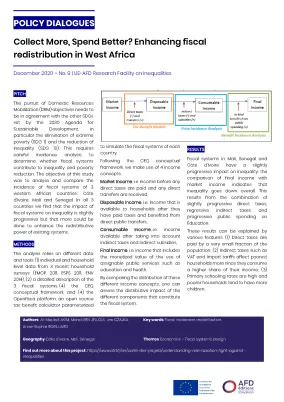
Collect More, Spend Better? Enhancing fiscal redistribution in West Africa
The pursuit of Domestic Resources Mobilization (DRM) objectives needs to be in agreement with the other SDGs set by the 2030 Agenda for Sustainable Development, in particular the elimination of extrem...
Published on
Meeting the equity challenge in Burkina Faso: regional policies to reduce economic inequalities
In their design and formulation, policy documents are generally limited to the macro level (entire country); they set out regional differences without explicitly highlighting the intraregional mechani...
Published on

Inequalities in Tunisia: what role for inherited human capital and social capital?
Regional inequalities are substantial in Tunisia. In the rural western regions, the poverty and unemployment rates are almost three times those of the more advantaged eastern regions. Several factors...
Published on