Share the page
International Development Finance Club (IDFC): a global network of public development banks supporting climate action and the SDGs
Published on
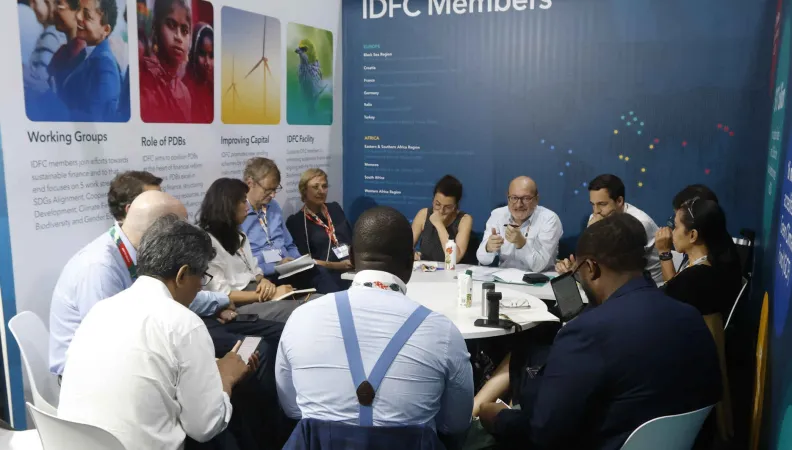
Created in 2011, the International Development Finance Club (IDFC) brings together 27 national, bilateral, regional, and multilateral public development banks. By pooling decades of experience in development and climate finance, the IDFC aims to position itself as a leading actor in achieving the Sustainable Development Goals (SDGs) and implementing the Paris Agreement and the Kunming-Montreal Global Biodiversity Framework. A founding member of the organization, AFD chaired the IDFC from 2017 to 2023 and continues to host its secretariat.
A committed partnership since 2011
Since 2011, the IDFC has brought together public development banks – primarily from developing and emerging countries – whose role is to support national policies and relay international priorities to their stakeholders. The Club’s activities complement the bilateral partnerships that AFD maintains with public development banks, particularly in countries of the Global South.
A concrete lever for financing the SDG
The partnership between Agence Française de Développement (AFD) and the IDFC aims to maximize the impact of public development banks in addressing climate challenges.
The IDFC, at the origin of the Finance in Common System (FiCS)
The IDFC helped drive the momentum that led to the creation of Finance in Common System (FiCS), the international platform bringing together all public development banks. Within this framework, the IDFC plays a structuring role by contributing to the strategic direction and coordination of collective action aimed at aligning public finance with the Sustainable Development Goals (SDGs) and climate action.
With $4 trillion in assets and more than $600 billion in annual commitments, the IDFC is the world’s largest provider of public climate finance and the leading public financier of energy and ecological transitions. Around $150 billion per year is dedicated to green finance, with climate finance reaching $167 billion in 2024, including $8 billion for biodiversity.
The objective is to strengthen the position of public development banks as a third pillar of development finance, alongside multilateral banks and the private sector.
Key actions include:
- equipping members with shared tools to better integrate climate issues into development finance,
- fostering coordinated dialogue with innovative private financial actors,
- harmonizing practices in line with the highest international standards and promoting these methodologies among other financial institutions,
- facilitating access for members – particularly in countries of the Global South – to international climate finance resources and mechanisms,
- establishing working groups aligned with the Sustainable Development Goals (SDGs), with a focus on climate, gender equality, biodiversity, and development cooperation.
The IDFC Facility
Created in 2019, the IDFC Facility is structured around four pillars: knowledge sharing, capacity building, access to international climate finance, and the implementation of joint operational initiatives. The climate finance accounting methodologies developed through the IDFC Facility are among the partnership’s most tangible outcomes. They help improve the tracking and measurement of financing flows, monitor their evolution over time, and bring members’ practices closer to those of leading private financial institutions.
The objective is to strengthen the network through dedicated governance structures and annual IDFC meetings designed to foster cooperation and scale up financing.
Steering Committee: in 2026, the Steering Committee is chaired by Serge Ekué, President of the West African Development Bank (BOAD). It brings together representatives from AFD, the Brazilian Development Bank (BNDES), the Development Bank of Latin America and the Caribbean (CAF), Morocco’s Caisse de Dépôt et de Gestion (CDG), the Development Bank of Southern Africa (DBSA), the Japan International Cooperation Agency (JICA), the German development bank (KfW), the Industrial Development Bank of Türkiye (TSKB), Italy’s Cassa Depositi e Prestiti (CDP), the Croatian Bank for Reconstruction and Development (HBOR), the China Development Bank (CDB), and the Colombian Development Bank (Bancóldex).
The Club brings together European, African, Asian, and Latin American institutions within a single network, while giving a central role to institutions from developing and emerging countries.
Members:
- Europe: BSTDB, HBOR, AFD, KfW, CDP, VEB.RF, TSKB, IIB,
- Africa: AFC, TDB, CDG, DBSA, BOAD, Development Bank of Rwanda,
- Asia and the Middle East: CDB, SIDBI, JICA, KDB, PT SMI, ICD,
- Central America, South America, and the Caribbean: BNDES, CAF, BCIE/CABEI, Bancóldex, NAFIN,
Find out more about the IDFC Facility
Key figures
-
27 public development banks united within the IDFC
-
Over 600 billion USD in annual commitments
-
167 billion committed to climate finance in 2024, including $8 billion for biodiversity