Share the page
A living laboratory in Türkiye shines a light on the future of French forests
Published on
Between 2019 and 2022, Agence Française de Développement supported a sustainable forest partnership program between Türkiye and France, focused on adapting to climate change and protecting biodiversity. The findings from this initiative continue to inform research and forestry practices in both countries today.
In 2019, AFD launched a partnership with the Turkish General Directorate of Forestry (OGM) and ONF International (ONFI), a subsidiary of the French National Forest Office, for the sustainable management of forest ecosystems. AFD mobilized expertise from French institutions including the French National Research Institute for Agriculture, Food and Environment (INRAE) and the French National Forest Office (ONF), as well as other technical specialists, drawing on both research and experience in the field. The program aimed to tackle common issues around climate change, such as drought, more frequent fires, and forest pests and diseases.
Open-air laboratories advancing French research
Zeren Erik, AFD’s program coordinator in Türkiye, summarizes the project as follows: “Türkiye and France are facing the same challenges. Both are in the Mediterranean climate zone, so our forests are very similar. These sites serve as living laboratories for France, helping us to understand how French forests can adapt to climate change in the coming decades.”
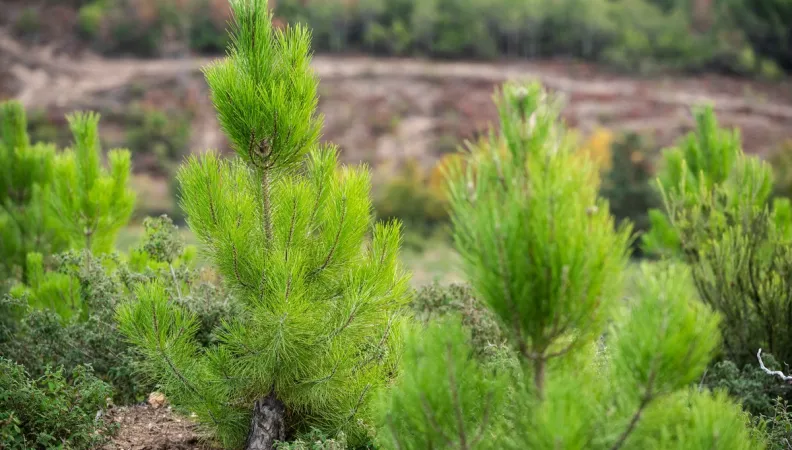
By 2050, the climate in mainland France will be similar to certain regions of Türkiye. These findings therefore provide a glimpse into the future of French forests. The ONF and INRAE teams have planted native Turkish saplings in various forests, including in Joigny and Tournefort, in the French departments of Yonne and Alpes-Maritimes respectively. Their growth will be closely monitored for around ten years, with the aim of increasing the diversity and resilience of French forests.
OGM forest engineers present a schematic map of a plot planted with Corsican maritime pine trees, used to identify specimens most resistant to this environment.
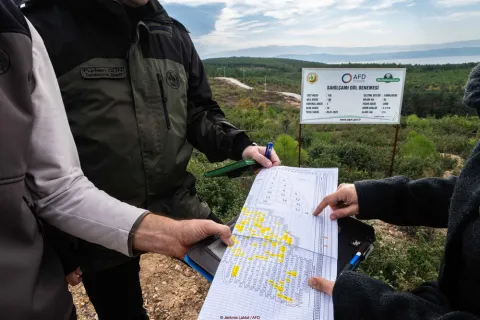 © Jérémie Labbé / AFD
Testing today to safeguard the forests of tomorrow
The program focused primarily on the exchange of forest genetic resources. Oak and pine seeds from different regions of mainland France and Türkiye were exchanged and then planted on pilot plots so that researchers could study their behavior under contrasting climate conditions.
“This program has shown that various oak species of different origins are tolerant to drought, which is increasing under global warming,” says Turgay Ezen, forest engineer for the OGM. “The data collected can be used to anticipate potential future threats to oak forests.”
In Türkiye, maritime pine seeds from Corsica have been planted in several regions, including Yalova. This species has proven to be fast-growing and highly resistant to insects, essential properties for future reforestation. The best-performing trees are then identified to cultivate seeds more suited to warmer, drier climates.
Protecting forest biodiversity through better awareness
In addition to long-term studies, this partnership has led to various measures with a more immediate impact, helping to control pests, prevent fires, and develop ecotourism in forests.
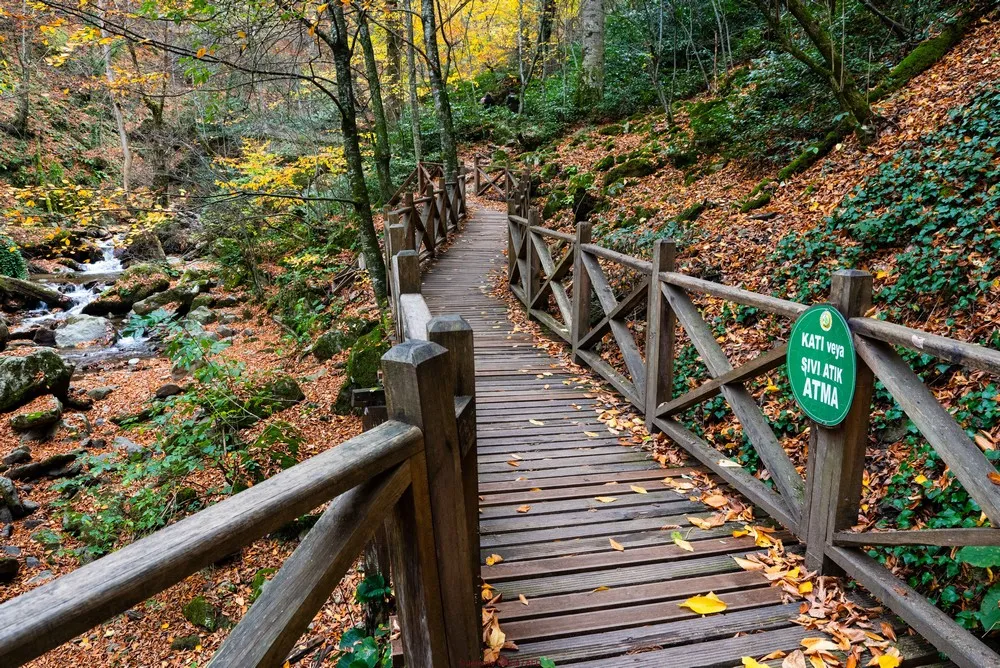
In Oylat, a thermal spring village located at the foot of the Uludağ mountain range near Bursa, a hiking trail has been established with technical support from the ONF. Mehmet Tok, Deputy Head of OGM for the Inegöl district, which covers Oylat, explains: “When developing ecotourism, appropriate signs are essential to raise awareness among the Turkish people about protecting forest biodiversity.”
Everyone can now explore the spectacular Oylat forest via an easily-accessible footpath, lined with signs promoting nature and biodiversity conservation.
Why does AFD also finance China, India, Brazil and Türkiye?
Read also
Rebuilding Lives after the Earthquakes in Türkiye and Syria: One Year On
Published on February 5, 2024