Share the page
Mother tongue education as a lever for learning and equity
Published on
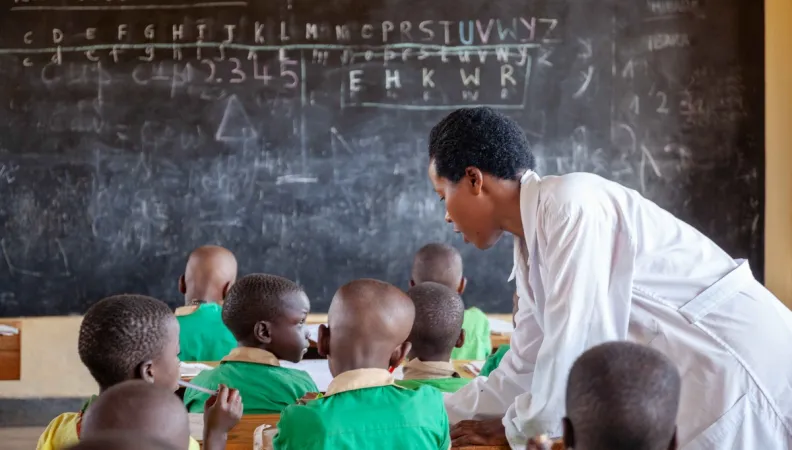
Around the world, millions of children begin school in a language they do not understand. In French-speaking Africa, fewer than one in five children receive early instruction in a language they understand, meaning that the vast majority begin school in an unfamiliar language. Evidence shows that bilingual and multilingual education can significantly improve learning outcomes and strengthen social cohesion.
In many education systems, persistent difficulties in reading, writing, and mathematics begin in the earliest years of schooling. When children cannot understand the language of instruction, they struggle to grasp foundational concepts, with long-term consequences for academic achievement and retention.
Beyond academic performance, the language of instruction is a powerful social and identity marker. It can exclude or include, create frustration or foster dialogue and cohesion. Ensuring that children learn in a language they understand is therefore central to achieving Sustainable Development Goal 4 on quality education and to reducing learning poverty.
ELAN: transforming education through bilingual and multilingual approaches
To address these challenges, the École et langues nationales (ELAN) program was launched in 2012 by the Organisation internationale de la Francophonie (OIF), with decisive support from Agence Française de Développement (AFD), and implemented by the Institut de la Francophonie pour l’éducation et la formation (IFEF).
A pioneering initiative across French-speaking education systems, ELAN supports African ministries of education in developing language-in-education policies tailored to national contexts. The program contributes to curriculum reform, the production of bilingual learning materials, teacher training, and community engagement.
Initially designed as a pilot initiative, ELAN has led to significant change. To date, more than 12 million students benefit from bilingual and multilingual instruction across 46 languages prepared for teaching, supported by more than 230,000 trained teachers. Results show that when learning begins in a language students master, reading and writing skills improve significantly.
The approach also offers lessons beyond French-speaking Africa. In multilingual contexts worldwide, integrating first languages alongside official or international languages can improve equity, system efficiency, and long-term educational outcomes.
Clear progress despite persistent misconceptions
Despite these advances, scaling up bilingual and multilingual education remains constrained by persistent perceptions. It is sometimes limited to early-grade literacy. Yet the objective extends beyond learning to read in a familiar language. It is about enabling students to reason, debate, and build knowledge in multiple languages. National languages must fully become languages of knowledge.
Another misconception associates these languages with a perceived disconnect from modernity. In practice, their institutional and social recognition is essential for equity. Moreover, bilingual and multilingual education does not generate structural additional costs. By reducing school failure and early dropout, it improves the overall efficiency of education investment.
Investing beyond early learning
Experience from the ELAN program shows that integrating first languages alongside an international language is decisive for academic success. But limiting the approach to early grades would be insufficient.
Investing in bilingual and multilingual models means preparing students to read, write, calculate, and think across linguistic environments. It also means shaping citizens who are aware of their cultural foundations and confident in their ability to understand the world and act within it.
Choosing bilingual and multilingual education is not only a cultural commitment. It is a strategic investment in learning outcomes, social cohesion, and long-term development. In an increasingly interconnected world, it helps prepare generations who are rooted and open, locally grounded and globally engaged.
Read also
Ten years on, the higher education and research program making a lasting impact in Africa
Published on May 6, 2025