
Share the page
Education and Training
Our commitment
Learning, training, and acquiring skills and knowledge open the door to a dignified life, meaningful work, and full citizenship. They also represent an investment in the future of a dynamic, innovative economy and a more inclusive society. This is why AFD Group is committed to lifelong learning, access to education, and decent work.
AFD works to:
- Build foundational skills through equitable access to education
- Develop professional and cross-cutting skills through training and employment policies
- Support research and innovation by modernizing higher education
AFD is working to strengthen its support through a systemic approach aligned with national sectoral policies. This includes program-based approaches, the involvement of French public and private partners (such as APPRENDRE, PASEC, Réseau FAR, and PEFOP), and close cooperation with major donors, including the European Union and the Global Partnership for Education.
Our approach
AFD finances the implementation of policies and infrastructure programs in education, training, research, and quality employment, with a particular focus on girls’ success and women’s empowerment.
By supporting the acquisition of foundational knowledge and skills, we help strengthen employability, stimulate innovation, and promote civic engagement. Together, we support future-oriented professions and encourage the engagement of French and European partners, as well as Global South cooperation.
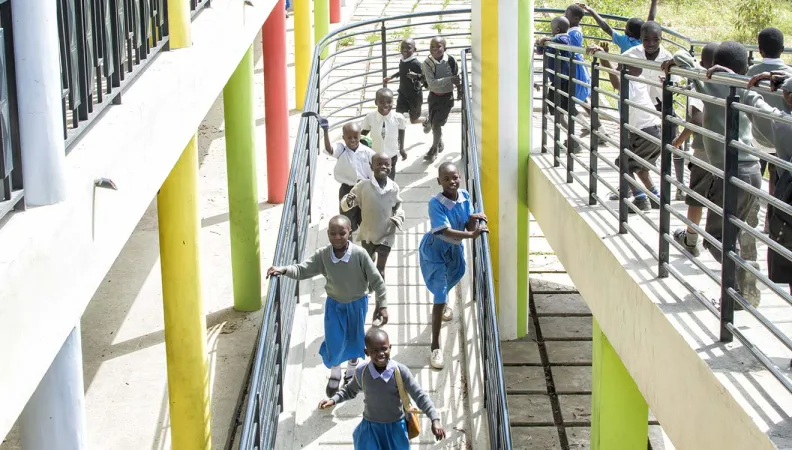
Reading, writing, arithmetic, communication, and critical thinking – these foundational skills are essential for individual development and for building just, inclusive, and resilient societies. Quality education for all – at least through the lower secondary level – is a cornerstone of the Sustainable Development Goals.
AFD works across all stages of education, with a focus on primary and lower secondary education, as well as transitions between cycles. Its work is structured around three complementary pillars:
- Access and equity: promoting inclusive education by reducing inequalities, particularly for girls and students in fragile contexts
- Quality: improving teacher training and better integrating issues such as climate change, digital learning, and language instruction into curricula
- Governance: supporting more effective and resilient education systems aligned with national policies, backed by sustainable financing mechanisms
For example, AFD supports the development of community-based lower secondary schools in Côte d’Ivoire, strengthens local management of primary education in Senegal to help prevent school dropout, and provides training for education supervisors in 25 countries, contributing to improved practices among more than one million teachers. In Guinea and Madagascar, AFD supports pooled education funds to enhance coordination among partners and improve the management of education resources.
Why invest in basic education?
Higher education and research foster innovation, strengthen the employability of young graduates, and enable each country to shape its own path toward sustainable development. They contribute to competitiveness, economic attractiveness, and international cooperation, while also helping to reduce inequalities.
AFD supports governments and higher education institutions to:
- Expand access to training: build inclusive and sustainable campuses and student housing, promote the digital transformation of universities, and implement support programs aimed specifically at improving access and success for young women
- Align programs with labor market needs: develop training aligned with priority development sectors, tailored to the needs of businesses and entrepreneurs
- Improve the quality of education and research: support training for academic staff, promote quality assurance policies, and foster balanced, mutually beneficial academic partnerships that meet local demand for joint projects (such as dual degrees, international accreditation, joint PhD supervision, and research collaboration), including with French institutions, and help raise the regional and international profile of universities
- Strengthen research system governance: support national agencies responsible for research funding, evaluation, and knowledge transfer
Several projects illustrate this approach: in Kenya, the creation of the Science and Engineering Complex at the University of Nairobi; in Colombia, a student loan program targeting vulnerable populations; and through the PeA program (Partenariats académiques Afrique–France), the development of career-oriented degree programs in 50 African and French universities.
In a constantly changing world, access to quality training at every stage of working life is essential to stimulate economic growth, strengthen employability, and support inclusive development.
AFD promotes approaches tailored to local contexts by helping to build sustainable training and employment systems, and supports the development of key sectors – energy, agriculture, health, and transport – that create decent jobs and contribute to people’s well-being.
In practical terms, AFD:
- Strengthens training centers that meet the needs of the formal sector
- Expands work-study and apprenticeship programs, especially in the informal economy
- Supports the integration of people who are far from the labor market through targeted training pathways
- Backs national policies through inclusive governance frameworks, financing mechanisms, and labor market observatories
In Morocco, AFD supported the creation of delegated management institutes (Instituts à gestion déléguée, or IGD) in sectors such as aerospace, with the aim of improving the integration of young graduates into the workforce. In Madagascar, AFD contributed to the launch of a national vocational training fund to help build the skills of the working population across the country.
Access to quality employment ensures autonomy, helps individuals reach their full potential, and contributes to national development. In the face of demographic, environmental, energy, and digital challenges, it is also a key priority for the future.
AFD works to:
- Create sustainable, quality jobs in future-oriented sectors such as ecological transition, health, and strategic industries
- Strengthen employability by developing skills and aligning training programs and public employment services with labor market needs, particularly in emerging sectors
- Support entrepreneurship and youth integration, especially for the most vulnerable
- Improve working conditions and support the social dimensions of ecological transitions
Women’s economic empowerment and the reintegration of vulnerable youth are central to AFD’s priorities, with tailored support mechanisms.
Through the JET (Just Energy Transition) project in South Africa, AFD is helping turn the energy transition into an opportunity for social justice, aimed at reducing unemployment, poverty, and inequality. In Côte d’Ivoire, AFD supports youth integration across the country by working with the public employment service, local authorities, and civic service programs.
On the ground
Below, you’ll find projects, news, and publications related to this topic — all in one place.
News & events
"Integral inclusion" for young people: a holistic approach to economic, social, and environmental challenges
Published on August 11, 2026
[Feature report] Artificial intelligence: governance, investment, transformation
Published on July 21, 2026
Related topics

Key figures
-
€418 million committed to 34 new education, training, and employment projects in 2024
-
€33 million committed to civil society organization projects in this sector in 2024
-
308,485 young people accessed basic education, vocational training, or higher education in 2024