Share the page
Chad: supporting young women in science and engineering
Published on
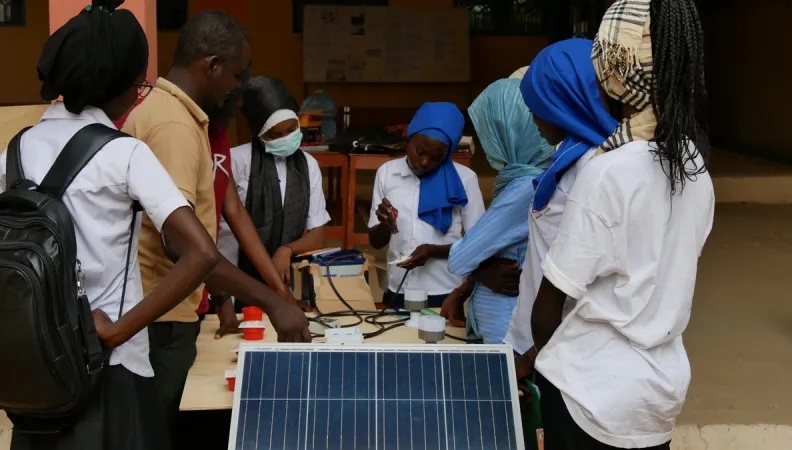
In Chad, women remain largely underrepresented in science and engineering higher education. Through the PeA-Tchad project, the National Higher Institute of Science and Technology of Abéché (INSTA) has placed gender equality at the heart of its strategy, with free training programs, awareness-raising initiatives, and tailored support aim to sustainably open technical fields to young women.
Chad’s higher education and research sector continues to reflect gender disparities, particularly in STEM fields. Research conducted by the Research Institute for Development (IRD) as part of a scientific assessment highlights the persistent underrepresentation of women, linked to early educational inequalities and academic pathways that remain strongly gendered.
In this context, the PeA-Tchad project, dedicated to building an international training hub in photovoltaic energy to support the country’s energy transition, has made gender equality one of its strategic priorities. Supported by the Africa–France Academic Partnerships program and jointly led by the National Higher Institute of Science and Technology of Abéché (INSTA) and Jean Monnet University Saint-Étienne, the project aims to structure a high-quality training offer while promoting more equitable access to high value-added fields. Professor Boukhari Mahamat Issa, INSTA’s Gender Officer, reflects on the findings that prompted this commitment, the concrete measures implemented, and the initial impacts observed.
What findings led INSTA and the PeA-Tchad project to make gender equality a strategic priority?
INSTA and the PeA-Tchad project identified a striking imbalance between girls and boys in access to science and engineering studies, the result of cumulative inequalities starting in primary school. Firstly, the proportion of literate girls remains very low compared with boys nationwide. As schooling progresses, their presence declines sharply in high schools and then in higher education, due to school dropout, gendered academic orientation, and socio-economic constraints. With few girls earning a science-focused high school diploma, they are almost absent from scientific and technical fields and rarely pursue long-term higher education. These factors underscored the importance of making gender equality a strategic priority for the institution.
A Gender Unit was established at INSTA in 2021, with a structured action plan ranging from recruitment to awareness-raising. How is this policy implemented, and which measures do you consider most effective in encouraging young women to pursue science and engineering fields?
The goal is to create an attractive and supportive environment that enables young women to enter and succeed in these high value-added fields. Flagship initiatives include open days specifically for girls, as well as free 10-day practical training sessions offered as internships under the “She is a Scientist” project. The PeA-Tchad project has also made it possible to provide young women with free degree programs at the bachelor’s, master’s, and doctoral levels. Beyond facilitating access to these programs, the initiative also helps strategic sectors such as photovoltaic energy benefit from women’s expertise. At the same time, Insta organizes awareness-raising activities during Gender Awareness Day, targeting families, school administrators, and local authorities. These efforts aim to ensure that young women receive strong guidance and support to continue their studies and thrive in scientific and technical fields.
What impact have these actions had?
Although women remain underrepresented in some fields, the share of young women within the institution has improved significantly, notably through the creation of new technical programs. However, within the PeA-Tchad project, a recent relocation of certain programs to another city, along with limited investment in awareness-raising efforts, has led to a decline in female participation. Despite these challenges, the results achieved so far represent a lever for the future of these fields and for the young people who have benefited from the programs. These advances have also transformed INSTA’s practices and working methods, embedding gender equality into its institutional DNA and ensuring a lasting impact on future generations.