
Share the page
AFD and ICRC renew their partnership to strengthen sustainable responses in crisis zones
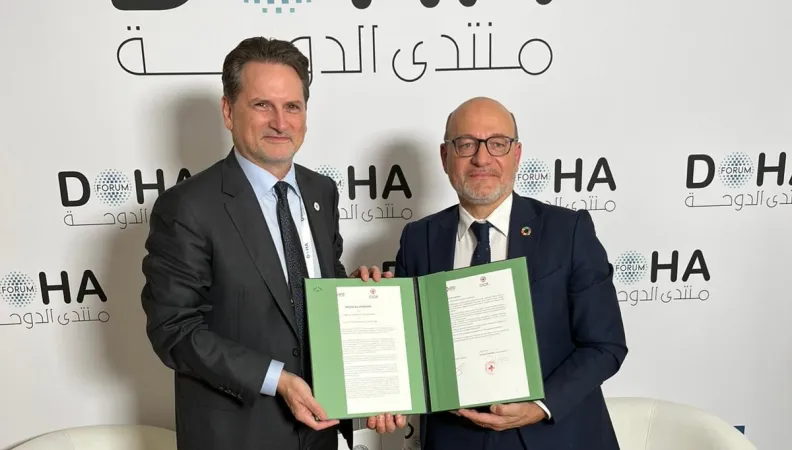
The French Development Agency (AFD) and the International Committee of the Red Cross (ICRC) have signed their third Operational Framework Agreement (2025-2030), marking a new stage in a partnership committed to sustainable responses that promote stability and resilience for affected populations.
France and the ICRC share a common vision regarding the need to reinforce partnerships as well as the complementarity and alignment of humanitarian action with development actors. Since 2017, the AFD and the ICRC have worked closely together to support interventions at the humanitarian-development continuum. Thanks to this structuring partnership, nearly €130 million have been mobilized for about ten projects in Africa and in the Near and Middle East regions to improve sustainable access to healthcare, water, sanitation and food security in crisis and growing fragility contexts.
A new structuring phase of the partnership
The signature of the new Operational Framework Agreement is paired with two new joint operations and reaffirm the ICRC’s and the AFD’s commitment to maintaining or restoring essential services, supporting local institutions and strengthening livelihood.
ESPOIRS Project – Lebanon (€5 million): This project aims to restore access to water and essential healthcare in 34 villages in southern Lebanon, particularly for the most vulnerable populations, including women and displaced persons. It strengthens the resilience of vital services and supports local and national authorities, particularly in favor of the Marjayoun and Tebnine hospitals, in order to ensure the continuity of public services.
AGRILAC project – Lake Chad Basin (phase II – €7 million): This second operation aims to strengthen the resilience of farmers and herders facing both the effects of conflict and climate change (in Cameroon and Chad). By combining emergency assistance and structural support, the project aims to preserve the dignity of the populations and consolidate their productive capacities in the medium and long term, by providing sustainable support to technical services and local partners.
A strategic partnership driven by common advocacy
Beyond their operational activities, the AFD and the ICRC are jointly advocating for:
- The importance of sustainable and predictable funding for humanitarian action.
- The added value of the humanitarian-development continuum in responding effectively to protracted crises.
- The complementarity of humanitarian and development actors in increasingly complex contexts.
Together with France, Brazil, China, Jordan, Kazakhstan and South Africa, the ICRC has launched a global initiative aimed at galvanizing political commitment to International Humanitarian Law (IHL) - an initiative now supported by 90 countries. Over the next two years, this initiative seeks to develop a set of concrete and actionable recommendations to ensure that IHL is not only better respected but adapted for the future. This effort will culminate with a High-Level Meeting to uphold humanity in war in 2026.
“In a fragmented world with protracted crises, linking emergency response to development action is no longer an option: it is a necessity. Together with the ICRC, we are joining force through concrete projects to multiply impacts, from restoring access to water and healthcare in southern Lebanon, to strengthening agricultural resilience in the Lake Chad basin. This renewed partnership reflects our shared ambition to combine respect for human dignity with sustainable responses." said Rémy Rioux, Chief Executive Officer of the AFD Group.
"In this dissonance between the long duration of crises and the short timeframe of humanitarian action, we can no longer afford to repeat the same actions year after year. We must consider the sustainability of our work and design interventions better suited to the needs of populations facing the horrors of conflict and protracted crises. Our partnership with the AFD is precisely aligned with this ambition. It allows us to provide concrete solutions—today around Lake Chad and in southern Lebanon, and, I hope, tomorrow in Syria, Gaza, and many other contexts. This is a crucial commitment to the dignity and living conditions of the communities with which we work." said Pierre Krähenbühl, Director-General of the ICRC.
AFD Press Contact:
Zied OUNISSI / email: ounissiz@afd.fr
ICRC Press Contact:
Erika OMAN CHAPPUIS / email: eomanchappuis@icrc.org
About the French Development Agency:
The French Development Agency (AFD) contributes to implementing France's policy on development and international solidarity. Through its financing activities in the public sector and NGOs, its research work and publications (Éditions AFD), training on sustainable development (Campus AFD) and awareness-raising in France, it finances, supports and accelerates the transition to a more just and resilient world.
We work with our partners to build shared solutions, with and for the people of the South. Our teams are involved in more than 3,250 projects in the field, in overseas territories, in 115 countries and in crisis-hit areas, working for the common good – the climate, biodiversity, peace, gender equality, education and health. In this way, we contribute to the commitment of France and the French people to the Sustainable Development Goals (SDGs). For a shared world.
For more information,
visit www.afd.fr
About the International Committee of the Red Cross:
The International Committee of the Red Cross (ICRC) is a globally recognized humanitarian institution founded in 1863 and headquartered in Geneva, Switzerland. As a neutral, impartial and independent organization, the ICRC operates within the framework of the Geneva Conventions and their Additional Protocols, with the aim of providing protection and assistance to people affected by armed conflict and other violence. The organization is present in many countries around the world, including regions facing complex and protracted crises. Thanks to its long-standing presence in conflict zones, the ICRC plays a central role in supporting affected communities, maintaining essential services and promoting respect for international humanitarian law.
For more information,
visit: www.icrc.org