
Share the page
Cameroon
Published on
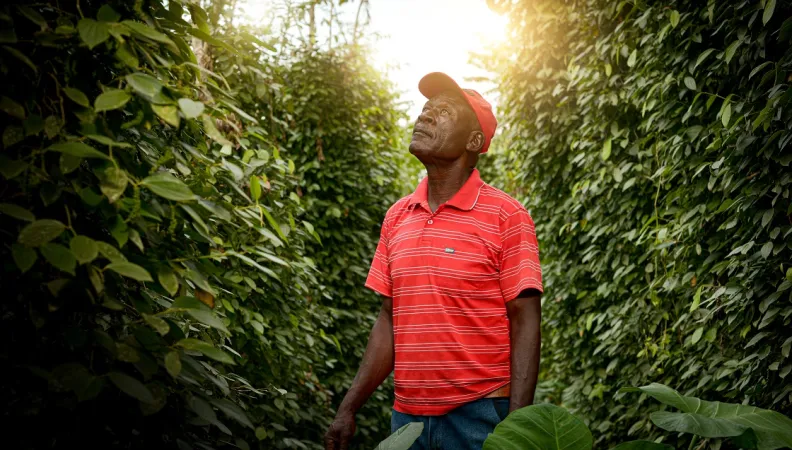
Situated at the crossroads of West and Central Africa, Cameroon has historically been one of AFD Group’s most important countries of operation. More recently, AFD has supported the country through large-scale infrastructure projects, such as the “Regional Capitals” program, financed through the C2D (Debt Reduction-Development Contract), which aims to modernize urban infrastructure in five secondary cities. The Sporcap initiative strengthens access to sports infrastructure in these cities. In addition, AFD has committed €150 million to the Flood Management Program for the cities of Douala and Yaoundé (PLIDY).
Context
With a population of 27 million and located at the crossroads of West and Central Africa, Cameroon is often referred to as “Africa in miniature” due to its geographic and cultural diversity. Alongside a 420 km maritime coastline, the country possesses a wide range of natural resources in the energy, mining, agriculture, and forestry sectors, positioning it as the leading economic power in the subregion.
However, despite a diversified economy and sustained growth over the past decade, Cameroon continues to face persistent challenges – including high poverty levels, regional disparities, underdeveloped infrastructure and social services, and high unemployment, particularly among young people.
As part of its goal to become an emerging economy by 2035, the Cameroonian government has launched an ambitious strategy to boost economic growth, create jobs, and reduce the isolation of rural areas, while promoting sustainable cities and investing in human capital. To support these efforts, AFD Group works alongside public and private stakeholders through a wide range of financial instruments – including the C2D (Debt Reduction-Development Contract), loans, and grants – as well as targeted programs. These include the Regional Capitals program, which aims to modernize five secondary cities, and food security initiatives that provide adapted services for rural entrepreneurs. AFD Group is also supporting the Nachtigal dam – a flagship hydropower project that is increasing national electricity production and contributing to a low-carbon transition.
The longstanding partnership between Cameroon and AFD has led to several significant results. In the education sector, the C2D Education program has enabled the construction of nearly 4,200 classrooms. At the same time, the National Participatory Development Program (PNDP) has supported the training and professional integration of 6,200 young people in the Far North region.
In terms of infrastructure, the urban drainage project has led to the development of nine neighborhoods equipped with accessible social and sports amenities – including 3.25 km of fitness trails, 22 public squares, five multisport fields, and five children’s play areas. In the agriculture sector, 1,179 agri-food and agricultural SMEs have received technical and financial support through credit, guarantee mechanisms, and zero-interest loans.
Our approach
AFD and Cameroon: Boosting local development and strengthening human capital
AFD supports rural development through a comprehensive set of initiatives that contribute to:
- Promoting the integration of young agro-entrepreneurs and improving the economic performance of key agropastoral value chains.
- Supporting research, development, and the dissemination of agroecological farming practices adapted to desertification in the Far North.
- Strengthening onion and rice value chains by improving seed production and certification, increasing land productivity, and enhancing the role of women in supported cooperatives.
- Providing agricultural enterprises with a full range of financial, technical, and advisory services across five targeted regions (Far North, North, Littoral, West, and Center).
AFD supports the sustainable development of the country’s main cities* by helping plan urban expansion and enhance city attractiveness. The projects aim to:
- Improve transport infrastructure to facilitate mobility.
- Strengthen market facilities to boost the local economy.
- Expand neighborhood-level urban services to improve living conditions.
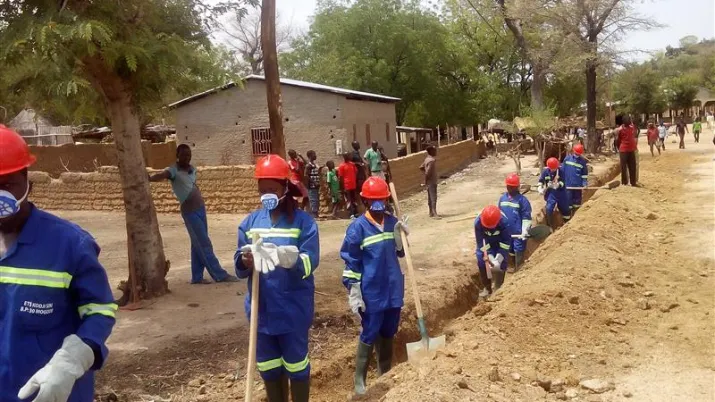
- Reduce flood risks and population vulnerability through the development of drainage systems in Yaoundé and Douala.
- Open up rural areas along the Belabo–Ngaoundéré corridor by rehabilitating the railway to strengthen the economy, ease the transport of goods and passengers, reduce logistics costs, and stimulate domestic and international trade.
*Yaoundé, Douala, Bertoua, Bafoussam, Garoua, Maroua, and Bamenda
AFD’s support aims to strengthen the efficiency, accountability, and transparency of the State and public administrations.
This includes:
- Designing and supporting public policies that deliver essential services to the population.
- Supporting the transfer of responsibilities and financial resources to local governments.
- Contributing to the reform of public financial governance.
To respond to climate challenges and help reduce Cameroon’s contribution to global greenhouse gas emissions – currently estimated at 0.4% – AFD supports efforts to:
- Develop Cameroon’s hydropower potential through the financing of dams in the Sanaga River basin.
- Promote the sustainable management of forests and biodiversity.
- Prevent flood risks.
- Support the development of national climate change mitigation strategies.
To boost growth, improve business productivity, and promote the creation of skilled jobs, AFD supports private sector stakeholders to:
- Modernize and professionalize agricultural and agri-food SMEs by improving access to financial and non-financial services.
- Facilitate access to financing in collaboration with local financial institutions.
- Strengthen vocational training to align skills with SME needs and promote youth employment.
In the field
Projects

News & Press Releases
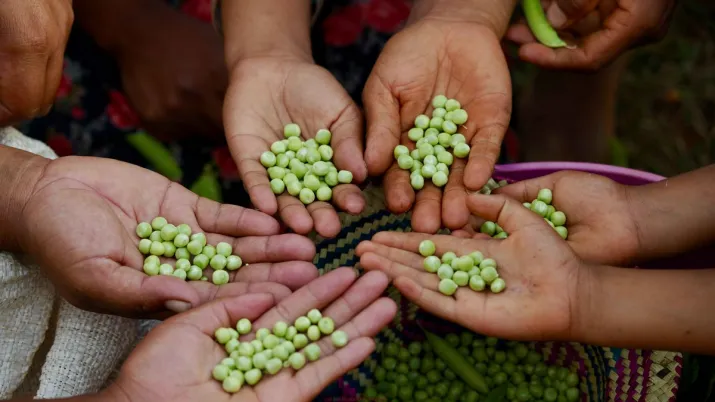
Reshaping European and African partnerships to advance the agroecological transition
Published on February 25, 2025
Publications & Media
Key figures
-
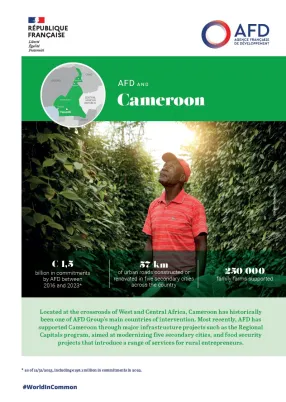
€905.6 million in active project portfolio volume in 2024 (approximately 584 billion CFA francs)
-
57 km of urban roads built or rehabilitated in five secondary cities across the country
-
250,000 family farms supported