
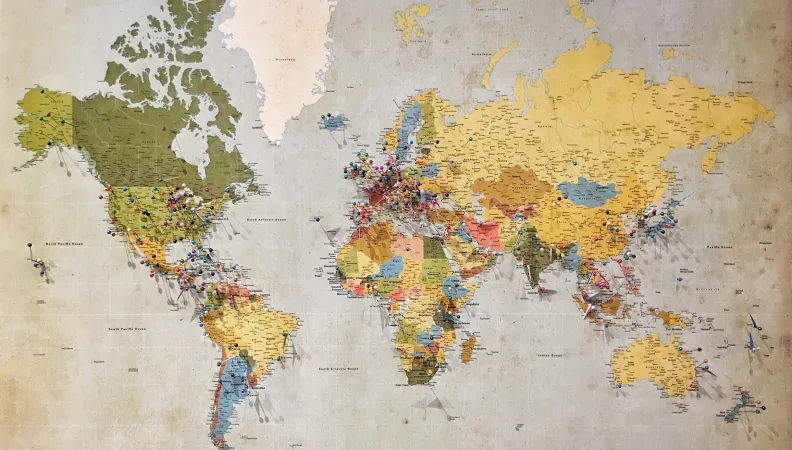
 For some sixty countries, AFD analyzes ongoing development processes, characterizes growth trajectories, and identifies the associated economic, social, environmental, political, and financial vulnerabilities. These assessments, which meet a regulatory requirement for banks, inform the operational and strategic decisions of AFD Group.
Context
As a public development bank, AFD must gauge the issues at stake and monitor the risks associated with its financing. To do so, it relies on a team of around ten economists dedicated to analyzing the macroeconomic and financial situation of its various countries of operation. This monitoring feeds into country assessments that inform the Group's operational and strategic decisions in each of its regions of operation. This activity is part of one of AFD's priority research areas, dedicated to macroeconomic diagnostics and forecasting.
Objectives
Country assessments make it possible to analyze the development processes under way in the countries where AFD operates, to characterize their growth trajectories, and to identify the economic, social, political, and financial vulnerabilities associated with these trajectories. This enables AFD Group to properly gauge the issues at stake and monitor the risks associated with each of its investments.
The scope covered focuses on developing countries, particularly in Africa, for which macroeconomic analyses are scarce or infrequent. The analyses produced are therefore often highly complementary to existing coverage of global economic developments, which tends to focus more on advanced economies and major emerging markets.
Method
The work of AFD's country-risk economists draws on close, long-term monitoring and an in-depth understanding of local contexts. Short-term developments, often highlighted in the news, are systematically examined in light of the structural trends of each economy and its regional context, in order to bring out the macroeconomic issues specific to each country while assessing risks against comparable trajectories over time and across countries.
Country-risk economists place the study of socio-political vulnerabilities, growth models, public debt sustainability, external balances, and financial system soundness at the heart of their diagnostics, and pay particular attention to countries' exposure to climate and natural hazard risks.
Publications
The MacroDev collection
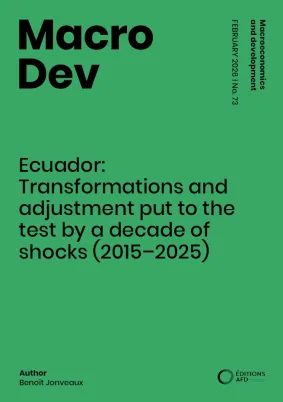
Some of the work carried out by country-risk economists, whether country assessments or cross-cutting analyses, leads to publications in the MacroDev collection of the Éditions Agence française de développement. In particular, the special “Semestrial Panorama” issues shed light on the key cyclical and structural issues facing emerging and developing countries.
The DecoDev webinars
The publication of each MacroDev “Semestrial Panorama” is accompanied by a DecoDev webinar: a session decoding the major macroeconomic trends, followed by three country focus segments.
The Team
-
Amaury MULLIEZ
Deputy Director of the Economic Diagnostics and Public Policy Department at AFD

-
Christophe BARAT
Country Risk Economist

-
Sylvain BELLEFONTAINE
Country Risk Economist
-
Benoît JONVEAUX
Country Risk Economist

-
Gaëlle BALINEAU
Country Risk Economist, Research Officer

-
Hélène EHRHART
Economist

-
Julien GOURDON
Country Risk Economist

-
Thibault VASSE
Country Risk Economist

 Ukraine is today at the heart of the priorities of many French public and development actors, yet academic expertise on the country remains scattered and has little visibility. Backed by AFD, the Observatory of Contemporary Ukraine supports Francophone academic research around one central question: how can we think about and prepare for the post-war period in Ukraine?
Context
The war in Ukraine, ongoing for more than a decade, is generating a growing need for knowledge about the country. Indeed, in order to act, many French public, civil-society, and media actors – including AFD – must draw on solid, up-to-date expertise. Yet while many researchers work on contemporary Ukraine, they are scattered across different research units with varied geographic and thematic focuses. Moreover, a significant proportion of them are in precarious employment situations, which reduces their visibility. The challenge is therefore twofold: to structure and strengthen an academic network, while better mobilizing its members' expertise to address the challenges of the post-war period.
Read also (in french)

Objectives
Supported by AFD, the French Ministry of Armed Forces, and the French Ministry for Europe and Foreign Affairs, the Observatory of Contemporary Ukraine was launched to address a twofold challenge: structuring a network of Francophone researchers in Ukrainian studies, and mobilizing their expertise to better respond to requests from French public authorities. For AFD Group, which operates in Ukraine, this high-quality expertise is essential to inform its action.
The Observatory of Contemporary Ukraine organizes its work around one central question: what are the key issues for understanding Ukraine’s post-war future? Two complementary strands seek to decode the country's profound transformations:
- Military dimension and the transition out of war: the complexity of mobilization and demobilization processes; changes in the practices and means of warfare; and issues relating to reconstruction, demographic trends, and memory work;
- Structural transformations (economic, social, etc.) of Ukrainian society in this context of war.
The Observatory will seek both to better disseminate and to deepen existing work, while encouraging the exploration of emerging topics that remain little documented
Method
To carry out its mission, the Observatory will develop a range of tools:
- Scientific monitoring of knowledge produced on Ukraine;
- Mapping of Francophone researchers in Ukrainian studies to build a network of specialists;
- Organization of events to foster dialogue between academia and public authorities and public-interest actors;
- Expertise: facilitating and coordinating the production of studies and other forms of expert input at the request of public authorities;
- Information: producing analytical briefs, organizing scientific and outreach events, and promoting researchers to the media.
Expected results
Over two years, the research team will produce or organize, in coordination with AFD:
- Three seminars a year, one of which will be hosted at AFD and will result in a policy paper;
- Ten briefs a year for the general public, published on the Observatory of Contemporary Ukraine's website;
- An annual thematic conference, for both academic and operational audiences.;
At the end of the project, a joint discussion will be organized with the Observatory on Reconstruction in the Middle East, another AFD-supported research project on post-conflict reconstruction issues.
Learn More (in french)

Contacts
- Anna Colin Lebedev, Associate professor of political science at the University of Paris-Nanterre and scientific director of the Observatory on Contemporary Ukraine
- Bertrand de Franqueville, Ph.D. in political science from the University of Ottawa and chief operating officer of the Observatory on Contemporary Ukraine
- Elodie Riche, Research officer, AFD
Want to stay up to date with AFD’s research news?

Discover other research projects

When Research Informs Public Action: A Toolkit to Rethink Monitoring and Evaluation
Completed
2020 - 2025