
Publications and media
The allocation of resources of national development banks
Public financial institutions and National Development Banks (NDBs) in particular are well suited to fill financing gaps in un- or under- served markets. By virtue of their developmental mandate, and...
Published on
Financial performance and Corporate Governance: Evidence from National Development Banks in Africa
This is a draft discussion paper and has not been through an external peer review process. A final ODI working paper will be published after the research conference. This study aims to examine the...
Published on
Can development banks step up to the challenge of sustainable development?
The great planetary challenges, be it the climate, loss of nature or human solidarity, call for concerted actions at all levels, on a scale commensurate with the problems. Yet, this transformative cha...
Published on
Climate Change and Development Bank Project Cycles
In the five years since the Paris Agreement, Development Finance Institutions have made various commitments to aligning their operations with climate change goals. In this report, we analyze the exten...
Published on
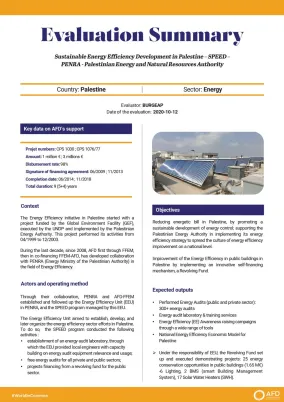
Evaluation Summary - Sustainable Energy Efficiency Development in Palestine – SPEED project
In Palestine, in the Energy sector, the Sustainable Energy Efficiency Development (SPEED) Program has been evaluated in September 2019. This SPEED program (2013-2018) aimed at supporting the main o...
Published on
Financial regulation of national development banks - NDBs
History shows that financial crises have been a significant driver of banking regulation evolution, since the 1930s. Although Basel III made much progress in building a safer and less leveraged system...
Published on
Funding Sources of National Development Banks
Access to large, long-term, and stable funding sources is a prerequisite for achieving the objectives of national development banks (NDBs). By systematically collecting data on the funding sources of...
Published on
Matching risks with instruments in development banks
This paper explores how development banks should deploy appropriate financial instruments to encourage real economic risk-taking while minimizing financial engineering risks. We distinguish real econo...
Published on
Emerging Use of Technologies for Development
With only 10 years left in the 2030 Agenda, development practitioners need to innovate how they make decisions and solve problems. Such innovations can be enabled by intelligences, born from innovativ...
Published on
Effective development banking: loans or guarantees?
How should National Development Banks (NDBs) assess the cost-effectiveness of using loans and loan guarantees in order to choose the type of financial instrument most appropriate for each program? We...
Published on
From global to local: Subnational development banks in the era of Sustainable Development Goals
Financing the implementation of the seventeen Sustainable Development Goals (SDGs) has been a development challenge since the establishment of the 2030 Agenda – especially under the unequal circumstan...
Published on
The ‘urbanization of water’ in La Paz, Bolivia: Historical and conceptual perspectives
This essay analyzes the historical production of water inequities in the city of La Paz, Bolivia. It relies on the concept of ‘urbanization of water’ to present historical evidence and conceptual refl...
Published on
Central banks at the heart of ecological reconstruction
Faced with the pandemic crisis and its economic and financial consequences in the short and medium term, central banks found themselves in the position of guardians of chaos. They thus acted quickly a...
Published on
Participatory irrigation management: from theory to reality – Insights from the Phước-Hòa irrigation project
PIM (Participatory Irrigation Management) has become one of the cornerstones of irrigation development. Its implementation always involves multilayered interaction between international ideologies, de...
Published on
Climate Variability and Inequality: Comparing the Experiences of Indonesia and Vietnam
Households in Indonesia and Vietnam that are poor, rural, older, headed by women, and/or from ethnic minorities bear the biggest burden of variability in climatic conditions. New research investigate...
Published on
The Impact of Climate Variability on Inequality: Evidence from Indonesia
Households in Indonesia that are rural, older, larger, and/or headed by women experience worsening income, deeper poverty, and social exclusion as a consequence of climate instability. New research f...
Published on
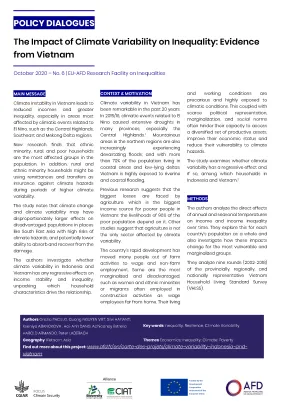
The Impact of Climate Variability on Inequality: Evidence from Vietnam
Climate instability in Vietnam leads to reduced incomes and greater inequality, especially in areas most affected by climatic events related to El Nino, such as the Central Highlands, Southeast and Me...
Published on
The Landscape of Adaptation Aid in SIDS
Small island developing states (SIDS) are recognised as “particularly” vulnerable to the effects of climate change, and accordingly receive relatively high levels of adaptation assistance as a group....
Published on
When governance fails: Institutional asymmetries in water management in the municipality of La Paz
This article reflects on the emergence of asymmetries in the institutionality of the water and sanitation sector, primarily caused by the presence of political, social and economic forces that catalyz...
Published on
An Overview of Inequalities in Urban Water Services in Bolivia
Urban drinking water services are a particularly prolific research object to think about inequalities in the city because they are by definition at the interface of economic, social and environmental...
Published on
Earnings inequality over the life-course in South Africa
This paper revisits the measure of inequality introducing a dynamic dimension, which allows analysing inequality over the life course.
Published on