
Publications and media
Earnings inequality over the life-course in South Africa
This paper revisits the measure of inequality introducing a dynamic dimension, which allows analysing inequality over the life course.
Published on
Spatial inequality through the prism of a pandemic: Covid-19 in South Africa
While the global impact of the COVID-19 pandemic made everyone feel very vulnerable, the pandemic has made manifest the significant gaps between individuals in terms of exposure and in terms of the ca...
Published on
Understanding the relationship between Consumption Inequality, Inequality of Opportunity and Education Outcome...
There have been calls for a shift in policy focus towards economic inequality given that it can potentially generate social instability and be harmful to economic growth in the long run. The current s...
Published on
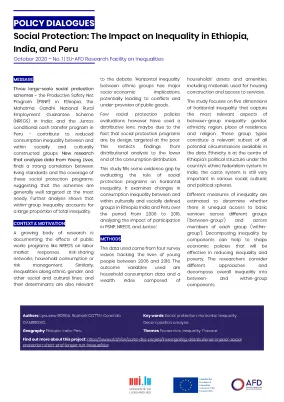
Social Protection: The Impact on Inequality in Ethiopia, India, and Peru
Three large-scale social protection schemes - the Productive Safety Net Program (PSNP) in Ethiopia; the Mahatma Gandhi National Rural Employment Guarantee Scheme (NREGS) in India; and the Juntos condi...
Published on
Social Protection: The Impact on Multidimensional Poverty in Ethiopia, India, and Peru
Three large-scale social protection schemes - the Productive Safety Net Program (PSNP) in Ethiopia; the Mahatma Gandhi National Rural Employment Guarantee Scheme (NREGS) in India; and the Juntos condi...
Published on
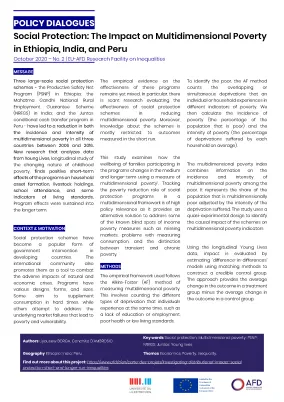
Social Protection: Impact on household resource allocation and Child Undernutrition
Three large-scale social protection schemes – the Productive Safety Net Program (PSNP) in Ethiopia; the National Rural Employment Guarantee Scheme (NREGS) in India; and the Juntos conditional cash tra...
Published on
Exploring the dynamics of micro- level consumption inequality in Ghana
Despite the country’s recent impressive growth record, inequality remains a pressing concern in Ghana as the benefits of higher incomes are not being evenly distributed. Existing micro-level studies o...
Published on
Who bears the burden of climate variability? A comparative analysis of the impact of weather conditions on ine...
Is climate variability regressive? One argument could be as follows: People living in areas with high risk of climate hazards usually correspond to the most disadvantaged populations. Due to existing...
Published on
Public debt in developping countries with Maxime Terrieux
Since the late 1990s, several developing countries have benefited from public debt relief. Yet by early 2020, half of the poor countries had reached a high risk or even already a situation of public d...
Published on
Estimating the distributional incidence of healthcare spending on maternal health services in Sub-Saharan Afri...
Improving access to maternal health services is a critical policy concern, especially in Sub-Saharan Africa (SSA) where maternal mortality rates remain very high, particularly so among the poorest seg...
Published on
Social Protection and Multidimensional Poverty: Lessons from Ethiopia, India and Peru
We investigate the impact of three large-scale social protection schemes in Ethiopia, India, and Peru on multidimensional poverty. Using data from the Young Lives cohort study, we show the trend, chan...
Published on
Social Protection and Intrahousehold Resource Allocation: Evidence from Three Large-scale Programs
Social-protection schemes have become a popular form of government intervention in developing countries. The empirical evidence is still scant on their effectiveness in reducing within-household inequ...
Published on
Social Protection and Inequality: Evidence from Ethiopia, India and Peru
Do antipoverty programs reduce inequality? Evidence from Ethiopia, We examine trends of consumption inequality among culturally and socially defined groups in Ethiopia, India and Peru during the pe...
Published on
Twenty years of official dollarization in Ecuador: a blessing or a curse?
Ecuador adopted the U.S. dollar as its legal tender in January 2000, in a context of deep economic and political crisis. Almost two decades later in December 2019, the Executive Board of the Internati...
Published on

Côte d'Ivoire: When debt reduction creates jobs for women
In Côte d’Ivoire, AFD is supporting training and vocational integration for young women via programs to set up micro and small enterprises (MSEs) and develop income-generating activities, including in...
Published on
Zambia: Resource-rich but vulnerable to shocks
Zambia, located in the north of Southern Africa and home to fewer than 18 million people, has built its development model on the abundance of natural, mainly mineral, resources. The country ranks as A...
Published on
Inequality and Income Mobility in Egypt
This paper explores trends in wage and income levels and inequality and mobility in Egypt, especially since 2012. Data are from the 1998, 2006, 2012, and 2018 waves of the Egypt Labor Market Panel Sur...
Published on

Promoting equitable development of the cashew nut sector in Mozambique
The project aims to contribute to the strengthening of the cashew nut sector in order to allow a sustainable improvement of farmers' incomes while preserving natural resources. ©AFD2020
Published on
Perceptions of Inequality and Social Mobility in Mexico
Despite evidence of high inequality and low social mobility throughout the world, there has been only limited demand for change. Using new survey and experimental data, we investigate how perceptions...
Published on
Social Mobility in Mexico. What Can We Learn from Its Regional Variation?
We run rank-rank regressions to estimate relative and absolute upward intergenerational social mobility of wealth in Mexico. At the national level, social mobility is low and the intergenerational per...
Published on
Incubating innovative Audio-visual content
The Digital Content Hub is AFD’s first investment in the area of digital innovation in South Africa and reflects a new focus on financing cultural, creative and tech industries as key players in local...
Published on