
Share the page
Guadeloupe
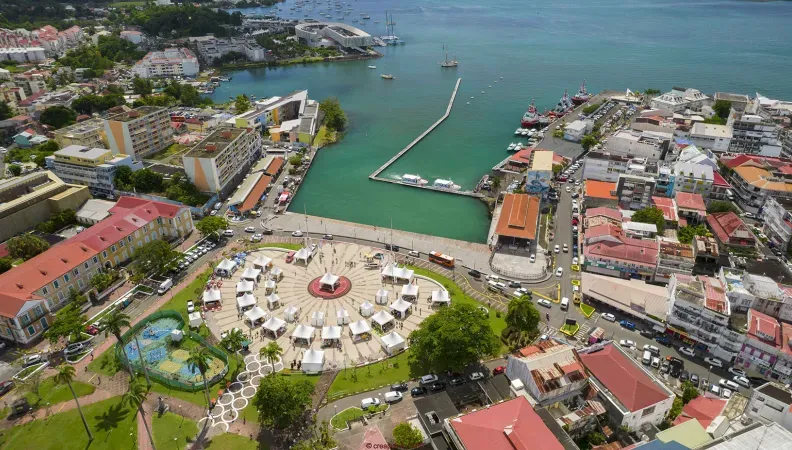
As the long-standing financial partner of local authorities and a leading lender to both public and private enterprises, AFD has committed €1.3 billion over the past ten years to accelerate and scale up sustainable investment in Guadeloupe and to improve how those investments are managed. In response to an aging population, significant economic and social needs (including growth, employment, access to services, and social cohesion), and high exposure to climate risks, AFD’s work aims to support land-use planning, strengthen the region’s economic and social momentum and resilience, and improve living conditions for the people of Guadeloupe.
Context
Known for the beauty of its natural landscapes and as a “land of champions,” Guadeloupe is the largest archipelago in the Lesser Antilles. It consists of five inhabited islands: Grande-Terre, Basse-Terre (the administrative capital), Les Saintes, La Désirade, and Marie-Galante, each with distinct characteristics in terms of size, population, and economic activity.
Since the 2003 constitutional reform, Guadeloupe has held the status of both a department and a single-department region. As an outermost region of the European Union, it is also an associate member of the Organisation of Eastern Caribbean States.
As of 1 January 2024, Guadeloupe’s population stands at 378,561 and has been declining by an average of 0.7% per year since 2014. This trend is due to more departures than arrivals, combined with a low natural increase. The fertility rate (2.08 children per woman) remains above the national average, but the population is aging significantly. People under 20 make up 22.8% of the population (compared to 27.9% in 2022), while those over 60 now represent 30.9% (21.1% in 2022).
The median annual income in Guadeloupe is €15,770, and 34% of the population lives below the poverty line. Poverty disproportionately affects single-parent families, young households, and the unemployed. For the most vulnerable groups, social benefits are often the main source of income. The territory also faces many other challenges, including agriculture, infrastructure (water, energy, mobility), healthcare, social exclusion, security, trafficking, and climate change. To address these issues, Guadeloupe can rely on key assets and potential: its geostrategic position, size, diaspora, natural resources and environment, economy and expertise, culture and traditions, and strong resilience capacity.
AFD Group supports the territory through financing for investment projects, including loans for public and private stakeholders, as well as capacity building and technical support funded by grants from the Overseas France Fund (FOM), managed by the French Ministry for Overseas Territories and delegated to AFD.
AFD Group’s work in Guadeloupe focuses on four main priorities:
- Accelerating investment by local authorities and strengthening their management
- Improving living conditions for the people of Guadeloupe
- Promoting sustainable and inclusive economic development
- Supporting regional cooperation with neighboring Caribbean territories
Our approach
Supporting Guadeloupe’s sustainable development initiatives through close local partnerships.
In Guadeloupe, AFD supports local authorities in modernizing and upgrading their infrastructure through long-term loans and pre-financing of grants from the French government and the European Union. The “Overseas France Transition – Public Sector Loan” offers improved financing conditions for projects that support social and environmental transitions.
This funding enables critical investment in schools, childcare centers, and school canteens, as well as in sports and cultural facilities, roads, public spaces, and tourism sites. It also supports the modernization of water and electricity networks, waste management systems, and sargassum control measures, helping local governments strengthen their capacity to deliver efficient, sustainable public services. These investments also ease pressure on municipal budgets, which are often constrained.
Beyond financing, AFD brings technical and financial expertise through the Overseas France Fund, supporting local governments in designing and implementing their projects. This technical assistance, recognized as a key factor in the success and long-term maintenance of investments, helps optimize resource use and ensures greater sustainability of infrastructure for the benefit of local communities.
To enhance quality of life for residents, AFD supports practical projects led by a wide range of local economic stakeholders.
In addition to the diverse initiatives carried out by local authorities (as mentioned above), such as ensuring quality education for children through improved school buildings and facilities, or providing residents with spaces to gather, learn, engage in sports, and enjoy cultural activities in a more pleasant living environment, AFD also contributes to the development and upgrading of hospitals, medical and social care centers, and nursing homes. These investments help improve access to healthcare for the entire population, particularly for women and older adults.
Projects implemented through major public and private operators in the region also promote green energy production, upgrades to electricity, water, and sanitation networks, and the reinforcement of public buildings through energy-efficiency improvements. These efforts aim to ensure reliable access to essential services, better protect municipalities from climate-related risks, and support the preservation of natural ecosystems.
By strengthening infrastructure and services, AFD helps create a territory where people have greater opportunities to build a better future, both for themselves and for future generations.
To stimulate economic activity and create jobs, AFD supports both public and private enterprises and promotes projects that help structure the local economy. It contributes to diversifying the region’s growth drivers by supporting the development of emerging sectors such as the blue economy and the green economy, which offer sustainable prospects for the territory.
AFD also finances major investments that enhance Guadeloupe’s attractiveness and competitiveness. These include the modernization of port and airport infrastructure, the development of tourism facilities, and sustainable urban planning projects. Such initiatives foster the emergence of innovative activities while addressing environmental challenges.
Finally, AFD promotes Guadeloupe’s regional integration by supporting economic and environmental cooperation with its Caribbean neighbors. This includes joint responses to crises and emergencies, collaboration in agriculture, and efforts to address the spread of sargassum. These initiatives help transform the territory’s assets into new opportunities for shared growth.
In the field
Below, find the country's projects, news, publications, and contact details in one click.
Projects

News & Press Releases

Publications & Media
Key figures
-
€1.3 billion in loans allocated between 2014 and 2024
-
144 projects supported, benefitting 70 stakeholders