
Share the page
How, and to what extent, can we still adapt ? Knowledge and Societies Facing the Challenges of Adaptation
-
When
-
From Tuesday October 6, 2026 to Wednesday October 7, 2026
-
Schedule
-
9:00 AM – 6:00 PM CET
-
Where
-
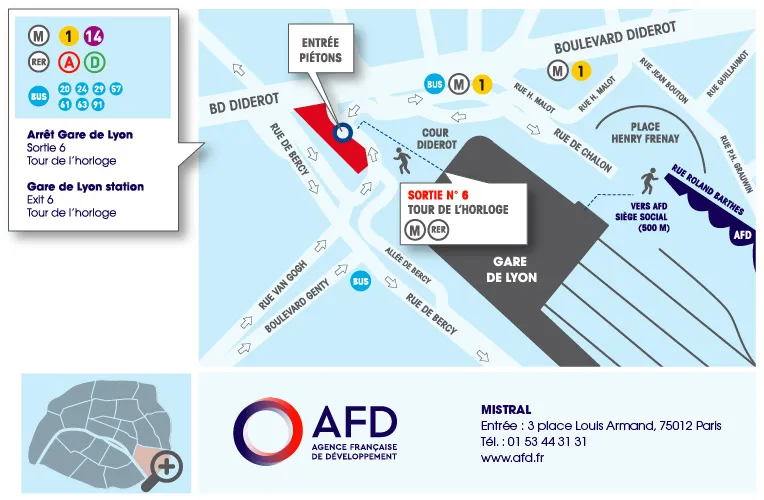
Mistral Auditorium - 3, place Louis Armand PARIS 75012, France
In-person event with live streaming
Join us for the 17th AFD International Research Conference on Development.
Registration
Organized by AFD Group as part of the French Presidency of the G7, this high-level international conference will bring together researchers, public decision-makers, development practitioners, and civil society actors to address the challenges of climate change adaptation.
The conference will bring together a wide range of leading researchers, including several authors of and contributors to the work of the Intergovernmental Panel on Climate Change (IPCC), alongside public policymakers, development practitioners and representatives of international institutions.
As climate impacts intensify, how can we design adaptation strategies that are fairer, more effective and better rooted in local realities? How can we connect research, public policy, and field experience to accelerate the implementation of concrete responses?
Over two days, discussions will focus in particular on: cities facing the challenges of adaptation; Locally Led Adaptation (LLA); measuring the progress of adaptation; the limits of adaptation; envisioning adaptation; new frontiers in adaptation; and the adaptation as a macro-fiscal challenge.
Each session will bring together research findings, lessons from the field and public policy perspectives to better understand how knowledge on adaptation can be translated into concrete decisions, practices, and forms of cooperation.
The sessions will also foster dialogue between experiences from AFD's partner countries, international research, and the challenges faced in France and elsewhere in Europe, encouraging cross-learning between territories experiencing the impacts of climate change.
At a time when climate impacts are intensifying, this conference aims to contribute to the renewal of the knowledge, practices, and forms of cooperation needed to strengthen societies' capacity to adapt.
Watch the live stream (coming soon)
Coming soon.
Agenda and speakers
See the program for Day 1.
Welcome and introduction.
Opening discussion to frame the conference and its main challenges.
A special surprise awaits attendees on the day.
With more than two thirds of the world's population set to live in cities by 2050, and ahead of the IPCC Special Report on Cities (SR Cities, 2027), this session examines urban adaptation in the face of intensifying and increasingly interconnected risks. It pays particular attention to informal settlements, which could be home to as many as three billion people, and explores the persistent gap between planning and implementation, as well as the risks of maladaptation and green gentrification.
Lunch break for in-person participants; live stream resumes at 1:30 PM.
Locally Led Adaptation is attracting growing attention as an essential approach to climate change. Building on eight principles for engagement, LLA seeks to make solutions more inclusive and more sustainable. Climate finance actors have complementary roles to play in supporting and scaling up this agenda, with synergies that remain to be strengthened. This session assesses the real contributions of LLA and identifies the conditions for genuinely transformational implementation.
Coffee break for in-person participants. Live stream resumes at 3:30 PM.
This session addresses the methodological and political challenge of assessing adaptation, brought into sharp focus by the adoption of the 59 Belém indicators at COP30. While these metrics are intended to help track the Global Goal on Adaptation under the Paris Agreement, their operationalization raises questions, notably the risk of favoring what is measurable at the expense of deeper transformations. The session therefore also explores qualitative methods capable of capturing essential dimensions of adaptation that aggregate indicators struggle to take into account.
Closing remarks and preview of the second day's program.
See the program for Day 2.
Opening address to set out the day's key challenges.
As climate risks intensify, the question of the limits of adaptation has emerged as a major scientific and political issue, with successive institutional milestones culminating in the Fund for responding to Loss and Damage. Insurance mechanisms are useful tools but have real limitations. In the most exposed territories, the question is no longer only how to adapt, but under what conditions and for how long a territory remains livable—and who decides this, on what basis, and with what alternatives.
Is the most significant limitation that researchers and practitioners have faced over the past 30 years not, in fact, the difficulty of imagining resilient, inclusive and desirable futures together with all stakeholders? The imaginaries of adaptation are plural, yet the dominant ones remain largely technocratic and top-down, often perpetuating existing power relations. Making these imaginaries explicit makes it possible to discuss and reorient them; broadening the space of imaginaries also means broadening the space of solutions and reducing the risks of maladaptation.
Lunch break for in-person participants. Live stream resumes at 1:30 PM.
The IPCC's Sixth Assessment Report makes it clear: incremental adjustments are no longer enough. The challenge now is to combine them with transformational adaptation, involving systemic changes in territories and societies, while also developing a more precise understanding of transboundary risks. It also appears necessary to develop new methodologies to better connect timescales—past, present and the long-term future—in order to define more robust adaptation pathways.
Long confined to environment ministries, adaptation is now becoming part of the trade-offs made by finance ministries. The economic literature has developed but remains fragmented: it underestimates extreme and cascading damages, poorly integrates deep uncertainty, and neglects long-term budgetary effects. Several instruments are emerging to equip ministries—taxonomies, green budgeting, expenditure tagging—and public development banks have a supporting role to play.
Political issues related to adaptation.