
Share the page
AFD and the World Bank: a stronger partnership for greater impact
Published on
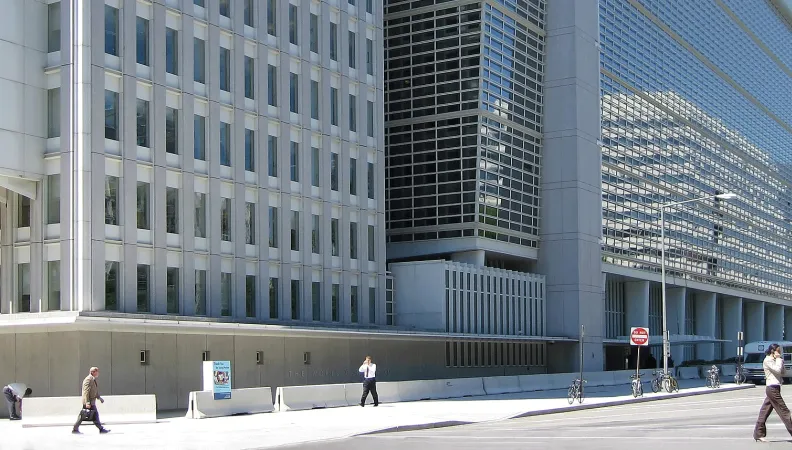
AFD Group is the leading bilateral financing partner of the World Bank Group (WBG) by number of co-financed projects. With a memorandum of understanding for a strategic partnership signed in 2024, and $32 billion invested in co-financing and parallel financing since 2014, the two public development banks are scaling up the most promising programs. An in-depth look at the 2026 Spring Meetings in Washington, DC.
Article originally published on April 11, 2024, updated on April 16, 2026.
Addressing the critical challenges of today requires an unprecedented level of collaboration among major international institutions. Against this backdrop, on 30 April 2024, the presidents of Agence Française de Développement (AFD) and the World Bank signed an agreement to promote sustainable and inclusive growth, with the aim of tackling poverty, inequality, and climate change. The priorities focus on vulnerable countries, supporting private sector development through the International Finance Corporation (IFC) and Proparco, as well as climate action in emerging economies and the electrification of the African continent, with the goal of helping 300 million people gain access to sustainable electricity by 2030.
The partnership reached a new milestone in February 2026 with the joint organization of the “Power of Cofinancing” event in Casablanca, Morocco – the first international gathering entirely dedicated to co-financing. The initiative highlighted cooperation between the two institutions and introduced The Casablanca Vision, set to become a key instrument for shaping the evolution of development finance practices and architecture. In this context, AFD became the first bilateral donor to publish projects on the Collaborative Co-Financing Portal, an initiative led by the World Bank and co-developed with 10 multilateral development banks. The platform is set to become a central lever for mobilizing joint financing, notably through major initiatives such as Mission300 and AgriConnect.
World Bank and AFD: co-financing scales up in Morocco
Collaboration between the two financial institutions is also driving the transformation of the international financial system, as demonstrated by the Finance in Common Summit (FiCS) initiative. As early as June 2023, World Bank Group had confirmed its support to bring together more than 500 public development banks, collectively responsible for $2.7 trillion in annual investments. The aim is to harness the strength of the financial system in support of the Sustainable Development Goals (SDGs).
This scaling up builds on a decade of unprecedented collaboration between the two major international institutions. Since 2013, AFD and the World Bank have jointly invested in more than 100 co-financed projects, aimed in particular at tackling climate change, poverty, and inequality. This partnership, built on complementary expertise and a shared vision of a more just and sustainable future, has helped improve living conditions for millions of people, reduce fragmentation in development assistance, and strengthen alignment with the priorities of partner countries.
The Global Development Banks’ Architecture
Joint action by AFD Group and the World Bank Group on financial systems and capital mobilization is one of their most emblematic collaborations. It focuses on financial system architecture, financial inclusion, green finance, the alignment of financial institutions (FIs) with the Paris Agreement, and support for financial institutions in their efforts to achieve, in particular, the Sustainable Development Goals (SDGs) related to biodiversity, climate, and gender. The two institutions are co-founders of the Consultative Group to Assist the Poor (CGAP), which supports the development of sustainable, resilient, and inclusive financial ecosystems, with a focus on underserved households’ access to financial services.
Another sector benefiting from these joint efforts is social protection. Since 2016, across Africa, Asia, Latin America, the Caucasus, and the Indian Ocean, the two public development banks have cooperated on investment projects and budget support operations. For example, in Türkiye, through the Earthquake Recovery and Reconstruction Project since 2023, and in Africa through the ACE program for more than 10 years. AFD and the World Bank have also introduced “Catastrophe Deferred Drawdown Options” (Cat DDO). This is a contingent credit line that provides immediate financing to countries in the event of a disaster. It helps strengthen a country’s capacity to manage risks and is designed to be part of a broader preventive risk management strategy. This type of instrument proved its relevance, for example in the aftermath of the COVID-19 pandemic.
Scale, reach, and agility
An innovative co-financing framework agreement, signed in 2018, had already helped channel billions of dollars into projects that drive socioeconomic progress, promote stability and security in fragile contexts, strengthen human capital, and address the climate crisis. With an average annual volume of $1.28 million channeled through this mechanism, the benefits and added value at the project level go far beyond higher financing volumes, as each institution brings its unique expertise to co-financed projects. With the new strategic memorandum of understanding and the 2024 co-financing framework agreement, it is now possible to finance a project by combining delegated tasks and parallel financing – that is, different contracts within the same project. This framework agreement maintains the ambition to cover all cooperation instruments implemented by the two development banks. It also supports mutual strengthening of expertise, the sharing of best practices, joint responses to emerging challenges, and the advancement of new priorities for the benefit of clients and partners.
Overview of the World Bank Group & AFD Group partnership
Risk sharing remains a key driver, particularly when operating in fragile contexts. By combining the World Bank’s financial capacity with AFD’s agility and local presence, the two institutions are helping to shift the broader development ecosystem. In this context, on 26 March 2026, the Board of Directors of the World Bank Group approved the removal of the requirement to recover from partners the costs associated with their mobilization under co-financing arrangements. This change, marking a shift from a cost-sharing approach to an impact maximization approach, is expected to remove an operational constraint for some donors and facilitate the mobilization of new partners.