
Share the page
ARGENTINA x FRANCE: THE PROVINCE OF SANTA FE DRIVES ENERGY RENOVATION OF ITS PUBLIC INFRASTRUCTURE
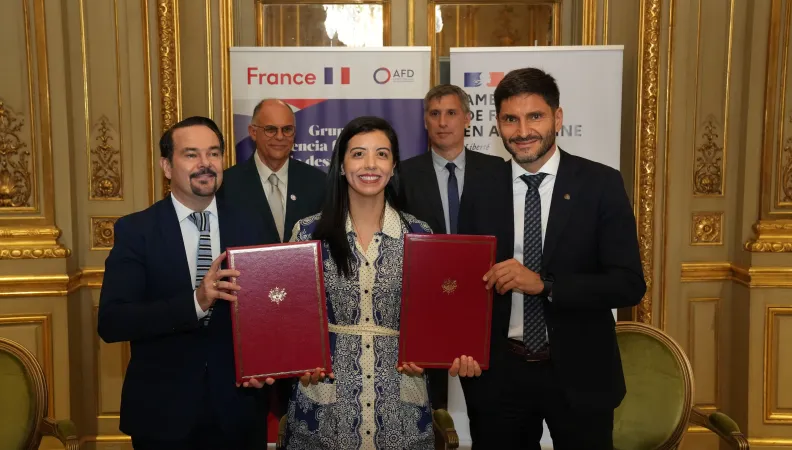
The French Development Agency (AFD), through the PEEBCool energy efficiency support program, is offering a sustainable response by modernizing schools, healthcare facilities, and airport infrastructure with efficient cooling solutions and durable building materials, adapted to the thermal variations specific to the region across the Province of Santa Fe. This financing strengthens Franco-Argentine cooperation in favor of more efficient and climate-resilient public infrastructure.
The loan signing ceremony between AFD and the Province of Santa Fe took place at the French Embassy in Buenos Aires, in the presence of Mr. Romain Nadal, French Ambassador to Argentina, Mr. Maximiliano Pullaro, Governor of the Province of Santa Fe, and Ms. Lorena Chara, AFD Director in Argentina.
Public buildings better adapted to thermal variations
The Province of Santa Fe is increasingly exposed to rising temperatures and frequent heatwaves, with summer peaks regularly exceeding 40°C. A significant portion of public buildings — particularly hospitals and schools — shows limitations in energy performance: insufficient thermal insulation, inadequate ventilation, and outdated cooling systems.
In a context of intensifying climate impacts, these vulnerabilities lead to increased energy consumption and operational costs, directly affecting the health, comfort, and working conditions of users and staff.
This new loan follows an initial financing signed two years ago for the "Biodiversity for Climate Action" project. It represents a new step in the bilateral cooperation between Argentina and France on energy transition, climate resilience, and the strengthening of provincial public services.
€50 million to modernize strategic infrastructure
The main objective of the project is the renovation of public buildings to reduce energy consumption and greenhouse gas emissions, through energy efficiency measures and the installation of renewable energy sources.
In this framework, the initiative also includes the creation of new energy infrastructure in facilities that previously had neither modern solutions nor adequate equipment, broadening coverage and ensuring more equitable conditions across the territory. This involves integrating efficient electrical systems, LED lighting, sustainable air conditioning, and renewable energy-based equipment into buildings that never had them before — strengthening the public network and enabling more institutions to operate to quality standards, with a reduced environmental footprint and greater energy autonomy.
The project includes the energy renovation of two hospitals, two provincial airport terminals, and targets a minimum of 19 schools, one per provincial department. It is implemented by the Province through its Agency for Economic Cooperation and External Financing (ACEFE) under the Ministry of Economy, and the Sub-Directorate for Renewable Energies and Energy Efficiency under the Ministry of Productive Development.
The non-sovereign financing includes:
- a €35 million loan from AFD;
- a €15 million concessional loan from the Green Climate Fund, delegated to AFD under the PEEBCool program.
The works will deliver:
- an annual reduction in energy consumption of approximately 3.95 GWh (nearly 40%);
- a decrease of 1,621 tonnes of CO₂ equivalent per year, representing over 60% compared to the current situation.
Beyond the energy and climate benefits, the modernization of buildings will help improve the thermal comfort of patients, students, and staff, ensure continuity of public services during periods of extreme heat, and promote local employment in the construction sector.
The renovation projects also offer an opportunity to address other building vulnerabilities related to safety, comfort, accessibility, and gender equality.
A strategic bilateral partnership
The signing of this financing reflects the strengthening of the strategic relationship between Argentina and France on energy transition and climate resilience. By supporting the priorities defined by provincial authorities, France is backing structural investments that modernize public infrastructure and durably improve the quality of services delivered to citizens.
About the PEEBCool program
The Partnership for Energy Efficiency in Buildings (PEEB) aims to transform the global building sector by promoting sustainable, energy-efficient, and climate-resilient construction. Launched at COP22 under the Global Alliance for Buildings and Construction (GlobalABC), PEEB supports the development of ambitious regulatory frameworks, the exchange of good practices, and the mobilization of investments for high-performing, climate-adapted buildings.
PEEB Cool, one of its flagship programs, supports 11 partner countries located in hot climates across Africa, Asia, Eastern Europe, and Latin America. It promotes improved building energy performance and enhanced resilience to heatwaves, extreme events, economic crises, and energy supply tensions.
The program is funded by the Green Climate Fund (GCF), the French Development Agency (AFD), and the German Federal Ministry for Economic Affairs and Climate Action (BMWK).