
Share the page
G7: Paris Dialogue members convene on development finance priorities
Published on
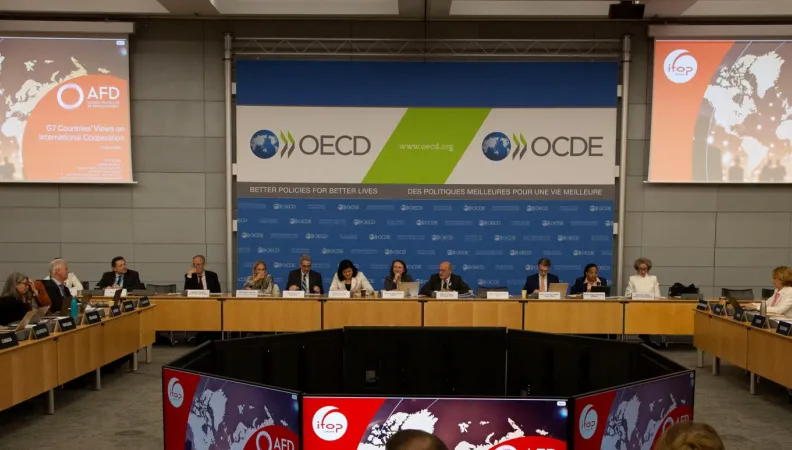
On the occasion of the official G7 high-level side event, 'Fitter, Smarter, Better: Towards a G7 Vision of Financing for Development', held in Paris on 28 April 2026, members of the Paris Dialogue convened to discuss on the effectiveness and strategic impact of financing sustainable development. Founded in 2023, the Paris Dialogue is a platform for advancing results-oriented global development partnerships, gathering the international institutions based in Paris: Groupe AFD, IEA, ICC, CEB, OECD, OIF, and UNESCO.
Following the historic decline in official development assistance (ODA), discussions focused on two complementary priorities:
1. Renewing narrative and better data for development finance
Participants explored the need for a renewed narrative and improved data for development finance, which effectively capture today’s realities and challenges. Discussions emphasised the importance of reaffirming international solidarity, particularly in support of the most vulnerable countries and populations, while enhancing the clarity and credibility of existing measurement frameworks.
Building on the ongoing work of the OECD Development Assistance Committee (DAC), there was a shared recognition of the need to strengthen the transparency and comparability of development finance data. New initiatives in this area include a new ODA dashboard for health, and co-ordinated efforts to track pandemic preparedness and response financing to identify key gaps and strengthen global resilience.
Participants also called for a more comprehensive approach to capturing the full spectrum of financial flows mobilised for sustainable development — including concessional and non-concessional public finance, as well as private finance mobilised with by official interventions and its impact on domestic resource mobilization. Building on existing efforts, this approach provides a means to better monitor investment aligned with global public goods and partner countries' priorities and help lift barriers to finance, including lowering the cost of capital. Participants also stressed the need for investing in sectors like education, culture, the sciences – and for building long-term, country led investment pathways in this regard
2. Strengthening the international financial architecture
Against a backdrop of increasing fragmentation and complexity, participants stressed the need to strengthen coherence and complementarity across the “system”. This included further enhancing coordination between multilateral (MDBs) and national public development banks (NDBs), building on their respective strengths, and promoting greater interoperability of standards, procedures, and financial instruments, while adhering to best international practises. In this context, the Finance in Common Summit (FiCS) was recognised as a key institutional platform for such coordination.
In addition, participants highlighted the role of country-led platforms in aligning public and private finance with national priorities, alongside the need to scale up private finance mobilisation, notably through guarantees and risk-sharing mechanisms. These approaches aim to maximise development impact, reduce fragmentation and strengthen country ownership. These principles also underpin the education finance agenda of the SDG4 High-Level Steering Committee and are central to the Sustainable Education Financing Pathways developed by GPE, UNESCO and partners.
Informing G7 discussions
These exchanges are intended to inform ongoing G7 deliberations. They reflect a shared ambition to modernise development finance frameworks — reinforcing their solidarity mandate, while complementing it with broader approaches to financing sustainable development — and to better leverage development finance institutions in support a fully coherent, impact-oriented international financial architecture.
Rémy Rioux, CEO, AFD Group said:
“The ongoing French presidency of the G7 has put financing for development and international partnerships policy at the heart of the common priorities.
From an AFD Group perspective, we have been advocating for many years for defining a new paradigm for development policy and for building a new shared narrative, that would protect ODA and reposition it in the full array of financial resources for development.”
Sandrine Gaudin, Vice-Governor for Financial Strategy, Council of Europe Development Bank (CEB) said:
“At a time marked by growing fragmentation, the Paris Dialogue provides a unique forum, bringing together Paris‑based institutions to promote shared ideas on how to make development finance more adapted, smarter and more effective. The CEB, whose mandate focuses on the most vulnerable, is committed to ensuring that social infrastructure — which is essential to resilience and social cohesion — is fully integrated into national development platforms and financed at scale through coordinated approaches among all stakeholders, combining loans and grants.”
Andrew Wilson, Deputy Secretary General – Policy, International Chamber of Commerce (ICC) said:
“Mobilising private capital at scale is indispensable to meet today’s development and infrastructure needs. The core challenge, as we see it, is aligning financial system incentives with these imperatives, starting with targeted adjustments to macroprudential regulation that can unlock more capital while safeguarding financial stability. The G7 has a decisive role in shaping these conditions.”
Press contact: _AFDpresse@afd.fr