Share the page
Track Adapt: Developing a Methodology to Measure Progress on Urban Climate Change Adaptation
-
Project start date
-
2025Status
Ongoing
-
Project end date
-
2028
-
AFD financing amount
-
169 716
-
Country and region
-
Research program
The Track Adapt research project aims to develop a new methodology, based on the GAP-Track monitoring system, to closely assess progress on urban adaptation to climate change. It will help build a shared understanding of adaptation challenges with local stakeholders in the cities of Cape Town and Nelson Mandela Bay (South Africa), and identify effective, context-specific adaptation pathways.
Context
Heatwaves, intense rainfall, prolonged droughts… As climate risks intensify, it is increasingly important to know whether adaptation measures implemented at the local level are actually reducing vulnerabilities and risks. Yet international debate remains largely focused on global indicators, such as the proportion of agricultural area using climate adaptation practices and technologies, or the proportion of population using climate-resilient water services. These indicators are useful but insufficient to capture local contexts, long-term trade-offs, and the risk of maladaptation—that is, measures that, paradoxically, may increase vulnerability rather than reduce it—faced by these territories.
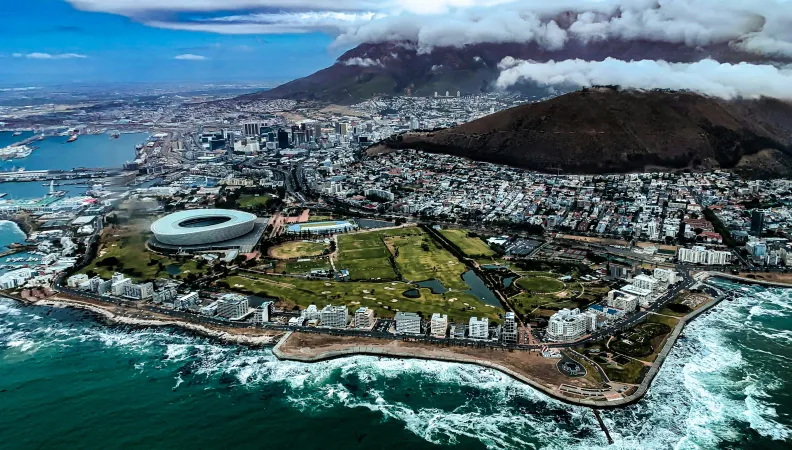
In South Africa, Cape Town and Nelson Mandela Bay are particularly exposed to climate risks: both cities face significant pressures linked to water scarcity, heatwaves, coastal erosion and coastal flooding. Beyond the material consequences of these risks, the challenge is also political: how can the visions, values, and interests of multiple stakeholders—municipalities, scientists, practitioners, civil society, communities, and the private sector—be reconciled to build robust and equitable adaptation pathways?
Objectives
To track progress on urban climate change adaptation, the Track Adapt research project aims to adapt the GAP-Track methodology (developed by IDDRI with support from AFD and ADEME), making it relevant at the urban scale, usable by relevant stakeholders, and replicable. To this end, the research team is working with stakeholders in two pilot cities: Cape Town and Nelson Mandela Bay.
Track Adapt focuses on three main questions:
- How can the tool be adapted to the metropolitan scale?
- What progress, gaps and needs emerge in two priority areas for these two cities: water security in the face of drought and heat, and coastal adaptation to erosion and flooding?
- How can regular assessment of adaptation measures make it possible to compare progress over time and across cities?
This action-research will be particularly valuable to development actors, as it enables a shift from monitoring focused on plans and indicators toward a shared understanding of what actually reduces risk. It will help municipalities, AFD and their partners prioritize actions, strengthen capacities, guide financing, and inform dialogue on more equitable adaptation pathways.
Track Adapt contributes to AFD's efforts to strengthen urban adaptation, inform public policy dialogue, and direct financing toward relevant and effective solutions
Method
In Cape Town and Nelson Mandela Bay, technical, institutional, and academic experts, as well as civil society and economic actors, will assess the progress and limitations of adaptation using a matrix structured around six dimensions: risk knowledge, plans, actions, capacities, evidence of risk reduction and adaptation pathways.
The project will bring together complementary expertise:
- The African Climate & Development Initiative, affiliated with the University of Cape Town (ACDI-UCT), will lead local engagement, stakeholder dialogue, and methodological development;
- IDDRI will provide methodological expertise on GAP-Track;
- Local stakeholders will validate the methodology and share experiential knowledge;
- AFD will provide scientific input to adapt GAP-Track to the local context, facilitate scientific outreach toward concrete adaptation projects—in South Africa and other regions of operation—and share experience with French cities.
Learning Labs will translate research findings into priority actions, financing options, and replicable lessons.
Expected results
Expected outcomes include a methodological note on applying GAP-Track at the urban level, participatory assessments on water and coastal issues in Cape Town and Nelson Mandela Bay, publications (project report, policy brief, research article, etc.), and multi-stakeholder workshops.
The project also aims to strengthen the capacities of municipal actors on adaptation; create a space for dialogue among scientists, practitioners, and decision-makers; and support the identification of investment priorities to bridge the gap between adaptation needs and the responses currently in place.
Want to stay up to date with AFD’s research news?

Contact
-
Christophe BUFFET
Research Officer on Adaptation