
Share the page
Egypt
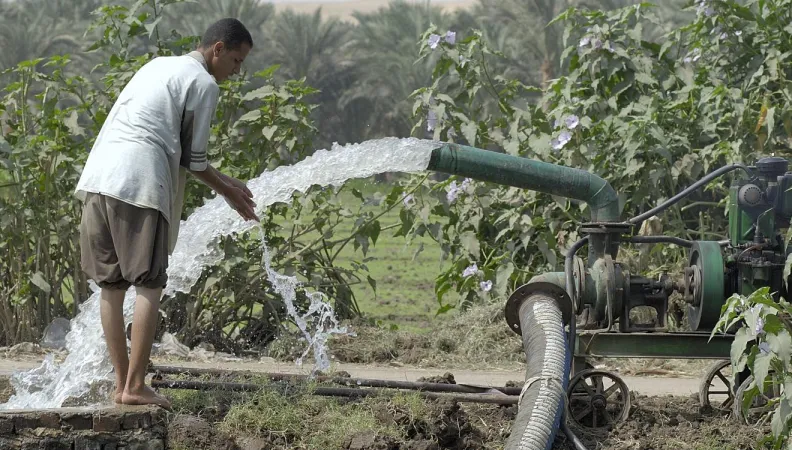
Over the past 20 years, AFD Group has become Egypt’s leading bilateral donor, with €4.2 billion committed since 2006 to support shared priorities. Through financing for sustainable infrastructure in transport, energy, water, and sanitation; support for social reforms, such as the rollout of universal health coverage; and assistance for entrepreneurship, training, and professional integration, AFD, Proparco, and Expertise France are supporting Egypt’s major economic, social, and climate transitions as part of the strategic partnership between France and Egypt. The goal is shared, sustainable, and inclusive prosperity.
Context
Situated in Northeast Africa, Egypt has significant natural and human resources. With a population of 116 million in 2026 and Africa’s second-largest GDP at USD 399 billion, Egypt is a key player on the continent and in the Mediterranean region. However, population growth and patterns of territorial development – with 98% of the population living on just 3.5% of the country’s land area, in the Nile Valley and Delta – are placing intense pressure on infrastructure, water resources, and public services. In addition, 60% of Egyptians are under the age of 30, and nearly one million young people enter the labor market every year. This demographic dividend also creates major challenges in terms of public services and sustainable job creation.
Egypt’s economy has faced several years of external shocks that have weakened its macroeconomic balances. The country is continuing a program of structural reforms under an IMF-supported program that runs through 2026. AFD, a partner of Egypt since 2006, supports the authorities’ priorities for sustainable investment and major social reforms.
Present in the country for 20 years, AFD Group experienced strong growth in its activities between 2019 and 2023, driven by portfolio diversification and stronger strategic engagement following the signing of the Egypt–France Intergovernmental Agreement in 2021. This partnership was renewed after French President Emmanuel Macron’s state visit to Cairo on 7 April 2025.
Over the past two decades, AFD has committed €4.2 billion across all financing instruments. Sovereign activity – loans to the state – represents the largest share of the portfolio, accounting for more than 70%. In addition, 66% of projects approved between 2019 and 2025 have a positive climate impact, while 50% contribute to gender equality. Over the past 15 years, AFD has also mobilized nearly €300 million in grants, particularly from the European Union, to finance projects with strong social impact and support technical cooperation and knowledge sharing.
Proparco, AFD Group’s subsidiary dedicated to the private sector, has committed nearly €500 million in Egypt, making it one of its main countries of operation in Africa. Expertise France – the subsidiary responsible for international technical cooperation – is also implementing several initiatives, including support for social protection reform and improvements to primary healthcare, alongside regional and multi-country projects that position Egypt within a broader continental and regional framework.
AFD's Egypt office is directly attached to the North Africa regional office in Casablanca.
Our approach
AFD and Egypt: supporting sustainable and job-creating growth
As nearly one million young people enter the labor market every year, AFD has been supporting job creation and entrepreneurship for the past 15 years, with €325 million in commitments. Its partners include the country’s main public banks and the state agency for micro, small, and medium-sized enterprises, MSMEDA. These operations place particular emphasis on supporting women through dedicated credit lines, while also helping SMEs invest in industrial pollution control, energy efficiency, and, in the future, decarbonization. To date, the impacts are estimated at more than 100,000 jobs created and 24,000 projects led or managed by women.
AFD also supports the regional bank Afreximbank through non-sovereign financing to promote intra-African and international trade, as well as climate finance.
PROPARCO, AFD Group’s subsidiary dedicated to the private sector, finances numerous SMEs directly in strategic sectors such as textiles and agribusiness, as well as through investments in private equity funds, which are particularly dynamic in Egypt.
Finally, Expertise France coordinated technical cooperation activities between 2023 and 2024 to promote finance aligned with the Sustainable Development Goals (SDGs). The initiative supported Egyptian public banks as well as financial regulators, helping drive the transformation of the financial system.
Egypt is experiencing strong population growth, placing increasing pressure on infrastructure, public services, and natural resources.
Promoting renewable energy
AFD Group has been supporting Egypt’s energy transition for more than 10 years, in a sector shaped by ambitious reforms. AFD financed pilot wind and solar projects, including Kom Ombo, the country’s first grid-connected solar power plant. At the same time, AFD supported the liberalization of the sector, paving the way for PROPARCO to expand its work in renewable energy through financing for solar power plants such as Benban, involving French companies including Total Eren and Voltalia. AFD supports Egypt’s ambition to become a regional hub for clean energy.
Reducing urban congestion and providing safe, reliable, low-carbon transport
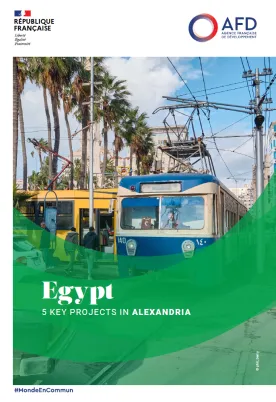
Since 2007, AFD has committed €820 million to urban mobility projects, a longstanding pillar of Franco-Egyptian cooperation. AFD supports the development of the Cairo Metro – including Lines 1 and 3 – enabling more than 11 million passengers each month to benefit from modern, safe, and low-carbon transport. AFD is also investing in the modernization of the Aboukir metro and the Alexandria tramway in Egypt’s second-largest city. More recent rail projects, including the Tanta–Damietta line and the connection to the dry port of 10th of Ramadan City, aim to improve safety and strengthen freight corridors.
Expanding access to water and sanitation
To support government priorities, AFD, alongside European partners, is contributing to the modernization of wastewater treatment plants in Alexandria, Helwan – south of Cairo – and Gabal Al Asfar – east of Cairo. As the world’s third-largest wastewater treatment plant, Gabal Al Asfar serves a population of 12.5 million people. AFD also finances water and sanitation infrastructure in cities across the Nile Delta and Upper Egypt.
Strengthening social cohesion and social justice
AFD was the first partner to support the rollout of universal health insurance in Egypt in 2019 through three public policy loans that now involve other donors, including the World Bank, JICA, and the European Union. This ambitious reform is accompanied by technical cooperation implemented by Expertise France, as well as an EU-funded investment program to improve the quality of and access to primary healthcare for vulnerable populations.
PROPARCO is also supporting improvements in healthcare quality and access through equity investments in MetaMed – a leading medical imaging company in the Middle East – and Humania, a private hospital platform.
AFD supports efforts to improve French-language teaching in government schools through the TrèFLE program, contributes to the restructuring of the French University of Egypt, and partners with Egypt on reforming technical and vocational education. These efforts promote professional training pathways aligned with private sector priorities in key sectors such as transport.
Through its CSO facility, AFD also supports civil society organizations working with vulnerable populations, including young people living on the streets, to improve access to psychological, legal, and healthcare support.
While more than half of Egyptians still live in rural areas, the governorates of Cairo and Giza are among the most densely populated urban areas in the world and continue to attract new residents due to population growth, rural migration, and the arrival of refugees. Urban planning, along with improvements to metropolitan and local infrastructure, must support these changes to promote equitable and sustainable development, ensuring quality living conditions, access to basic services, and employment opportunities for all.
AFD therefore supports improvements to public services in informal neighborhoods in the Cairo and Giza governorates and, in the future, in Alexandria. Beyond urban renewal, AFD works with Egyptian public and private financial institutions to improve access to credit for micro and small enterprises, which are the country’s main source of job creation.
Food security and agriculture are also at the crossroads of territorial development, inclusion, and climate resilience challenges. Subsidized baladi bread is a cornerstone of Egypt’s social contract. As the world’s largest wheat importer, Egypt faces major supply vulnerabilities. In response, AFD and the European Union are supporting the construction of an additional 375,000 tonnes of grain storage capacity – increasing national storage capacity by 10% – to help protect the most vulnerable households from supply shocks.
Gender inequality remains a major challenge in Egypt and a priority for the Egyptian authorities. To support these efforts, AFD is strengthening its gender-focused actions and systematically promoting equal opportunities for women. As a result, 50% of financing approved between 2019 and 2024 has a positive impact on gender equality.
For example, while women’s labor force participation has declined over the past decade and remains below 20%, AFD supports women’s entrepreneurship by improving women’s access to formal credit through the MSMEDA agency for micro, small, and medium-sized enterprises. In addition, AFD’s support for the rollout of universal health coverage primarily benefits women, who were largely excluded from the previous health insurance system and remain the main users of healthcare services.
Lastly, investments in sustainable urban mobility, renewable energy, climate finance, and more efficient wastewater treatment are all examples of projects with climate co-benefits – helping reduce emissions and/or strengthen the country’s and communities’ resilience to climate change.
In the field
Below, find the country's projects, news, publications, and contact details in one click.

News & Press Releases
Climate change: a MOOC for more sustainable construction in the Mediterranean
Published on September 7, 2026
Cairo Metro Line 3: a flagship project of cooperation between Egypt and France
Published on June 23, 2026

Publications & Media
Key figures
-
€4.2 BN in cumulative commitments since 2006
-
No.1 bilateral donor to Egypt
-
6 M Egyptians already covered by universal health insurance since 2019