
Share the page
Zambia
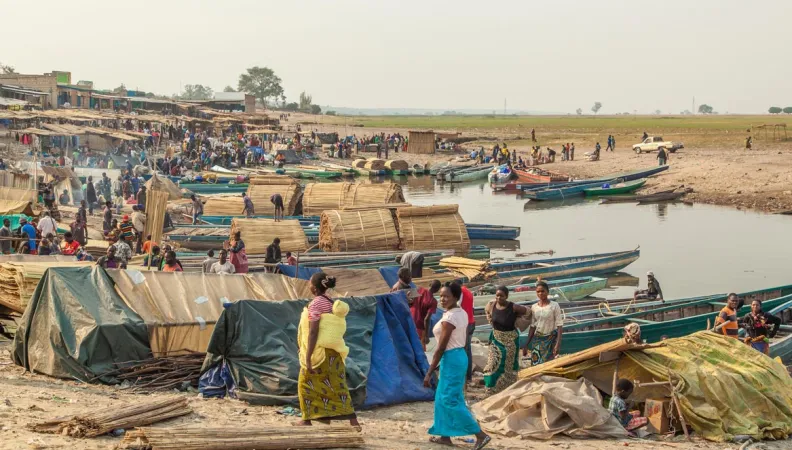
Zambia, a landlocked Southern African country, has many strengths: political stability, mining resources, great economic potential and rich biodiversity. But poverty remains high and inequalities prevail. The country also needs to improve the quality of its infrastructure to promote its economic development.
Since 2012, AFD has been operating in three priority sectors: energy, water and sanitation and transport, and is expanding its focus with growing investments in financial services, forestry and conservation.
Context
Present in the country since 2012, AFD has been working with the Zambian government to improve road infrastructure and forest resources, expand access to electricity and clean water, food security and support the transition toward a sustainable energy future.
Between 2012 and 2017, AFD’s portfolio was mostly focused on sovereign lending, but is now diversifying its lending options to include non-sovereign loans and credit guarantee schemes to both private and public sectors. Through its Technical Assistance programs, AFD helps prepare projects to become investment-ready. Support has so far been extended to both state-owned enterprises and NGOs.
AFD's Zambia office is directly attached to the Southern Africa regional office in Johannesburg.
Our approach
AFD and Zambia: Improving access to basic services and developing infrastructure
In order to respond to growing electricity demand, the Zambian government has committed to developing and maintaining energy infrastructure and services, as well as exploring alternative sources of energy.
AFD is a long-term partner of ZESCO, Zambia’s national electricity provider, and has been instrumental in assisting the country in diversifying its energy mix. Renewable energy sources are abundant in Zambia, notably solar, hydro, thermal, biomass and wind. Around 92% of the country’s electricity comes from four hydroelectric plants.
AFD group has played a major role in increasing Zambia’s installed electricity capacity by co-financing the construction and operation of a 120 MW power plant at the foot of the Itezhi Tezhi Dam. This project is the first public-private partnership in Zambia’s energy sector.
Since 2012, AFD has invested €212M in the sector. In the energy sector, the total (AFD/Proparco) investments is around $70.4M ($34.4M for the Itezhitezhi hydro transmission lines and $36M for Proparco for the Itezhitezhi hydropower station).
In Zambia, access to water and sanitation is uneven across the country. Most of the infrastructure built in the 1960s and 1970s is now obsolete and needs significant rehabilitation. In peri-urban neighbourhoods, access to water and sanitation remains low, as infrastructure has not kept pace with urbanization.
In its National Long Term Vision 2030 (NLS), the Zambian Government has set the target of extending access to safe drinking water and sanitation in urban areas to respectively 100% and 90% by 2030.
AFD has made long-term investments in water and sanitation infrastructure in Zambia with the aim of improving access to clean water and adequate sewerage and sanitation throughout the country. One such project consists of the rehabilitation and expansion of water and wastewater services in the mineral-rich Copperbelt Province. The project improves access to reliable, sustainable and affordable clean water and waste water services for 460,000 residents.
Additionally, AFD is collaborating a utility company, Lusaka Water Supply and Sanitation Company to identify suitable water and sanitation projects for possible development and implementation financing. This effort is supported through a technical facility that will conduct a diagnostic assessment of the utility company to determine their needs and subsequently carry out a feasibility study for the selected project.
In 2022, France and Zambia signed a bilateral cooperation agreement on the sustainable management of forests. Since then, AFD has launched three different initiatives in support of Zambia’s forestry sector.
Through the development of a pilot forestry inventory methodology and the identification and strengthening of local non-timber forest product value chains, AFD is working with the Forestry Department within the Ministry of Green Economy and Environment in the development and implementation of its national forestry policy.
AFD is also collaborating with ZAFFICO, Zambia’s largest public forestry company, in the diversification of its business strategy in alignment with its sustainability, climate resilience, and long-term competitiveness goals.
In the field
Projects
Publications & Media
Key figures
-
10 institutions supported directly or indirectly since 2012
-
250 million euros in commitments in 10 years
-
360 km of roads upgraded