Share the page
Coalition launched to strengthen dialogue between public development banks and civil society
Published on
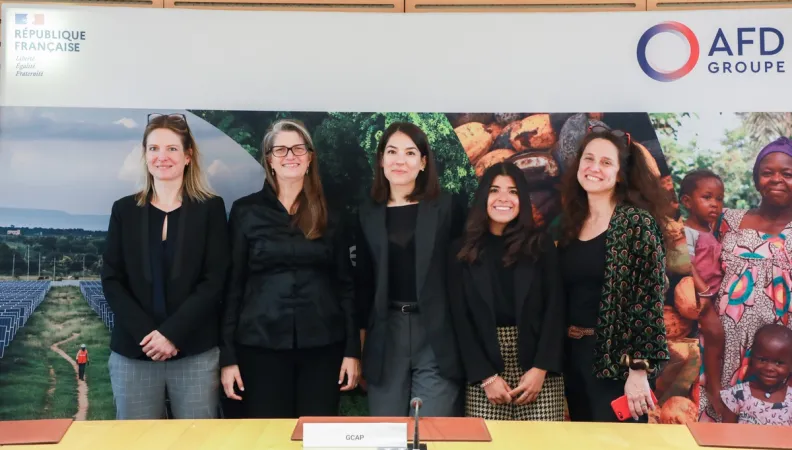
On 28 April 2026 in Paris, as part of the French G7 Presidency, the Finance in Common System (FiCS) officially launched a coalition bringing together public development banks (PDBs) and civil society organizations (CSOs). Co-chaired by AFD, Italy’s Cassa Depositi e Prestiti (CDP), and the international CSO network Forus, the initiative aims to establish a lasting framework for dialogue.
Dialogue with civil society organizations began within FiCS at the inaugural Paris summit in 2020, at AFD’s initiative. FiCS now brings together more than 550 public development banks. AFD has maintained a long-standing partnership with civil society. In 2022, this partnership was strengthened at the Abidjan summit, where public development banks adopted a declaration on human rights co-developed with civil society organizations.
Since then, AFD has supported CSO participation in FiCS through its I-OSC facility, via a project led by Forus and the International Federation for Human Rights (FIDH).
Why create a formal coalition?
The final communiqué of the FiCS Summit in February 2025 proposed the creation of a coalition dedicated to dialogue between public development banks and civil society organizations. For AFD, this means ensuring continuity in the dialogue. As Juliette Grundman, head of the Civil Society Organizations Division at AFD, explains: “The purpose of this coalition is to provide a permanent and regular space for dialogue between civil society actors and public development banks. Civil society actors are not simply invited to participate in the summit, but are contributing to an ongoing dialogue with public development banks.”
The decision comes at a particularly difficult global moment, as civic space is shrinking in many regions and development aid budgets are collapsing. For Marianne Buenaventura, project coordinator at Forus, “the issue is not only to mobilize more financing, but also to ensure that development finance is responsible, inclusive, and truly effective for people and the planet.”
A three-way co-chairmanship: what each party stands to gain
The coalition’s governance reflects its approach: neither public development banks alone nor civil society organizations alone, but shared leadership from the outset. Fosca Nomis di Pollone di Valfenera, who represents Cassa Depositi e Prestiti (CDP) within the coalition, explains: “We worked with determination for a year alongside our colleagues at AFD and Forus because we are convinced that this coalition can provide a meaningful space for dialogue and multilateral cooperation.”
Civil society actors complement public development banks through their proximity to local communities. In return, public development banks provide civil society organizations with financing capacity, access to political and technical decision-making spaces, and institutional legitimacy in contexts where civic space is shrinking. As Marianne Buenaventura notes, “Civil society can help ensure that public development bank interventions are more transparent, more accountable, and better aligned with sustainable development, human rights, and democratic values.”
Looking ahead to 2027
By 2027, Forus hopes to produce a first joint declaration setting out shared principles and concrete commitments to strengthen the meaningful participation of civil society within the public development bank ecosystem.
A practical guide for public development banks on strengthening their engagement with civil society is also expected.