Share the page
Southeast Asia: building efficiently in the face of energy crises
Published on
As energy efficiency in buildings becomes increasingly critical in Southeast Asia, the PEEB ASEAN program is supporting projects that demonstrate alternative ways to build and renovate: from an energy-efficient museum renovation in Laos, to well-designed vocational training centers in Phnom Penh, and an AI laboratory planned with energy performance in mind.
Following the closure of the Strait of Hormuz, the Philippines declared a national energy emergency. Importing 98% of its oil from the Middle East, the capital Manila – like many of its neighbors – now faces a renewed urgency to reduce energy consumption in buildings in order to withstand the crisis. The country has begun rationing energy use in public administrative buildings, canceling travel, and shifting meetings online.
The case of the Philippines illustrates a broader vulnerability shared across the region. As energy demand continues to rise, the most resilient response is not only to diversify energy supplies, but also – and above all – to consume less. In a region where buildings account for nearly one-quarter of final energy consumption, reducing the energy footprint of public buildings is not only a climate issue; it is also a matter of sovereignty and energy security.
English subtitles available
A region under pressure
Southeast Asia is one of the world’s fastest-growing regions in terms of infrastructure demand. Rapid urbanization, expanding middle classes, and efforts to strengthen public services are driving the construction of millions of square meters of buildings each year. Without a major shift, the sector’s energy consumption could increase by 90% by 2050. In the region’s tropical climate, cooling demand alone is expected to account for 30% of regional electricity consumption by 2035.
Policy responses are beginning to emerge: building codes in Thailand and Indonesia, Singapore’s target of 80% green buildings by 2030, and a regional objective to reduce energy intensity by 32% under APAEC – the ASEAN Plan of Action for Energy Cooperation. Yet these efforts are still constrained by the lack of harmonized standards and insufficient financing mechanisms in middle-income countries. This is precisely the gap that PEEB ASEAN – the Program for Energy Efficiency in Buildings in Southeast Asia – aims to address.
Officially launched in June 2024 and running through 2028, the program is implemented in partnership with the ASEAN Centre for Energy and financed by Agence Française de Développement (AFD). Its objective is to make public buildings a driver of sector-wide transformation by combining support for national policies, technical assistance for project owners, and targeted investment grants.
Three projects, three building types
On the ground, this approach is taking shape through concrete projects in very different contexts.
In Laos, the Savannakhet Museum is undergoing a renovation that incorporates bioclimatic design and resilience to extreme climate risks through PEEB ASEAN. Known as the Champa project, it demonstrates that heritage preservation can be combined with natural ventilation. In a country where public resources are limited and technical expertise remains scarce, the model matters: reducing the energy bill of a heritage building also frees up resources for its long-term maintenance.
In Cambodia, PEEB ASEAN is supporting two distinctly different projects.
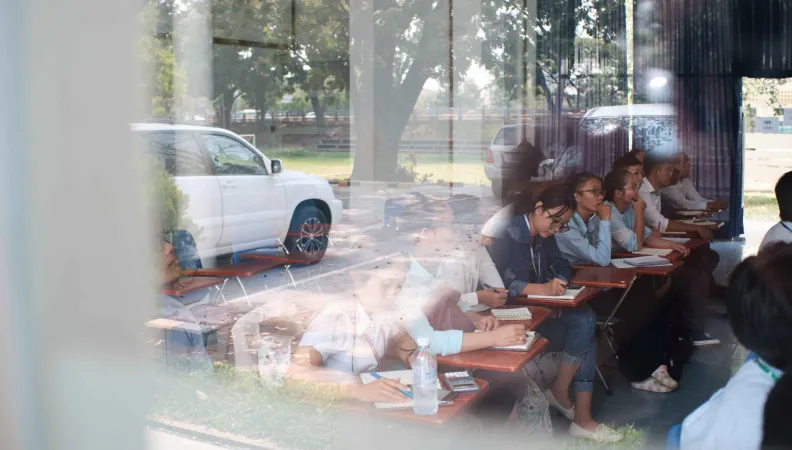
The first focuses on vocational training centers for industrial trades. Co-financed with the Asian Development Bank, it covers several facilities in Phnom Penh and Koh Kong. PEEB technical assistance is being provided during the design phase to integrate energy efficiency in buildings (EEB) standards before technical decisions are finalized – because that is when the most important choices are made.
The second project is more unprecedented. AFD is considering financing the construction of Cambodia’s future National Artificial Intelligence Center. This national laboratory would send a strong signal across the region: digital infrastructure, too, can be designed from the outset to meet high energy performance standards. PEEB ASEAN is already involved upstream through technical assistance funding to ensure that these criteria are integrated into the architectural pre-programming phase. The program may also provide an investment grant for the project, with the amount to be determined at the end of the design phase according to the building’s energy performance.
The right time to act
These three projects reflect a common approach: intervening early, before plans are finalized and practices become entrenched. Improving the efficiency of building envelopes and systems could reduce CO2 emissions from the building sector by more than 60% by 2040 compared with 2020 levels. But this requires action now, during the region’s current phase of large-scale construction.
Public buildings have a particular role to play in this transition. Funded with public resources, highly visible, and replicable, they can become benchmarks for the entire sector.
Read more
What role does AFD Group play in international environmental negotiations?
Published on October 7, 2026
Why does France’s development bank finance climate action in other countries?
Published on October 7, 2026

“Climate adaptation should be seen as a pathway, not a collection of solutions.”
Published on October 2, 2026