
Share the page
Kenya: 68 hectares of forest restored with French support handed over to Kenya Forest Service
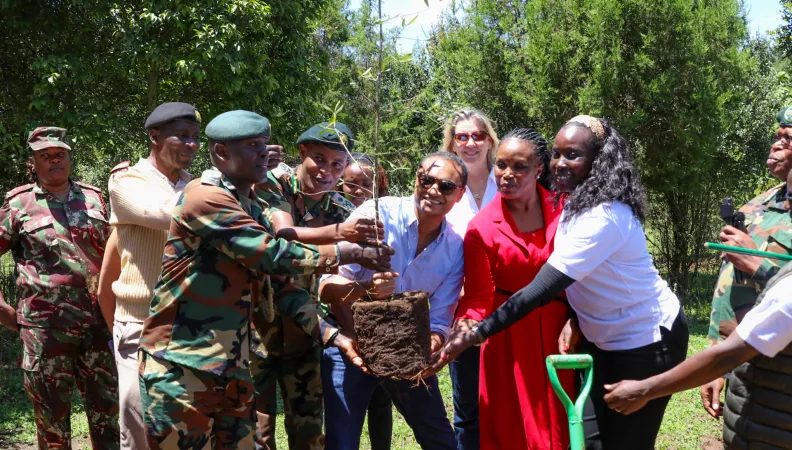
On 30 September, the Green Belt Movement (GBM) handed over 68 hectares of restored forestland in Dundori Forest to the Kenya Forest Service (KFS). The handover was part of Phase II of the Mau Reforestation Project, supported by France through the Agence Française de Développement (AFD). The project has restored more than 400 hectares of degraded forest in Dundori, North Nandi and Tinderet. In Dundori alone, it has created livelihood opportunities for more than 1,000 households living around the forest, while strengthening water catchment protection, soil conservation, biodiversity and climate resilience.
The handover marked a significant milestone in the restoration of the Mau Watershed and showed what government institutions, development partners, civil society and communities can achieve when they work together to restore Kenya's forests.
For GBM, the most important achievement was not the number of hectares restored or seedlings planted, but the growing role of communities as custodians of the forest. From preparing land and planting trees to caring for seedlings and protecting the forest, communities have been central to the restoration process.
“A forest is restored by people as much as it is restored by trees. The communities living around our forests understand the value of these ecosystems because their lives and livelihoods are directly connected to them. When communities are given meaningful opportunities to participate, they invest not only their labour but also their knowledge, commitment and sense of ownership in the restoration process,” said Joshua Nzola, Acting Executive Director of the Green Belt Movement.
Mr Nzola stressed that restoration must go beyond tree-planting campaigns to support the establishment, survival, protection and long-term stewardship of forests.
Partnership for community-led restoration
Ambassador of France to Kenya, H.E Wadid Benaabou attended the handover of the project, which is financed by AFD through a 1.3M€ grant financing over a five-year implementation period.
"Through this project, France confirms its long-term commitment to protect Kenya's forest and empower local communities, predominantly women, whose hands and dedication, made this restoration possible. Growing trees not only preserves critical ecosystems, it also provides food and water security, energy, resilience and a source of income for communities. France will continue to support Kenyan authorities, civil society and people's efforts to enhance biodiversity conservation," said H.E Ambassador Wadid Benaabou.
“AFD has supported the Green Belt Movement in its efforts to protect and restore Kenya’s forests since 2005. At the heart of this partnership are local communities and their livelihoods: protecting the Mau Forest ecosystem has helped diversifying income sources for the 1,200 households living alongside the forest, through tree-growing activities and alternative, sustainable uses of forest resources ”, said Anne-Gaël Chapuis, Director of AFD Kenya.
GBM thanked AFD for its continued support for community-centred forest and landscape restoration in Kenya, which has enabled communities to actively participate in restoring their forests, helping to protect critical water catchments and strengthen climate resilience.
GBM also thanked the Kenya Forest Service for its partnership and institutional leadership. The collaboration combines KFS's statutory mandate and technical oversight with GBM's experience in community mobilisation and landscape restoration, alongside the commitment of Community Forest Associations and local communities.
Long-term approach to forest restoration
The handover followed the GBM–KFS Forest Site Adoption Framework, a three-year pathway for restoration. It built on Phase I of AFD's support, during which GBM rehabilitated about 2,000 hectares in the Aberdares Watershed, working with communities to protect a critical water catchment. Lessons from that work have guided the expansion of community-based restoration into the Mau Watershed.
“If we want the 15 billion tree ambition to become more than a national target, we must invest in the people who will nurture those trees after the cameras leave and the planting ceremonies are over. Communities must be supported to become the long-term guardians of restored landscapes. That is the lesson Dundori gives us and it is a lesson we should carry into every restoration effort across Kenya,” Mr Nzola said.
The Green Belt Movement reaffirmed its commitment to working with KFS, AFD, Community Forest Associations, local communities and other partners to expand restoration efforts and strengthen the systems needed to ensure that restored forests remain protected for generations to come.
About Green Belt Movement
The Green Belt Movement (GBM) was founded by Nobel Laureate Professor Wangari Maathai in 1977 under the auspices of the National Council of Women of Kenya. For nearly five decades, GBM has worked to empower communities, particularly women, to conserve the environment and improve livelihoods. Its work combines environmental conservation, community empowerment, climate resilience, sustainable livelihoods and advocacy, using tree growing as an entry point for wider community action. GBM continues to work with communities across Kenya to restore ecosystems, protect watersheds and strengthen local stewardship of natural resources.