
Share the page
Measuring our concrete results
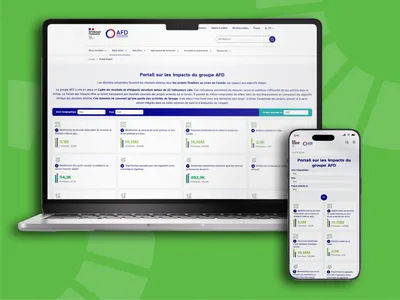
AFD Group’s Results and Impact Framework enables us to measure how well we are delivering on our ambitions for development and environmental protection. It tracks how our financing translates into tangible impacts for people, shared prosperity, and nature, while ensuring accountability and transparency.
What do we measure?
The new Results and Impacts Framework (RIF) includes 22 results and impact indicators on which the Group and its subsidiaries will focus their measurement, monitoring, and data quality efforts. This updated framework places AFD Group at the forefront of current practice, aligning with the recent adoption by the World Bank Group of a new Scorecard to measure impact.
Monitoring these indicators makes our results data fully transparent, improving the clarity of the Group’s work for French citizens and our international partners. AFD thus becomes the first bilateral public development bank to provide full transparency on its impact data. These data will highlight both the performance of its operations and the challenges addressed daily in the field where its financing is deployed.
In line with this commitment to transparency and clarity, AFD joined the international coalition of the Operating Principles for Impact Management (OPIM) in 2024, thereby joining a recognized impact management framework that ensures rigorous monitoring practices aligned with international standards.
Developed under the leadership of the International Finance Corporation (IFC, World Bank Group), these principles establish a market standard for impact investing, bringing greater transparency, credibility and discipline to investment practices. They define what constitutes an impact investment and aim to integrate impact considerations into every phase of the investment lifecycle.
In 2025, AFD is among 182 investors that have adopted these Operating Principles for Impact Management, positioning itself as a pioneer among public development banks.
Each year, AFD commits to publicly releasing its Disclosure Statement, which transparently presents the various components of its Impact Management System and is subject to independent verification.
What impact data do we produce?
The Group tracks two kinds of results and impact data:
- The development promises made when granting financing: these are the objectives in terms of the results expected from the operations financed, that will be realized in the future;
- The actual and measured results of the projects once completed.
These two types of data are collected and monitored annually across different project portfolios: projects completed during the year to collect data on their actual results and impact; and projects granted financing during the year to collect data on development promises.
Once a project is complete, the results data collected is used to inform our analyses and evaluations so that lessons are learned from past projects. AFD has been conducting a sustainable development analysis at the end of each project since the summer of 2023: the promises made in terms of sustainable development impact at the time when financing is granted are compared with the results achieved. This information is used as a guide for reflecting on what worked well or less well during the project's implementation with regard to sustainable development.
Finally, the knowledge produced and the lessons learned from the evaluations are used to adapt projects, strategies and operational tools in order to improve quality and amplify their sustainable development impact through on-going learning. In addition to these evaluations, AFD also capitalizes on this knowledge by examining the practices and experience gained during projects in order to compile knowledge that can be shared for future use.
Our priorities for Solidarity- and Sustainability-Driven Investment
AFD Group was the first public development bank to align with the Paris Agreement in 2017. The Group is now committed to a "100% SDG" alignment approach. Through its financing operations, AFD strives to achieve a high level of sustainability for its development models, i.e. models that combine ecosystem integrity (land, water), reduction in equalities and prosperity for all.
In its fifth Strategic Orientation Plan (POS V), AFD Groups sets outs its roadmap for upholding this commitment, by:
- placing greater emphasis on impact;
- systematically addressing three overarching challenges: (i) protecting the planet, (ii) reducing multidimensional and gender inequalities and (iii) supporting democratic and citizen participation, as well as the promotion and protection of human rights.
To give concrete shape to this commitment, AFD group has developed processes and tools which are used to improve the quality of the operations it finances and to better measure the results. These measures have been incorporated into the Group's financing cycle, so that it can meet customer demand and global challenges more effectively.
Inclusive and sustainable investment and increased human capital must be the cornerstone of any just and low-carbon transition, especially in regions and communities that are vulnerable to crises and conflicts. The promises made will improve access to essential services, support public institutions and policies, ensure investment over the long term and deliver social progress in a more solidarity-driven, fairer and peaceful world, where just transitions will be achieved by investing in young people.
For more information about our activities:
Agriculture and rural development
To achieve the SDGs, the Group is supporting the development of high-quality, long-lasting and resilient infrastructure that addresses the needs of populations (quality of life, prosperity, employment, equality, young people), while meeting the challenges involved in protecting the planet (climate change, environment, biodiversity) and strengthening the institutions that manage them (skills, governance, anti-corruption measures).
For the Group, building a sustainable economy and financial system means ensuring that growth helps create decent jobs, reduce inequalities and generate shared and inclusive prosperity, while guaranteeing that the essential functions provided by nature are preserved over the long term. This agenda is fully aligned with the Pact for Prosperity, People and the Planet, in order to reduce inequalities and mitigate the effects of climate change, while preventing the destruction of natural resources.
- Every year, 40% of AFD's commitments are made on a co-financing basis, with an average leverage effect of three- to five-fold relative to the total value of projects.
- AFD has become the World Bank's leading bilateral partner with $30 billion in co-financing over the last ten years. Other agreements have been signed since then, the most recent being with the Asian Infrastructure Investment Bank (AIIB) at the end of 2024.
- The new strategic focus on "Mobilization" in the POS V plan opens up new avenues for financial partnerships, notably in the field of philanthropy or with the private sector.
AFD believes that national development banks have a specific role to play in mobilizing financial resources to support fair and sustainable development projects.
AFD Group's commitment to people and the planet
AFD Group aligns its actions with the Pact for Prosperity, People and the Planet (4P), which sets out four main principles for a more effective international finance policy to help the most vulnerable countries amid crises and climate transition challenges.
AFD Group's actions are inspired by France's progressivist, humanist and liberating vision.
Health
Facilitating access to healthcare, reducing infant mortality, improving maternal healthcare, combatting HIV, increasing climate change resilience, and so on. Heath and social protection are at the core of AFD Group's actions all over the world.
Nutrition
With malnutrition on the rise, food systems must be completely redesigned to improve health and strengthen the resilience of the countries concerned.
For feminist diplomacy
AFD systematically incorporates gender diversity into all its projects and is an agency committed to feminism, in line with France's feminist diplomacy policy. It has made gender equality a central pillar of its "100% Social Link" strategy.
For supervised migration
By investing in migration governance, AFD Group aims to promote greater understanding of migration issues so they can be better managed on all levels, by supporting institutional stakeholders, civil society organizations and the private sector.
For entrepreneurship and job creation
AFD Group supports access to employment and higher quality jobs. It also helps to create jobs by supporting the private sector and financial systems.
As the first public development bank to align itself with the Paris Agreement in 2017, AFD Group now intends to apply the same stringent standards to the climate and environment, while continuing to set increasingly ambitious objectives for the planet.
This involves a three-step process:
- increasing the share of financing given over to projects with transformational value
- aligning projects with the Global Biodiversity Framework (GBF) adopted at COP15
- placing greater focus on the challenges associated with the just transition and potential vulnerabilities
Climate
For more than ten years, AFD Group has been taking action for the climate, while focusing on three priorities: reducing greenhouse gas emissions, helping vulnerable regions adapt to the effects of climate change and supporting resilient, low-carbon development trajectories.
Biodiversity
AFD believes that protecting ecosystems should be as high a priority as the climate. It supports projects to restore and sustainably manage natural spaces, which benefit local communities, and incorporates biodiversity issues into all its development policies.
Oceans
AFD has stepped up its work in light of the growing threats to the oceans. It is committed to supporting both maritime projects and those involving coastlines or watersheds that have an impact on the marine environment.