Share the page
Integral inclusion of young people, a holistic approach to economic, social and environment challenges
Published on
One in every six people worldwide is aged between 15 and 24. In Africa, this young generation makes up the majority of the population but, amid global threats like climate change and instability, young people not only need to find employment but also to become fully-fledged members of society. This approach focuses on helping young people become agents of change to address the major challenges that lie ahead in the coming decades.
This demographic shift could present an opportunity if young people are given the resources they need to develop full autonomy, despite facing a rapidly-evolving economic, social and environmental landscape as they transition into adulthood. However, according to an analysis of institutional publications by various development actors, the strategies and programs targeting young people often prioritize a single sector – employment, education, health, civic engagement, etc. – at the expense of others.
And yet, while vocational training can help young people find work, it does not ensure full autonomy if that work remains precarious, provides limited opportunities to participate in local decision-making, or involves a sector threatened by climate change. Programs that encompass skills development, decent employment, engagement in community life and climate action provide young people with the essential building blocks to construct a shared and sustainable future.

For this reason, international development actors like AFD are focusing their efforts on integral inclusion. This refers to young people’s ability to successfully develop full autonomy, exercise their rights and become drivers of change in the world around them.
Three interconnected dimensions of integral inclusion
With this approach, the social, economic and environmental dimensions are viewed as closely interconnected. When progress is made in one area, it broadens the scope for action in the other dimensions. Conversely, the obstacles faced in one dimension can threaten the entire process of autonomy.
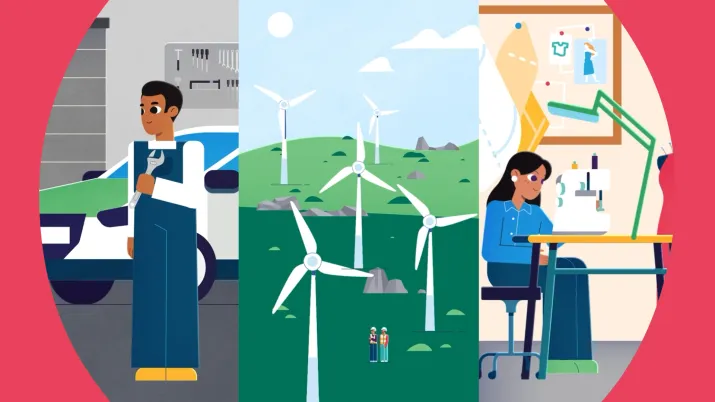
Economic and professional inclusion requires access to financial autonomy, through employment, business creation or participation in local economic dynamics. In particular, it includes training, skills development, access to opportunities and support in entering the labor market. However, when training for young people focuses solely on employability, they may go about their daily work without paying much attention to the social and environmental issues that affect their employment. They might even act in ways that could exacerbate these issues.
Social and civic inclusion considers young people as fully-fledged members of society, endowed with rights and responsibilities. It encompasses education, health, equity, social justice, gender equality and participation in civic, social and political life.
Environmental and climate inclusion refers to involving young people in global issues such as sustainable transitions, the preservation of natural resources and environmental justice.
These three dimensions only make sense when viewed as parts of a whole. Sustainable economic integration, for example, means that young people can exercise their rights, have a say in decisions that affect their lives and take advantage of the opportunities presented by the green transition. Conversely, civic engagement or climate action is harder to sustain when they have no prospects for financial autonomy.
This fairly recent concept of integral inclusion is already being put into practice through various development projects financed by AFD, notably through its CSO-I mechanism.
JADE: Empowering young people as agents of change
Led by the international NGO Gret, the JADE program for “Young People as Stakeholders in the Future” aims to support youth involvement in ensuring integral inclusion, across several pilot countries in Africa, Asia, and Haiti.
The first phase of this program ran between 2020 and 2023 and helped over 13,000 people – nearly half of whom were young women – to find sustainable employment, both from a social and environmental standpoint. An additional 5,600 people were targeted by awareness campaigns on social, civic and environmental issues, and several dozen local initiatives were supported.
For example, in the Democratic Republic of Congo, the Jagov project has set up a certified training program for waste pre-collection operators, which covers technical, social and environmental skills. The young people trained are now active participants in the circular economy and the sustainable transition in their local areas, whether addressing social, economic or environmental issues.
Launched in 2024, the program’s second phase is continuing this work with several thousand young people. In Cambodia, where many young people migrate to cities and abroad, the Esypa project, implemented over 18 months in the Siem Reap province, aims to empower young women and men and encourage active civic engagement in rural areas.