Share the page
From local venues to screens worldwide, Africa’s cultural industries are booming
Published on
The Africa Forward summit, co-organized by France and Kenya on 11–12 May in Nairobi, will highlight the dynamism of the cultural and creative industries (CCIs). In a chapter devoted to this sector in the collective work "L’économie africaine 2026" (African economies 2026), researchers show that behind this momentum lie ongoing challenges related to structuring value chains and ensuring fair remuneration for artists.
African cultural productions have achieved unprecedented visibility. Among the examples: The Senegalese TV series “Mistress of a Married Man” attracts millions of viewers on television and is widely commented on YouTube. Nigerian Afrobeat and South African Amapiano pieces created in home studios are establishing themselves on worldwide playlists. The Cannes Film Festival screened a record 15 African films in 2023. And, defying global trends, the number of cinema screens in Nigeria increased by more than 80% between 2018 and 2024.
But the African CCI sector has not suddenly appeared out of nowhere. Rather, this new visibility is the sign that its long-standing vitality has finally been recognized. “The global circulation of African cultural production had often slipped under institutional radar, but digital technology has now made it visible, measurable, and comparable,” says Alessandro Jedlowski, anthropologist and co-author of the chapter on the sub-Saharan musical and audiovisual industry in L’économie africaine 2026. This chapter, co-written with anthropologist Jaana Serres and AFD Research Officer Audray Perraud, analyzes long-standing national and translational dynamics based on ethnographic surveys conducted in Nigeria, Côte d’Ivoire, Senegal, and the Democratic Republic of the Congo.
Nollywood goes digital
The authors show that music and cinema have developed in contexts marked by weak infrastructure, limited access to equipment, and the domination of international players. Creators have dealt with these constraints by inventing flexible, fast, and often informal economies rooted in popular usage. A good example is Nollywood. Cinema closures and the collapse of traditional channels gave rise to Nigerian cinema, which has relied on video production, with films produced in a few weeks and distributed first by cassette and then DVD. Long disregarded internationally, it first established itself as a mass industry on the domestic market before reaching broader distribution via digital platforms. Today, CCIs account for about 6% of jobs in Nigeria.
In music, digital technology has enabled repertoires sung in local languages to reach audiences far beyond the continent. “Diasporas play a central role and are often a first market and an opportunity for recognition,” says Alessandro Jedlowski.
AFD works to meet these challenges via the projects it supports. In Ghana, a program launched in 2023 is promoting copyright proceeds and revenue capture in the music industry. It has conducted awareness campaigns reaching tens of thousands of professionals and trained 22 entrepreneurs. A study was also carried out to transform the Accra’s Round Pavilion into a location dedicated to music distribution.
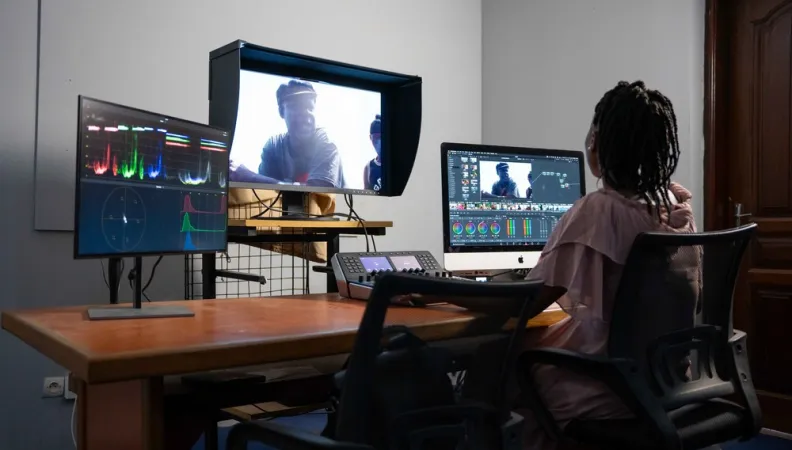
Meanwhile, in Senegal the Kourtrajmé Dakar school, Centre Yennenga Center, and CINEKAP are training young screenwriters, directors, post-producers, and producers and supporting them in their professional integration. And a project to safeguard and promote Senegalese audiovisual heritage is bringing together public institutions and the National Audiovisual Institute (INA) in an effort to sustainably strengthen local skills in the archiving, documentation, and transmission of images, and to reintegrate these resources into the contemporary dynamics of creation.
Cultural sovereignty and economic fragility
While production tools have become more democratic, distribution remains concentrated in the hands of a few global platforms that impose formats and economic models. These arrangements bring up the issues of dependency and cultural sovereignty once again. “Historically, narratives about Africa were widely produced and disseminated from outside the continent. But in Africa since independence, artists and intellectuals have tried to reclaim the African narrative,” says Alessandro Jedlowski.
The copyright issue remains critical. For a long time, many African musicians recorded in Europe so that they could rely on copyright systems deemed more reliable than those of their countries of origin. Even today, the situation is one of contrast. In Côte d’Ivoire, the mechanisms in place work only partially. In Nigeria, a national copyright commission exists for cinema, but resources to fight piracy effectively are lacking. This fragility explains the key role of live performances as the main source of income.
African creation has found its audiences. The challenge is now to develop the economic, legal, and institutional frameworks that can enable it to endure and to remain in control.
Discover the AFD Group program at the Africa Forward summit and follow the sessions live.

Retrouvez ici et en direct la session Sport for Sustainable Investment,
le 11 mai de 14h00 à 15h00 (heure de Nairobi, Kenya)
(Les sous-titres en français sont activables dans le player vidéo en haut à droite)
Read also
"Cultural and Creative Industries Promote Employment and Social Cohesion"
Published on October 3, 2023