
Share the page
Democratic Republic of the Congo
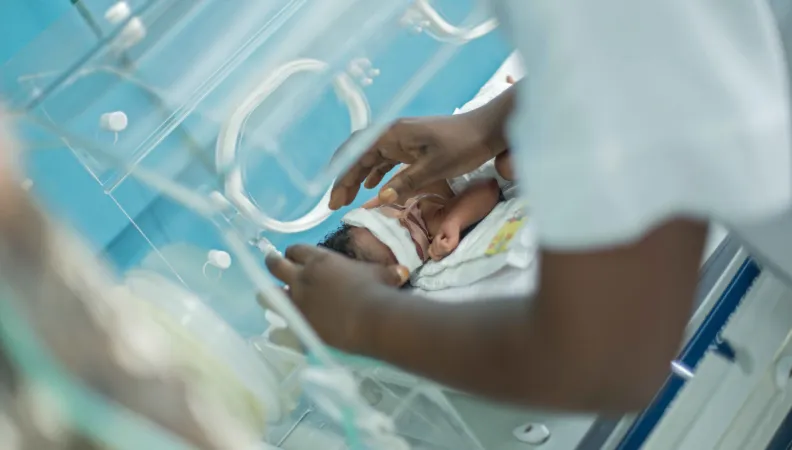
With a population of more than 110 million and borders shared with nine countries, the Democratic Republic of the Congo (DRC) is Africa’s second-largest country and the world’s largest French-speaking country. Thanks to its extensive mineral resources, the DRC recorded strong growth of close to 7% in 2024, although it remains highly dependent on commodity prices. However, this growth remains largely non-inclusive, with more than 60% of the population living below the poverty line. With a GDP of USD 70 billion in 2024, or around USD 650 per capita, the DRC is classified among the least developed countries (LDCs) and ranks among the five poorest countries in the world.
Context
The Democratic Republic of the Congo has substantial natural capital, positioning it as a “solution country” for achieving carbon neutrality by 2050, but it continues to face significant economic and social fragilities. In 2020, it ranked 175th out of 189 on the Human Development Index, with 73.5% of the population living below the poverty line in 2025.
The country faces major governance challenges, including weak institutions, systemic corruption, and fragile public financial management, which constrain economic development. In addition, the economy remains poorly diversified and relies heavily on the mining sector (one-third of GDP). It is constrained by a challenging business environment and limited infrastructure, particularly in energy, transport, water and sanitation, as well as in essential services such as education and health.
The agricultural sector, which accounts for 20% of GDP and employs most of the workforce, remains underexploited despite 80 million hectares of arable land, a dense hydrographic network, and favorable climate diversity. Although considered the world’s seventh-largest potential agricultural power, the DRC does not yet produce enough to feed its population.
Present in the DRC since 1976, AFD suspended its activities between 1991 and 2004 due to political crises before resuming operations with a grant-based model. In 2013, the signing of the first Debt Reduction and Development Contract (C2D) for €106.4 million marked a key milestone.
Since 2019, the strengthened partnership between France and the DRC has led to a significant acceleration of AFD Group activities: signing of a second C2D for €64.9 million in 2019, a fivefold increase in grant volumes since 2018, the resumption of concessional sovereign loans in 2022, the opening of an Expertise France office in 2022, and the expansion of Proparco’s activities. These activities are governed by a Memorandum of Understanding signed in December 2021, targeting €500 million in Group commitments over the 2022–2025 period. By the end of 2024, this target had already been exceeded, with cumulative commitments reaching €558 million.
AFD Group supports the DRC in promoting inclusive and sustainable economic and social development.
AFD’s strategy for 2022–2026 is structured around five main priorities:
- improving access to essential services,
- strengthening human capital and promoting balanced territorial and economic development,
- protecting and enhancing natural capital,
- placing young people and women at the center of development,
- strengthening the role, capacity, and resources of institutions.
These priorities are supported by two cross-cutting objectives:
- supporting a sustainable economic pathway aligned with the Paris Agreement on climate,
- reducing inequalities and vulnerabilities across ecosystems and communities.
AFD’s interventions also support the priorities set out in the Government Action Plan for 2024–2028.
AFD’s office in the DRC has been informed about a number of phone calls, messages over the internet (mainly through social networks) and fraudulent e-mails in the name of AFD, its directors and staff, using the AFD Group logo, to obtain money from individuals by promising a loan or a job in return for the payment of administrative fees.
AFD calls on both professional partners and individuals to be extremely vigilant, and to abstain from replying to any such requests, in particular concerning the services offered by the fraudulent platform “Crédit Mutuel AFD”.
We therefore encourage you to read the following page carefully: Fraud Alert
Our approach
AFD Group and the Democratic Republic of the Congo: Promoting inclusive and sustainable economic and social development
Development depends on equitable access to quality health care. A key priority of Franco-Congolese cooperation, AFD’s support to the health sector has increased since 2019, with the signing of a joint roadmap to combat epidemics. Projects aim to strengthen health systems, improve maternal and child health, and enhance epidemiological surveillance through laboratory networks, following a One Health approach. A gender perspective is integrated across all activities to sustainably reduce inequalities.
Following the introduction of free primary education in the DRC in 2019, AFD supports the authorities in addressing education quality challenges by reforming initial teacher training, including the construction of a pilot teacher training institute, the building of classrooms, and support for teacher retirements.
Building on its partnership with the Institut National de Préparation Professionnelle (INPP) since 2013, AFD supports the alignment of training programs with labor market needs and promotes agricultural and rural training through the GIFT project in Tshopo, implemented with ENABEL to encourage sustainable practices, support employment, and reduce gender inequalities.
Lastly, AFD is also active in higher education to modernize training programs in line with major government-led development projects, particularly in the energy sector, and to strengthen faculty capacity.
In the DRC, addressing urban challenges is essential to improving daily life. In this context, AFD supports the city of Kinshasa through the TO PETOLA project (“cleaning up together”), which works with civil society on waste pre-collection, sorting, and reduction, while strengthening local capacity to maintain roads, riverbanks, and drainage systems. More than 80,000 residents vulnerable to flooding benefit from the project in the N’danu, Salongo, and Abattoirs neighborhoods. The project also supported health facilities in response to COVID-19.
The Pour Elles: Women’s Entrepreneurship project, financed by AFD and implemented by Expertise France under the Choose Africa initiative, promotes women’s economic empowerment in Kinshasa by combining business support, access to finance, and the mobilization of local stakeholders to strengthen an inclusive and innovative ecosystem.
To improve the quality of life and well-being of young women through sports and cultural activities, the Pour Elles: Sport and Culture project is rehabilitating six sports facilities in Kinshasa, supporting creative spaces, and strengthening more than 200 local actors. It provides over 3,000 beneficiaries with access to sports and cultural opportunities, while raising awareness of health and gender-based violence.
Lastly, in Boma, AFD supports a pilot sustainable city initiative aimed at developing infrastructure to:
- adapt the city to climate change challenges, particularly flooding,
- enhance Boma’s attractiveness (roads, water, heritage) and support its economic development,
- provide local authorities with territorial planning tools.
Strengthening financial governance and increasing domestic revenue mobilization (DRM) are critical challenges in the DRC to enable authorities to finance social spending and the investments needed to achieve more inclusive growth and reduce poverty. Increasing DRM is also one of the three priority pillars of the program agreed with the International Monetary Fund (IMF) under the Extended Credit Facility. It is also a priority of the partnership between the DRC and the European Union under the Team Europe Initiative “Governance, Peace and Security” within the 2021–2027 Multiannual Indicative Program.
Cooperation between the Ministry of Finance and AFD on financial governance has led to the development of the Support Program for Domestic Revenue Mobilization (PAMIR), financed under the two C2Ds with support from the European Union.
More broadly, AFD-funded projects aim to promote sound financial governance and ensure the financial sustainability of the infrastructure and systems they support.
Alongside the Ministry of Environment and Sustainable Development, AFD works to balance forest protection with local development. With support from the Central African Forest Initiative (CAFI), it implements the Programme de Savanes et Forêts Dégradées (Savannas and Degraded Forests Program), which promotes sustainable land-use practices in savanna and degraded forest areas to strengthen local economies, preserve forest landscapes, and reduce pressure on forest resources. Operating in the provinces of Kwilu and Tshopo, the program will support around 4,000 farmers in their agroecological transition.
AFD also supports the Government of the DRC in managing its forest resources. Together with CAFI, it supports the Programme de Gestion Durable des Forêts (Sustainable Forest Management Program), which aims to assist the DRC in developing and implementing its forest policy and thereby contribute to combating deforestation.
Lastly, the Avenir project (2023–2030), co-financed with the International Fund for Agricultural Development (IFAD), aims to strengthen food security and improve the supply of quality local food to the city of Kinshasa and four neighboring provinces by acting across the production, storage, transport, and distribution chain. Targeting nearly 2 million people, it aims to increase the incomes of 63,000 producers by 30%, improve the nutrition of 50,000 households, modernize 21 markets, and rehabilitate 670 km of rural roads and 15 river ports. The project contributes to food security, job creation, and climate action, while integrating gender, youth, nutrition, and inclusion considerations.
AFD supports major spatial planning projects and the development of digital, energy, and transport infrastructure to drive economic growth.
For example, the Tu Tokeshayi Kabinda project, co-financed by AFD and the World Bank under the AGREE program (2022), aims to expand access to electricity through mini-grids in Mbuji-Mayi, Kananga, and Kabinda, using a public-private partnership model in which the private sector is responsible for construction, operation, and maintenance. The project supports economic and agropastoral growth in Kabinda, improves access to sustainable electricity for more than 250,000 people, and supports sector reforms.
In a Team Europe approach with the European Union, AFD is currently preparing a project to supply electricity to the city of Kisangani. The project aims to increase generation capacity through the rehabilitation of the Tshopo power plant (20 MW) and the addition of a 5 MWp solar facility, while promoting a public-private partnership model for electrification.
In coordination with the European Union, AFD is also assessing a road project within the Global Gateway priority corridor No. 6 “Douala–Kribi–Kampala” (Cameroon, Central African Republic, Democratic Republic of the Congo, Uganda). The project involves developing a transport corridor (roads, bridges, rural tracks, and ports) linking Bangui in the Central African Republic to Zongo in the DRC, then to Gemena and Akula – potentially extending to Lisala on the Congo River – over a total distance of approximately 400 to 550 km, connected to the river transport network of the affected provinces.
Lastly, a digital transformation project co-financed with the World Bank includes the deployment of 10,000 km of fiber-optic backbone and digital skills training, with a focus on women’s inclusion. It aims to provide 30 million people with access to affordable, high-quality internet, a key condition for developing digital services and innovation.
In the field
Projects


News & Press Releases
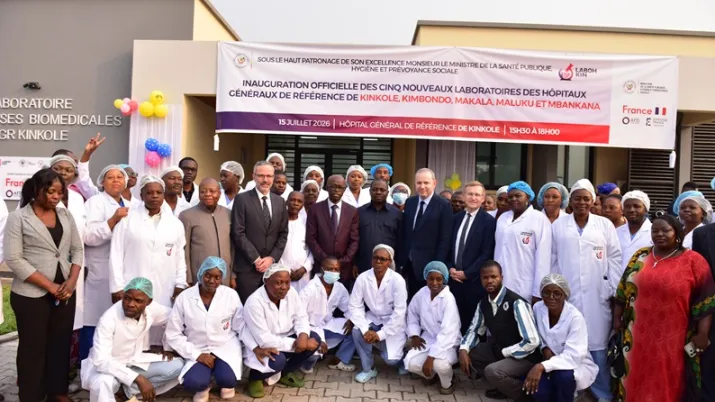
DRC: AFD Group strengthens regional and global health efforts against Ebola
Published on July 22, 2026
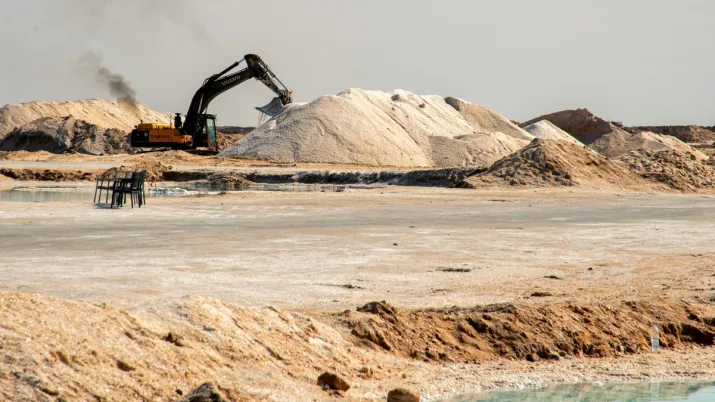
From local venues to screens worldwide, Africa’s cultural industries are booming
Published on May 7, 2026

Key figures
-
€558 million committed by AFD between 2022 and 2025 under the memorandum of understanding signed with the DRC
-
1,240 classrooms built in the provinces of Kinshasa, Bandundu, and Bas-Congo
-
€60 million euros of projects currently implemented by Expertise France in the sectors of health, entrepreneurship and security