Share the page

Livable, Resilient and Water-Secure Cities Investment Program – Phase 1
Project

-
Project start date
-
Status
Ongoing
-
Project end date
-
-
Project duration
-
20 years
-
AFD financing amount
-
€ 120 000 000
-
Country and region
-
Location
-
Cambodia
-
Type of financing
-
Beneficiaries
-
Kingdom of Cambodia
This program will run for twelve years (2026–2038) and is structured into four phases. The first phase aims to improve life for nearly 600,000 people by developing strategic spatial and land use plans and tools, expanding access to clean water, modernizing sanitation systems, and enhancing waste management for healthier, more sustainable cities.
Context
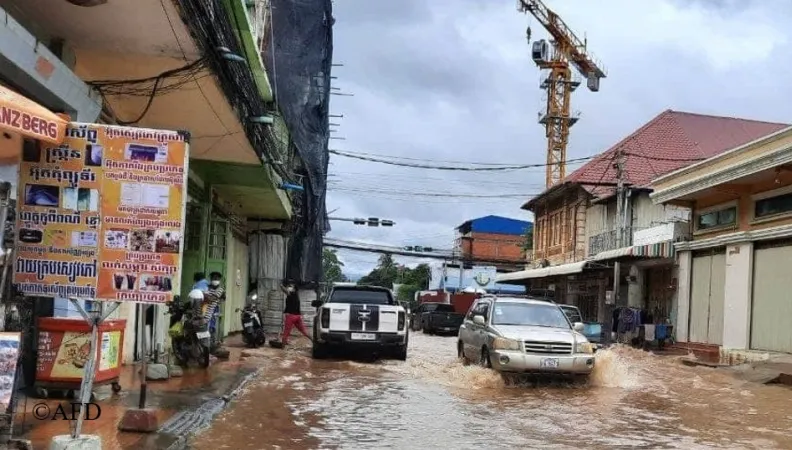
Cambodia is one of the world’s most climate-vulnerable countries, ranking 12th in the 2020 World Risk Index. Each year, about 4.4 million people are affected by floods, droughts, storms, and heatwaves. Without stronger climate planning, annual flood-related losses could reach USD 10.6 billion by 2050.
Rapid urbanization — from 35% in 2023 to an expected 60% by 2040 — is putting pressure on essential services such as water supply, sanitation, drainage, and waste management. This increases pollution, health risks, and social inequalities, especially in fast-growing secondary cities. Key ecosystems like Tonlé Sap, the lower Mekong, and coastal areas are under growing stress. Women and vulnerable households are the most affected.
The key challenge is to safeguard people and ecosystems while guiding urban growth through climate-resilient investments and risk-informed planning. To address these challenges, AFD is partnering with the Asian Development Bank (ADB) in designing a program that will strengthen the resilience of Cambodia’s secondary cities and foster a more sustainable future.
Description
This program will run for twelve years (2026–2038) and is structured into four phases. It aims to strengthen urban and water resilience across 14 cities and 12 districts, benefiting around 2 million people.
The first phase will be implemented from 2026 to 2032 and will cover 10 cities and 2 districts: Kampong Chhnang, Pursat, Battambang, Serei Saophoan, Stung Saen, Kampong Cham, Kratie, Stung Treng, Kampot, and Kep, as well as the districts of Kampong Siem and Prey Chhor in Kampong Cham Province.
It is structured around three components:
- Component 1 focuses on inclusive and climate-resilient urban planning and capacity building. It includes the development of spatial plans at national, regional and provincial levels, and cities’ land use plans. Furthermore, development and digitalization of land use platform and other essential instruments are also provided, along with capacity development to national and sub-national staffs.
- Component 2 finances climate-resilient urban infrastructure and the operation of services. It includes the rehabilitation of 135 km sewer/drainage/flood protection networks, the connection of 11 800 new households, and the construction of a new wastewater treatment plant of 2 200 m3/day capacity. Modernization and improvement of landfills, market rehabilitation and urban parks are also included in this component. Technical assistances are provided to ensure the implementation and the sustainability at operational stage.
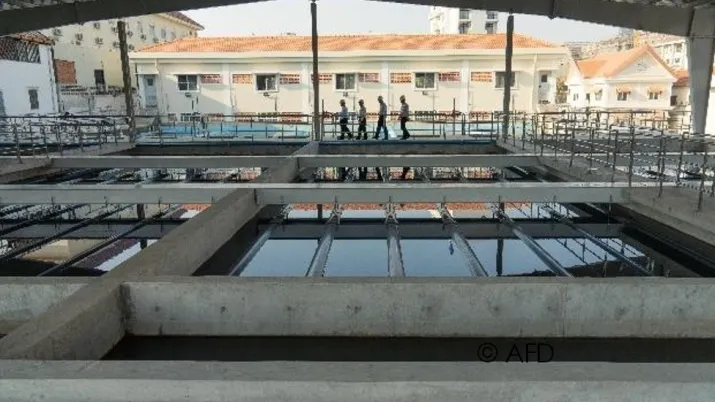
- Component 3 focuses on drinking water and water resilience. It includes the construction of one water treatment plants with a capacity of about 50,000 m³ per day, 29 km of main pipelines, and around 24,500 household connections, etc. Same as component 2, Technical assistances are also provided to ensure the implementation and the sustainability at operational stage.
The first phase of the program is co-financed by the ADB and AFD, taking the form of a sovereign loan to the Kingdom of Cambodia. The total cost of this phase amounts to €295 million, including $22.6 million self-financed by the Kingdom. AFD will provide a €120 million concessional loan, disbursed in two tranches of €60 million each, with the first tranche scheduled for 2025.
Impacts
This first phase will tangibly improve the quality of life for nearly 600,000 people by expanding access to safe drinking water, modernizing sanitation networks, and strengthening solid waste management. These investments will directly support public health, help reduce waterborne diseases, and lessen social inequalities — especially for women and vulnerable communities living in fragile urban areas.
The program will also generate major environmental and climate benefits, with an estimated reduction of 3,623 tonnes of CO₂-equivalent per year. Furthermore, 40% of the total investment qualifies as biodiversity financing, and 69% is aligned with climate adaptation objectives. Finally, it will deliver lasting institutional impacts by strengthening urban governance, territorial planning, and local capacities for infrastructure management and maintenance.