
Share the page
Morocco
Since 1992, Kingdom of Morocco has been a major partner of Agence Française de Développement (AFD). The Kingdom’s New Development Model (NDM), published in 2021, guides AFD’s operations in supporting the achievement of the Sustainable Development Goals (SDGs), helping Morocco adapt to climate change, and reducing inequalities. These operations support a broad range of stakeholders – including public sector actors, institutions, and civil society organizations – across Morocco.
Context
For the past two decades, the Kingdom of Morocco has pursued both a process of political, economic, and social modernization and a strategy of international openness and Euro-Mediterranean integration, supported by the country’s strategic geographic location.
Driven by a policy focused on economic diversification, high levels of investment, growing international attractiveness, and integration into global value chains, Morocco’s per capita income increased 3.5-fold between 1990 and 2024. Extreme poverty fell from 11% in 1990 to 0.3% in 2022, while access to essential public services has been extended to nearly the entire population.
In addition, the NDC 3.0 published at the end of 2025 confirms stronger climate ambitions, particularly in emissions mitigation and the energy transition. Key commitments include reducing greenhouse gas emissions by 53% by 2035, tripling renewable energy capacity by 2030, and announcing a conditional phaseout of coal by 2040.
However, economic growth (2.8% in 2024) remains insufficient to generate enough jobs. Income, gender, and territorial inequalities remain high, while the inclusion of young people in society continues to be a major challenge.
The country is also highly exposed to the effects of climate disruption, with increasingly severe droughts and more frequent extreme weather events, including heat waves and floods. Efforts to accelerate adaptation and mitigation are focused on combating desertification and drought, improving water management, and supporting the transition to a low-carbon energy system.
AFD Group’s Strategic Intervention Framework (2022–2026) in Morocco supports the country’s national ambitions and is aligned with the strategy of the French Embassy in Morocco.
AFD Group’s operations are structured around four objectives:
- Private investment and entrepreneurial initiatives,
- The socioeconomic inclusion of young people and women through human development,
- The decarbonization of the economy,
- The ecological and social resilience of territories.
Three cross-cutting objectives are also pursued:
- Strengthening the territorial dimension of public policies and citizen initiatives,
- Supporting experimentation and innovation – including through civil society and the diaspora –
- Promoting co-investment in Africa.
AFD’s Morocco office reports to the North Africa Regional Department.
Our approach
AFD and Morocco: supporting the transition to the New Development Model
The New Development Model (NDM) sets out a long-term roadmap to strengthen human capital, reduce inequalities, and support more inclusive growth. This momentum is accompanied by major reforms, including the expansion of social protection coverage, the modernization of public action, and the further implementation of advanced regionalization. In line with its systematic search for synergies across the Group, AFD supports this strong national momentum.
Despite significant progress, the Kingdom of Morocco still faces high levels of inequality in 2026, affecting access to healthcare, employment – particularly for young people and women – and education, with around 300,000 students leaving school early each year.
In response to these challenges, AFD supports several of the Kingdom of Morocco’s priority reforms. Since 2021, AFD and Expertise France have supported the expansion of mandatory health insurance coverage, particularly for self-employed workers and vulnerable populations. In partnership with France Éducation international, AFD has also supported the rollout of the pioneer middle school reform since 2023. According to a 2025 evaluation conducted by the Morocco Innovation and Evaluation Lab, the program has tripled student learning outcomes and reduced school dropout rates by one-third.
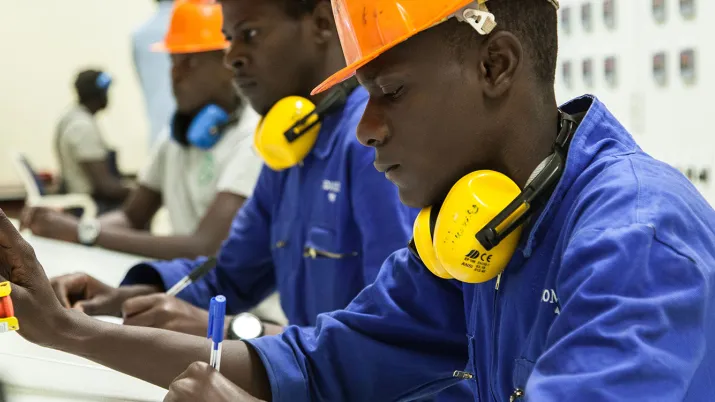
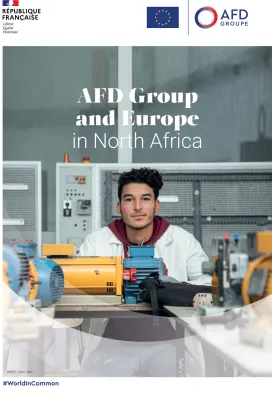
AFD also supports vocational training and youth economic inclusion programs through assistance to several delegated-management training institutes operating in strategic sectors such as aeronautics, the automotive industry, renewable energy, and the pharmaceutical industry.
Lastly, as part of Morocco’s ambitious national gender equality policy, AFD works in partnership with UN Women to support measures aimed at strengthening women’s economic empowerment and ensuring that public spending benefits women and men equally.
AFD supports Morocco’s ambition to decarbonize its economy by reducing greenhouse gas emissions while promoting renewable energy and energy efficiency. To this end, AFD supports major companies in implementing decarbonization and environmental transition strategies. Financial and technical support – with assistance from Expertise France – is also provided for the green budgeting reform led by the Ministry of Economy and Finance, which aims to align public spending with environmental and climate objectives.
To promote sustainable urban development, AFD supports low-carbon transport systems, including the Rabat and Casablanca tramway networks, which carry 450,000 passengers per day, the Tangier–Casablanca high-speed rail line, and the Agadir bus rapid transit (BRT) system. Through these investments in urban mobility, AFD intends to continue supporting Morocco’s investment strategy.
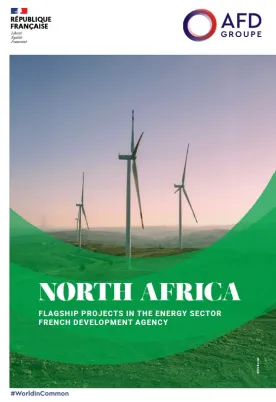
AFD has also supported the Noor Solar Plan, which aims to increase the share of renewable energy in the electricity mix to 52% by 2030, through the co-financing of several solar power plants, including Ouarzazate I and III. Research and development projects in the green hydrogen sector are also receiving support.
Lastly, AFD is helping strengthen skills and human capital by supporting the creation of vocational training institutes specializing in renewable energy and energy efficiency (Instituts de formation aux métiers des énergies renouvelables et de l’efficacité énergétique – IFMEREE).
The Kingdom of Morocco is being affected by the impacts of climate disruption, particularly on water and food security. In this context, AFD supports the implementation of innovative solutions for rural development and the sustainable management of natural resources.
Territorial-level operations are reflected in the deployment of territorial approaches, including through financing for public policies such as the Generation Green 2020–2030 strategy alongside the European Union and the World Bank. AFD also works with a broader range of partners to support advanced regionalization through direct financing for regions and the Municipal Equipment Fund (Fonds d’équipement communal).
In the water sector, AFD supports the Kingdom of Morocco in implementing national and regional drinking water and sanitation programs. In particular, it works with the National Office for Electricity and Drinking Water (Office national de l’électricité et de l’eau potable – ONEE) as well as Regional Multi-Service Companies (Sociétés régionales multiservices – SRM) across several regions.
Because the resilience of territories and populations also depends on the resilience of ecosystems, AFD – through a partnership with the National Agency for Water and Forests (Agence nationale des eaux et forêts – ANEF) and Expertise France – is supporting the transition of the forestry sector.
AFD promotes an approach based on experimentation and shared innovation, bringing together public administrations, financial institutions, businesses, and civil society organizations. In 2026, AFD directly supports 33 projects led by around 100 Moroccan and French civil society organizations (CSOs), representing approximately €16 million in financing.
AFD Morocco also implements the AdaptAction program, which supports the implementation of Morocco’s Nationally Determined Contribution (NDC), particularly its climate adaptation component. From academic research and capacity building to improving access to financing, the program helps address tomorrow’s climate challenges.
In addition, several programs supporting Morocco’s major reforms include financing mechanisms for civil society initiatives. For example, under the IHYAE program linked to the Generation Green 2020–2030 strategy, calls for projects managed by the Agricultural Development Agency (Agence de développement agricole) support agroecology and agricultural entrepreneurship with funding totaling €9 million. The Kaddoussa program, implemented by the National Agency for the Development of Oasis Zones and the Argan Tree (Agence nationale pour le développement des zones oasiennes et de l’arganier – ANDZOA), finances territorial development and employment projects for a total of €2.9 million.
Lastly, under the Equality Support Program, AFD helped structure the co-BSG collective, which brings together associations involved in monitoring gender-responsive budgeting, in partnership with the Center of Excellence for Gender-Responsive Budgeting under the Ministry of Economy and Finance.
To increase its impact and finance large-scale investments, AFD works alongside other development partners such as KfW, the European Investment Bank, Cassa Depositi e Prestiti, and the World Bank. AFD also mobilizes funding from partners including the European Union and the Green Climate Fund.
In the field
Below, find the country's projects, news, publications, and contact details in one click.
Projects


News & Press Releases
Climate change: a MOOC for more sustainable construction in the Mediterranean
Published on September 7, 2026
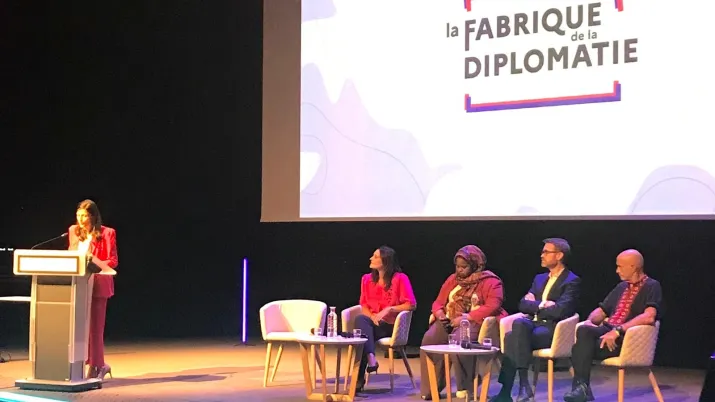
Development or climate action? Rethinking the choice at "La Fabrique de la Diplomatie"
Published on September 7, 2026

Publications & Media
Key figures
-
4 million people with access to improved drinking water service
-
450,000 people transported every day by tram in the cities of Casablanca and Rabat-Salé
-
36,000 young people trained at delegated management institutes over the past 15 years