Share the page
Development or climate action? Rethinking the choice at "La Fabrique de la Diplomatie"
Published on
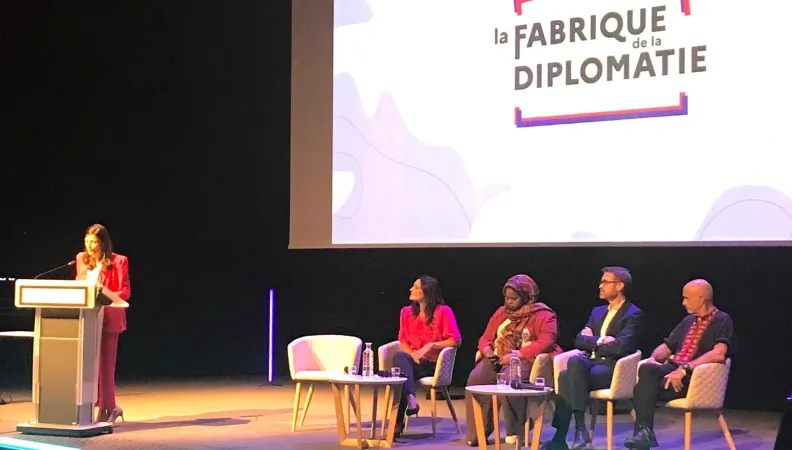
On 4 and 5 September 2026, AFD Group took part in the second edition of "La Fabrique de la Diplomatie" (the Fabric of Democracy) in Paris, organized by the French Ministry for Europe and Foreign Affairs to make France’s foreign policy and international engagement easier to understand. One conference posed a deliberately provocative question: “Climate or development: the energy dilemma?” A shared conviction emerged: far from being competing priorities, climate action and development are now inseparable.
A crowd gathers outside the auditorium at Sorbonne Nouvelle University, which soon fills with a particularly young audience attending La Fabrique de la Diplomatie. Among them are three Cameroonian international relations students in Paris who have come to hear what diplomats, activists, and development professionals have to say about global warming. One of them, already concerned about environmental issues, explains how the summer's heatwaves had further strengthened his beliefs: “If we reach a point where periods like this happen more and more often, it will become difficult to live.” For the next hour, the discussion in the auditorium focuses on the very real impact of climate change on development trajectories.
Climate action or development: do we really have to choose?
Three speakers with different backgrounds take the stage to explore what initially appears to be a contradiction: Nisreen Elsaim, a Sudanese climate activist and laureate of the Marianne Initiative; François Grünewald of Groupe URD, a specialist in evaluation and operational research in crisis settings; and Laurent Biddiscombe, Executive Director, Sustainable Development Solutions at Agence Française de Développement (AFD).
Opening the discussion, Éléonore Caroit, Minister Delegate for Francophonie, International Partnerships and French Nationals Abroad, has just returned from a visit to the Pacific islands, where Tuvalu’s vulnerability to rising sea levels gives the conference’s dilemma a very tangible dimension. Her answer is unequivocal: when it comes to climate action and development, “you can’t have one without the other.”
The question, then, is how to pursue both. Behind this broad consensus lie very different realities, starting with Sudan, which is facing a major humanitarian crisis. Drawing on the situation in her country, Nisreen Elsaim stresses the need to reduce emissions while investing in infrastructure that can withstand climate shocks. In a phrase that resonates with the audience, the young activist says she already feels like “a bad ancestor.” She advocates in particular for “nature-based solutions”, which draw on ecosystems to address climate challenges. She also calls for renewed attention to traditional knowledge and ways of building that are better adapted to ecosystems and generate fewer CO₂ emissions.

François Grünewald also grounds the debate in practical experience. He cites the example of a Colombian city destroyed in the Andes, where trees were used to stabilize riverbanks instead of concrete. This nature-based solution also created local jobs. And, as he points out, this kind of choice is by no means unique to distant contexts: similar debates are taking place in the Drôme region of France.
Despite the very different experiences and backgrounds of the speakers, a common thread gradually emerges: climate change is not simply another constraint to add to development priorities. It is reshaping the very conditions in which development takes place.
The financing challenge
One major obstacle remains: how to finance this transformation. As Laurent Biddiscombe points out, adapting to the impacts of climate change and transforming energy systems require considerable investment, particularly in countries that do not always have the financial room to make it.

The cases of Senegal, Morocco, and Kenya illustrate some of the main financing barriers. In Senegal, the debt crisis has constrained the country’s ability to borrow, even as it has committed to a Just Energy Transition Partnership (JETP), an international cooperation mechanism designed to help countries gradually transition away from fossil fuels.
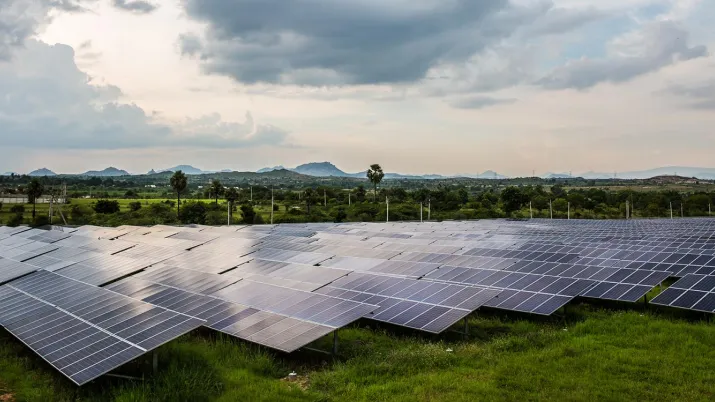
In Morocco, the pathways under consideration would require 12 to 15 years of very high levels of investment to shift to renewable energy. In Kenya, meanwhile, the cost of borrowing to finance a solar power plant can reach 9% to 10%, compared with 4% to 6% in France. In other words, the countries that need to invest heavily in their energy transition are sometimes those for which raising the necessary capital is most expensive.
This is where a public development bank such as AFD has a key role to play. The aim is not simply to finance lower-emission infrastructure, but to support development pathways that can withstand the impacts of climate change that are already being felt. Laurent Biddiscombe emphasizes that solutions cannot be developed by funders and governments alone. They must also be shaped on the ground, with businesses, banks, consumers, and civil society.
In South Africa, for example, gradually phasing out coal also means supporting mine workers as they transition to new jobs, illustrating how the energy transition is also a social transition.
Financial tools themselves must evolve. As grants become scarcer, Laurent Biddiscombe stresses the need to target them more effectively. He also points to new mechanisms such as debt swaps, which convert debt to free up resources for climate projects.
From Kenya to France, the same challenge
As the discussion progresses, the dilemma posed in the conference title begins to fade. Despite their different perspectives, the three speakers reach the same conclusion: development can no longer be considered without taking climate change into account, or its impacts risk undoing the progress already made.
Laurent Biddiscombe sums it up: “Pitting climate action against development makes no sense: if we fail to address the urgency of climate change, development itself is at risk.”
The heatwave mentioned before the auditorium opened echoes the situations discussed on stage and ultimately reframes the question posed an hour earlier. The issue is no longer climate action or development, but rather: what kind of development is possible in a rapidly warming world?