Share the page
PETTAL: structural initiatives to transform agroecology education
Published on
As part of the PETTAL project, supported by the Academia Partnerships Africa-France program, the University of Sine Saloum El-Hâdj Ibrahima Niass (USSEIN) in Senegal and the Institut Agro Montpellier in France have, since 2021, been developing professionally oriented training programs in agroecology and sustainable food systems at USSEIN, from bachelor’s to PhD level. On completion of its five-year implementation, the project has introduced several structural and innovative initiatives designed to boost the students’ skills and facilitate their entry into the workforce.
In this interview with Dr Sidy Diakhaté, PETTAL project advisor, and Djibril Thiam, project leader at the Institut Agro Montpellier, we focus on two of these initiatives: USSEIN’s integrated educational farm, which offers an effective space for experimentation and support for entrepreneurship, and the student mobility scheme to leverage a broader academic and professional experience.
Why was the educational farm needed, how does it operate and in what way is it a tool for enhancing the students’ professional skills?
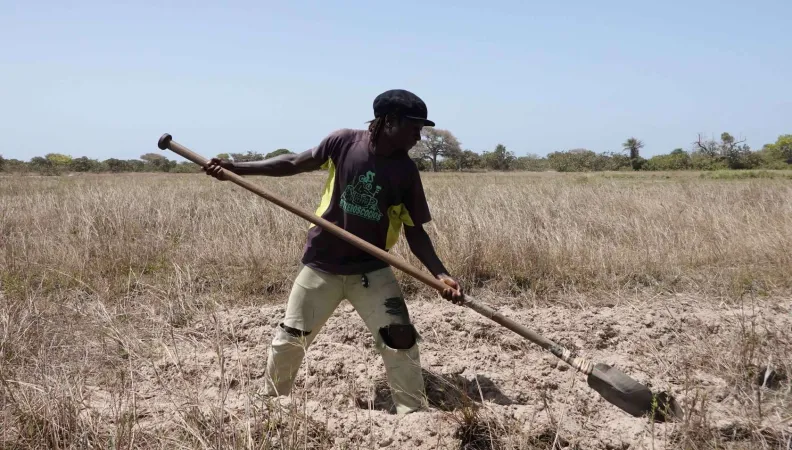
Dr Sidy Diakhaté: The creation of the educational farm was a strategic milestone for PETTAL, requiring a clear vision, targeted investments and close coordination between the technical teams, faculty and partners such as AFD. It involved rehabilitating existing infrastructure, such as the 750 m2 propagation greenhouse, building a 3,000 m2 greenhouse, a borehole, and a rearing pen, as well as the purchase of equipment such as a tractor and a composting platform. Today, the farm’s plant production section is operational, with field crops and the production of chilies and peppers in the greenhouse. Moreover, the farm is an educational tool that gives the students a hands-on learning experience to try out different production methods, analyze results and develop practical skills. They play an active role and are involved in the day-to-day management and decision-making. A pilot agricultural site will also be created so that students and young people from the community can test their projects before implementing them. As a result, the farm is becoming an open-air laboratory, combining theory and practice, and preparing future professionals able to innovate in response to the current challenges facing the agricultural sector.
PETTAL has also introduced a mobility scheme enabling students to study at the Institut Agro Montpellier. How is it organized and what role does it play for the students?
Djibril Thiam: The mobility scheme that enables our students to enroll in the Master of Science and Technology in Agronomy and Agrifood Science at Montpellier is based on a rigorous selection and support process. The project provides the selected students with financial support for their administrative steps, academic preparation and settling in France. In Montpellier, they study in an international environment that includes lessons, fieldwork, group projects and long-term internships, giving them real on-the-job immersion. Beyond the academic framework, this mobility also helps to structure their professional future: international exposure, autonomy, the ability to analyze and synthesize, access to scientific and professional networks.
These achievements have been designed to continue beyond the project. How do you see this happening?
Dr Sidy Diakhaté: From the outset, the design of the PETTAL project had already planned for the long-term sustainability of its achievements beyond the PeA funding window. The mobility program is set to continue via schemes such as AgreenMob/Erasmus+. The USSEIN–Institut Agro partnership will also provide for the long-term mobility of USSEIN students to Montpellier, with the prospect of extending this to a two-way exchange. Furthermore, the continuity of the MOOC “Agroecology in West Africa” will help to maintain access to innovative educational resources. In parallel, framework agreements signed between the partner institutions will ensure that ongoing collaborations are sustained long term beyond the end of PETTAL. Lastly, the investments made, the enhanced skills of USSEIN’s teaching staff and the involvement of the professional partners will ensure that the actions launched by the project will continue over time.
Read more
Strengthening biodiversity cooperation between India and Southern Africa
Published on November 26, 2025

Africa–France academic partnerships (PeA) program: Five new recipients
Published on December 12, 2025