Share the page

Reducing Food Insecurity and Undernutrition with the Electronic Vouchers Project - Walang Gutom
Project

-
Project start date
-
Status
Ongoing
-
Project end date
-
-
Project duration
-
15 years
-
AFD financing amount
-
€ 200 300 000
-
Country and region
-
Location
-
Philippines’ 10 poorest region
-
Beneficiaries
-
The Republic of the Philippines
-
Type of beneficiary
-
State
Providing nutritional support to food-insecure households, preventing child malnutrition, and contributing more specifically to strengthening adaptive social protection in a context of increasing climate vulnerability.
Context
Malnutrition remains a major issue in the Philippines, affecting 75 million people. Nearly one in three children under five suffers from stunting and wasting. Micronutrient deficiencies, overweight, and obesity are worsening, impacting learning, health, and perpetuating poverty. The total cost of child undernutrition to the Philippine economy is estimated at 1.5% of the country's GDP.
This is further worsened by the severe impact of climate change. Ranked as the most at-risk country in the world in 2024, the Philippines experiences an average of 20 typhoons per year, severely affecting millions of people – particularly the poorest and most vulnerable. Households that rely directly on natural resources are seeing their livelihoods increasingly threatened by recurring disasters and rising temperatures, which lead to decreased agricultural and fishing productivity, as well as higher food prices.
Description
In response to these challenges, the President of the Philippines announced in July 2022 the launch of Walang Gutom 2027 (“Zero Hunger 2027”), a program designed and implemented by the DSWD to provide food and nutritional assistance to the most vulnerable Filipino households in order to reduce food insecurity and enhance climate resilience. This project aligns with the political priorities of the Philippine government. Combating food insecurity and malnutrition is identified as a key priority in the Philippine Development Plan (PDP) 2023–2028, which led to the development of the government’s Social Protection Plan (PSPP) 2023–2028.
The project is structured around two main components:
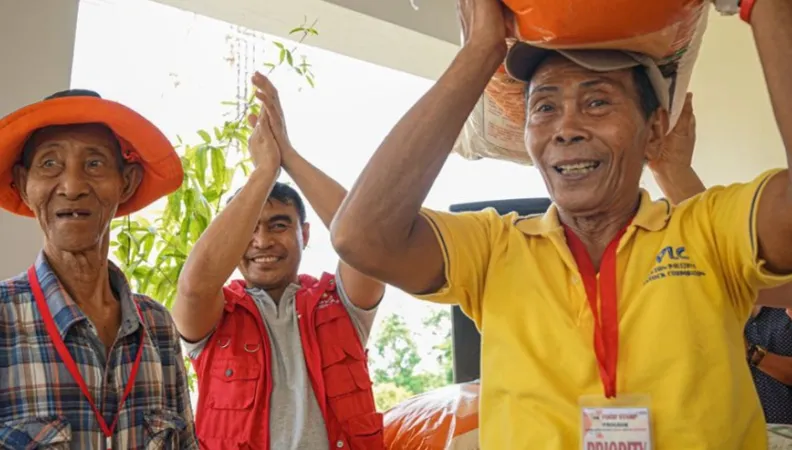
(i) the distribution of electronic food vouchers to the poorest food-insecure households;
(ii) monthly nutrition and productivity enhancement education sessions, the later providing skill-building support to improve employment access.
These social behavioral change sessions are especially important as the project directly addresses gender issues – particularly targeting pregnant and breastfeeding women – as well as social inclusion challenges, by tailoring the program to effectively reach indigenous populations.
Impacts
By 2027, the project aims to achieve three specific objectives:
- Provide assistance to 750,000 families in the form of monthly food vouchers, granting access to nutritious food for three years, sourced from pre-identified and accredited retailers.
- Support the institutional capacity of the DSWD and its national and regional teams, in collaboration with local government units, to implement a national program that is inclusive, climate-resilient, gender-sensitive, and adapted to the needs of indigenous populations.
- Strengthen systems and operational processes for managing, monitoring, and evaluating the food voucher program using measurable performance indicators, validated through impact assessments:
- At least 10% increase in average per capita monthly food consumption among program beneficiary households.
- At least 50% of beneficiaries report consumption of at least 5 recommended food groups in the previous day or night within the household.
- At least 60% report a reduction in household hunger or food insecurity.
- At least 70% of women beneficiaries report one of the following: (i) increased nutrition knowledge; (ii) adoption of healthier dietary practices, including increased consumption of diverse food groups; and (iii) increased agency for household decision-making