Share the page


Supporting the Philippines in its climate commitments
Project

-
Project start date
-
Status
Ongoing
-
Project end date
-
-
Project duration
-
10 ans
-
AFD financing amount
-
€ 250 000 000
-
Global financing amount
-
€ 917 000 000
-
Country and region
-
Location
-
Philippines
-
Beneficiaries
-
Government of the Republic of the Philippines
-
Type of beneficiary
-
State

As a country particularly vulnerable to climate change, the Philippines has set ambitious targets under the Paris Climate Agreement. AFD supports the country in its reforms to achieve low-carbon, resilient and inclusive development.
Context
The Philippines is particularly vulnerable to the impacts of climate change. Without intervention, economic damage from climate change could reach up to 13.6% of GDP by 2040. The agriculture and natural resources sectors, which are vital to the Philippine economy, are highly exposed to the impacts of climate change. Despite technological advances in recent decades, agricultural productivity remains dependent on climate conditions. The energy and transport sectors account for 56% of the country’s emissions, and fossil fuels supplied 79% of electricity production in 2020. Accelerating renewable energy development is essential for energy self-sufficiency, reducing dependence on fossil fuels and mitigating greenhouse gas emissions. In this context, the Philippine government reaffirmed its commitment to sustainable and inclusive economic development by submitting its first Nationally Determined Contribution (NDC) to the United Nations Framework Convention on Climate Change (UNFCCC) in April 2021.
Description
The Climate Change Action Program (CCAP) was launched in 2021 at the request of the Philippine government. It supports the key policies and institutional reforms needed to implement the NDC.
The program aims to accelerate these reforms and improve their quality. It combines budget support, paid into the State budget, with a technical cooperation program. A policy design and monitoring framework (PDMF) sets out three priorities:
-
Strengthening planning, financing and institutional links for climate action;
-
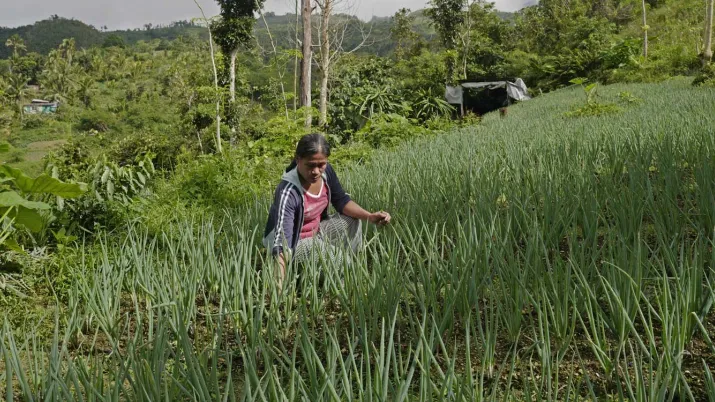
Strengthening the resilience of populations and ecosystems to the impacts of climate change, through adapted agricultural practices and improved natural resource management;
-
Mitigating greenhouse gas emissions from the energy and transport sectors.
AFD, ADB and JICA will each provide the Government of the Philippines with a policy-based loan of €250 million, €449.115 million and JPY 35 billion (approx. €218 million) respectively. These loans will be complemented by grants for a technical cooperation program. To this end, AFD plans to strengthen existing collaborations and mobilize new resources (€500,000 under FAPS and €500,000 under FEXTE).
Impacts
The program aims to accelerate the implementation of priority reforms to tackle climate change, while promoting social inclusion. These reforms should place the Philippines’ economic growth on a green and inclusive trajectory by fostering a lower-emission economy. They also aim to reduce social disparities by improving the resilience of rural populations to climate change and by addressing gender inequalities.
Integrating climate considerations into natural resource management policies will help reduce inequalities related to resource use and improve the quality of ecosystems by reducing pressure on natural environments.
The program intends to have an impact on governance frameworks, by institutionalizing climate action within ministries and local governments, as well as on regulatory frameworks and funding mechanisms. By combining the mobilization of public and private financial actors with public policy dialogue, the program will contribute to the country’s low-carbon trajectory, to be reaffirmed in the new NDC to be submitted to the UNFCCC in 2025.
Key impact indicators expected by 2027 include:
- 50% of the policies and measures set out in the NDC implemented;
- 6 million farms with access to climate services;
- at least one parametric insurance product for agricultural risks available;
- 5 hubs for organic agriculture development established;
- the share of renewable energy increased to 42% of the energy sources used in the country;
- 99% of unconnected areas with access to energy.
Sustainable Development Goals
Climate Action
Goal 13 aims to strengthen countries’ resilience and adaptive capacity to climate hazards and disasters, with a focus on building capacity in least developed countries and small island developing states. This ambition is reflected across all levels: through international cooperation – including operationalizing the Green Climate Fund – through national policy and planning, citizen awareness, and early warning systems.