
Publications and media
Modelling economy for a sustainable future with Devrim Yilmaz
Ecological transitions are a real revolution. They can have major effects - both positive and negative – on employment, imports and exports, financial stability, or public finances. They induce a glob...
Published on

Can Colombia cope with a Global Low Carbon transition?
This paper aims to understand the long-term consequences for the Colombian economy of a global low-carbon transition. The paper proposes an empirical Stock-Flow Consistent model for Colombia, encompas...
Published on
Impact study of the creosote ban on power grid projects
Throughout the world, a vast majority of electric utility poles are made of wood. To increase the service life of these poles and improve their durability against various types of deterioration (insec...
Published on
ESTEEM: A Decision Support Tool for Decarbonized Horizons
The implementation of the necessary changes toward a low-carbon economy is accompanied by risks to which the Global South is particularly vulnerable. The ESTEEM model proposes to identify certain t...
Published on
Low carbon strategies need to tackle the carbon footprint of materials production
Like Net-Zero GHG emissions (NZE) country goals which have recently multiplied, national low carbon strategies currently focus on reducing direct territorial emissions across sectors, such as domestic...
Published on

Transition of the European power system within planetary boundaries
Planetary boundaries define a formal framework for a more "integrated" analysis of human activities' impacts on various environmental categories. Their application to energy systems allows assessing t...
Published on
How can accounting reformulate the debate on natural capital and help implement its ecological approach?
This paper shows that the mainstream usage of ‘natural capital’ (NC) is incompatible with an ecological approach. It argues that accounting is relevant for (re)structuring the debate around NC and imp...
Published on

The Green Transition Dilemma: the Impossible (?) Quest for Prosperity of South American Economies
This paper explores the tensions that the transition toward a zero-carbon economy entails for countries relying on natural resources exploitation as the main drivers of (net) exports, as is the case o...
Published on

Strong sustainability and property rights
The core principle of strong sustainability is non-substitutability. Many economic resources rely on ecosystem function, which is at best partially substitutable; ecosystem function can be maintained...
Published on

Unbundling Eskom: How would a new distribution system impact on energy poverty
South Africa’s electricity generation and transmission are currently dominated by the country’s vertical monopoly power utility, Eskom. Distribution is shared between 165 licenced municipalities and E...
Published on

Energy transition minerals and the SDGs. A systematic review
In order to meet the climate objectives set by the Paris Agreement, all countries will have to operate a dramatic structural change by replacing most fossil energy sources with renewable ones that are...
Published on

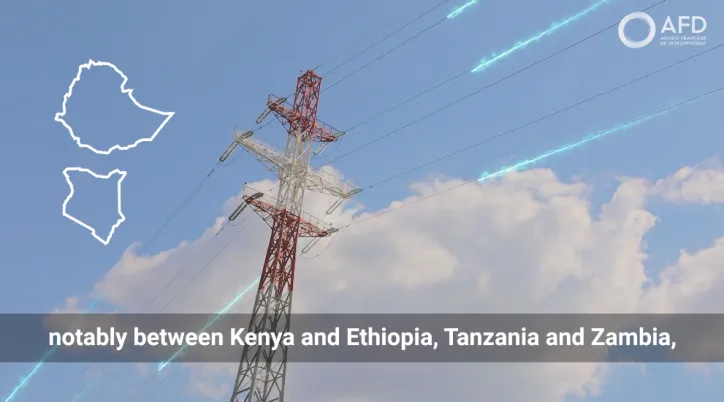
Sustainable energy in Eastern Africa: the importance of regional integration
Jérémy Gasc, Energy Task Team Leader for Eastern Africa at AFD, details the potential of regional integration for the development of green energy in the region, but also AFD's actions to support this...
Published on
AFD and Macroeconomic Modelling Tools for the Ecological Transition
AFD has been developing two macroeconomic modelling tools – the GEMMES and ESTEEM models – for analysing the macroeconomic aspects of the ecological transition.
Published on
AFD and Energy Transition in China
Driven by sustained economic growth, demand for energy in China has increased dramatically in recent decades. In response to crucial environmental and health issues, the Chinese government has adopted...
Published on

Private production or public project ownership to scale up the construction of photovoltaic power plants in Af...
Despite its abundant solar resources, Africa currently has low solar photovoltaic (PV) power generation capacities compared to other continents. Yet, the International Renewable Energy Agency (IRENA)...
Published on

AFD and the Energy Transition in New-Caledonia
With New Caledonia's energy transition blueprint, the Government plans to make the territory an energytransition and sustainable-development model. New Caledonia's energy transition policy aims to...
Published on

Dominica: a high geothermal potential
Dominica is a volcanic island in the Caribbean arc with a population of 70,000. The island currently has an installed capacity of 26.7 MW, of which 77% is fossil fuel and 23% is hydro. The price of el...
Published on

AFD Group and Support to Energy Transition Policies
Energy transitions combine the multiple objectives of universal access to quality energy services, low-carbon development, and social justice. Achieving these objectives requires optimizing demand, re...
Published on

Employment in a zero net emissions future in Costa Rica: Renewable energy to enable widespread benefits for th...
In pursuit of a "3D" economy (decentralized, digitized and decarbonized), Costa Rica is encouraging transformations to work towards the year 2050 through its National Decarbonization Plan (NDP) and th...
Published on
Greening China’s investments in Africa: issues and challenges
The 8th Forum on China-Africa Cooperation (FOCAC), which was held in Dakar in November 2021, strengthened the pillars of a “new era” of China-Africa cooperation in various fields, including energy, wh...
Published on

Replay: MacroDev Online Webinar on the Commodity Prices Boom
Along this webinar at the occasion of the release of the MacroDev-Semestrial Panorama 2022 #2, AFD economists provided analysis in a thematic note devoted to commodities. Several country cases illustr...
Published on
