Publications and media
Clean cooking in Africa: an urgent priority for health and climate
Nearly 80% of households in sub-Saharan Africa still lack access to modern cooking solutions. Continued reliance on traditional fuels, such as wood and charcoal, poses major challenges for human devel...
Published on

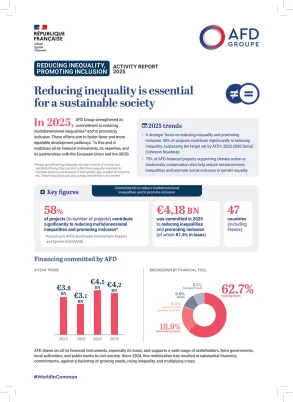
Reducing inequality, promotion inclusion: 2025 Activity report
In 2025, AFD Group strengthened its commitment to reducing multidimensional inequalities* and to promoting inclusion. These efforts aim to foster fairer and more equitable development pathways. To thi...
Published on
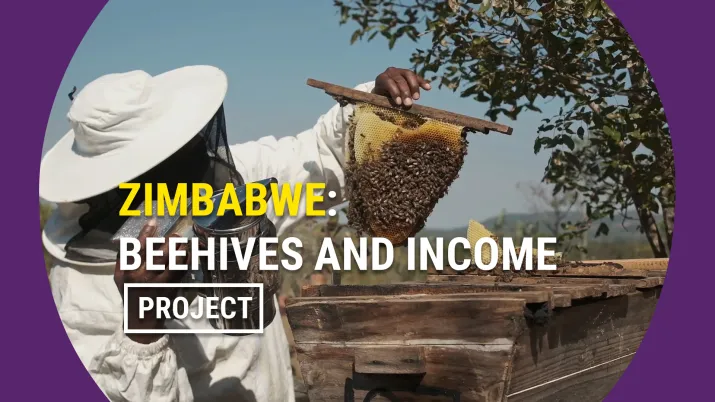
How is beekeeping boosting women's incomes in Zimbabwe?
Hands-on training in Matabeleland North, Mashonaland East and Manicaland provinces helped beekeepers strengthen their technical skills and improve the quality and productivity of their operations.
Published on
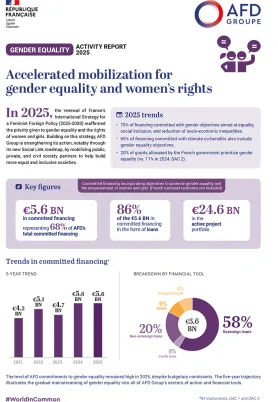
Gender equality: Activity report 2025
In 2025, the renewal of France’s International Strategy for a Feminist Foreign Policy (2025-2030) reaffirmed the priority given to gender equality and the rights of women and girls. Building on this s...
Published on
South Africa: Towards a Change of Course?
As South Africa faces major challenges—including chronic underinvestment, the inefficiency of state-owned enterprises, inadequate infrastructure, limited financial inclusion, persistently high unemplo...
Sustainability Statement 2025
AFD Group has voluntarily published its first sustainability report, improving transparency and governance in accordance with the CSRD (Corporate Sustainability Reporting Directive).
Published on

Handbook on Inequality Measurement for Country Studies - Updated version
Writing a country level study on inequality can be an intimidating task for researchers. How does one begin to conceptualize such a study? What needs to be included? What sorts of analyses are require...
Published on

AFD supports Armenia on its path towards more sustainable and resilient development
How can development finance address climate, social and institutional challenges at once?
Published on

Gender and Income Distribution in a High- Informality Context: A CEQ-Based Analysis for Colombia
This study assesses the extent to which Colombia’s fiscal policy mitigates gender gaps in income and poverty. Using the fiscal incidence methodology developed by the Commitment to Equity (CEQ) Institu...
Leveraging social protection to reduce inequalities in the just transition
Addressing the dual challenge of climate change and inequality require policies delivering on both environmental and social sustainability aspects. In this context, social protection can play a critic...

How Can Financial Inclusion for the Most Vulnerable Help Achieve the SDGs?
Although financial inclusion has progressed, 1.3 billion people remain excluded from formal financial systems. Predominantly living in developing countries, women, rural populations, youth, low-income...

Training Social Workers to Support Societies in Transition
At a time of major ecological, social, and demographic transitions, social work is a crucial lever for supporting the most vulnerable populations and preventing social divides. While governments and...

Social cohesion, the basis for a sustainable and inclusive world - A crosscutting goal for social cohesion 202...
This document provides a summary of the Cross-Cutting Social Cohesion Roadmap for the 2025–2030 period. In a world marked by multiple and interconnected crises, social cohesion is a key driver of s...
Published on

Inequality and Climate Change Measuring Interlinkages to Inform Equitable Climate Policy
The interlinkages between climate change and socioeconomic inequality are increasingly acknowledged, yet analytical frameworks and empirical tools that jointly address these dimensions remain limited....

Replay | How Technology Facilitates Gender-Based Violence and What We Can Do About It
This conference is part of AFD's "TechTalks" webinar series.
Published on

Promoting menstrual health and hygiene Impact and lessons learned from two projects in Ethiopia and Madagascar
Menstrual health and hygiene is a global issue affecting nearly 500 million people. Despite being on the international agenda, there is still a lack of data to identify effective levers for promoting...
Simulating the Employment and Inequality Impacts of the Energy Transition in Mexico: An Input–Output Approach
This paper examines the distributive and labor market impacts of Mexico’s transition from fossil fuels to renewable energy using a multisector input–output model calibrated to the 2020 national accoun...
Assessing the Impact of the Monitoring, Follow-Up, and Control Strategy on Territorial Inequalities in Colombi...
This article analyzes the Monitoring, Tracking, and Control Strategy (EMSC) of Colombia's General System of Participations (SGP) as an instrument for reducing territorial gaps in key sectors such as e...
Gaps in Human Capital and Labor Demand in Oaxaca
This report examines the structural barriers that constrain the development of talent in the Mexican state of Oaxaca. It proposes concrete strategies to translate the region's cultural, productive, an...
Inequality Matters: Can the GNU solve inequality in South Africa?
South Africa remains the most unequal society in the world, with persistent disparities rooted in the legacies of colonialism and apartheid. Despite three decades of democracy and redistributive polic...
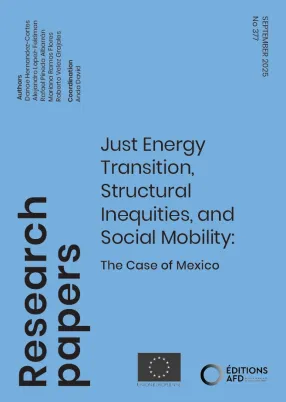
Just Energy Transition, Structural Inequities, and Social Mobility: The Case of Mexico
Mexico’s energy transition unfolds in a context of deep structural inequalities and persistently low social mobility. While most households have electricity, large disparities remain in affordability,...