
Share the page
Assessing macro-economic risks and opportunities in the face of nature degradation: a new open-access internet portal

-
Project start date
-
2025Status
Ongoing
-
Project end date
-
2028
-
AFD financing amount
-
465 000
-
Country and region
-
Location
-
Case studies in South Africa, Tanzania, Morocco and Armenia
-
Partners
-
Research program
A new web portal assessing exposure of 150 countries to socio-economic risks resulting from biodiversity loss is being developed by AFD, revealing also nature-related opportunities. This tool, which will be freely accessible, will help inform public decision-makers and financial institutions about resilient transition issues, and facilitate dialogue between environmental and economic institutional actors.
Context
Human activities are accelerating biodiversity loss at an unprecedented rate: according to IPBES, one million species are threatened with extinction and vast portions of ecosystems have been altered. As ecosystems degrade, the essential services they produce – food production, water purification, climate regulation, etc. – decline. As with climate change, this affects macro-economic stability by generating systemic socio-economic and financial risks, either physical or transitional.
Although complex, assessing these risks is crucial for sustainable socio-economic stability. It has progressed in recent years: AFD, for example, has developed several methodologies to measure economies' exposure to socio-economic and financial risks linked to biodiversity loss (see "To learn more"). On the other hand, unlike nature-related risks, nature-related opportunities are much less documented, which calls for further research.
Objectives
Noting significant interest from the international community in its work, AFD has decided to supplement its publications by developing an open-access web portal.
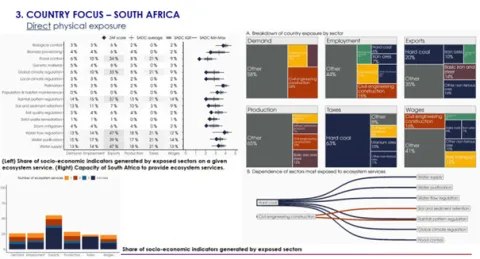
Funded by the 2050 Facility, it will allow users to generate results by type of exposure for 150 countries where data are available. The goal is to help ensure that the nature-related impacts and dependencies of national economies, which lead to nature-related risks and pending opportunities, are better taken into account, with a high level of granularity by economic sector and by ecosystem service.
This portal – which will assess at the country level the consequences of nature degradation on taxation, the economy and social protection – could be particularly useful to:
- Central banks, to identify economic sectors most exposed to disruptions due to biodiversity loss, and to anticipate necessary prudential policies related to transition risks;
- Ministries of Finance, to locate economic sectors where biodiversity loss could affect GDP, employment or taxation, as well as economic sectors more resilient to nature-related risks, and to identify economic and budgetary impacts of ecological transition policies;
- Public agencies in charge of biodiversity, to identify ecosystem services critical to maintaining socioeconomic and ecological resilience, and to target conservation policies using socioeconomic arguments;
- The private sector, to anticipate supply chain disruptions due to ecosystem degradation, to assess the impact of new environmental standards and to innovate to comply with them;
- Commercial banks/private equity firms, to map investments most exposed to nature-related risks and reallocate portfolios toward resilient assets, while identifying investment opportunities in innovative companies aligned with sustainability goals.
Method and expected results
The project will unfold in three stages:
1. Development of a prototype on risks related to nature degradation
Building on AFD’s historical experience in socio-economic risk assessment and its numerous international cooperation on this subject, an initial prototype portal analyzing physical and transition risks linked to nature loss will be proposed to and challenged by partners, to consolidate and improve it through their feedback.The partners include three countries and three types of economic actors: DBSA, ie the development bank for Southern Africa; the Central Bank of Tanzania; the Department of Macroeconomic Policy within the Armenian Ministry of Finance; and the Financial Analysis and Forecasting Division (DEPF) of the Ministry of Finance of Morocco.
2. Addition of a module on opportunities related to nature preservation
A new module will be specifically developed and added to allow partners to analyze opportunities related to nature preservation, around two main areas of reflection:
- What are the economic activities that contribute strongly to a country's major macro-economic aggregates and that depend on ecosystem services in good condition, a condition that may be useful to preserve?
- What are the economic activities that also play an important socio-economic role in a country and that exert low pressures on nature degradation, activities that may be interesting to favor for a resilient transition?
3. Launch of an open and free version of the web portal
A free, open-access version of the portal will be made available by AFD, where it will be accessible to any user wishing to assess nature-related risks and opportunities in a given country, among the list of 150 countries covered. Users will be able to filter results on specific variables, adjust criticality thresholds, download calculation results, and generate graphs.
These data can inform actions aimed at better integrating biodiversity into public policies and reducing subsidies harmful to biodiversity (Targets 14 and 18 of the Kunming-Montreal Global Biodiversity Framework). It can also indirectly help reduce pressures on biodiversity and create sustainable opportunities for sustainable and desirable growth (Targets 7, 8, 10 and 11 of the Framework).
To learn more
- A “Silent Spring” for the Financial System? Exploring Biodiversity-Related Financial Risks in France (2021)
- Global biodiversity scenarios: what do they tell us for biodiversity-related socioeconomic impacts? (2022)
- Socioeconomic and spatially-explicit assessment of Nature-related risks: the case of South Africa (2023)
- Assessing economic exposure to nature-related risks (2025)
- Biodiversity, macroeconomics and sovereign risk (2026)

Contacts
- Constance Gires, Nature expert and Coordinator of the project
- Antoine Godin, Head of the Macroeconomic Modeling Unit at AFD
- Julien Calas, Research fellow at AFD
- Paul Hadji-Lazaro, Research fellow at AFD