 A new web portal assessing exposure of 150 countries to socio-economic risks resulting from biodiversity loss is being developed by AFD, revealing also nature-related opportunities. This tool, which will be freely accessible, will help inform public decision-makers and financial institutions about resilient transition issues, and facilitate dialogue between environmental and economic institutional actors.
Context
Human activities are accelerating biodiversity loss at an unprecedented rate: according to IPBES, one million species are threatened with extinction and vast portions of ecosystems have been altered. As ecosystems degrade, the essential services they produce – food production, water purification, climate regulation, etc. – decline. As with climate change, this affects macro-economic stability by generating systemic socio-economic and financial risks, either physical or transitional.
Although complex, assessing these risks is crucial for sustainable socio-economic stability. It has progressed in recent years: AFD, for example, has developed several methodologies to measure economies' exposure to socio-economic and financial risks linked to biodiversity loss (see "To learn more"). On the other hand, unlike nature-related risks, nature-related opportunities are much less documented, which calls for further research.
Objectives
Noting significant interest from the international community in its work, AFD has decided to supplement its publications by developing an open-access web portal.
Funded by the 2050 Facility, it will allow users to generate results by type of exposure for 150 countries where data are available. The goal is to help ensure that the nature-related impacts and dependencies of national economies, which lead to nature-related risks and pending opportunities, are better taken into account, with a high level of granularity by economic sector and by ecosystem service.
This portal – which will assess at the country level the consequences of nature degradation on taxation, the economy and social protection – could be particularly useful to:
- Central banks, to identify economic sectors most exposed to disruptions due to biodiversity loss, and to anticipate necessary prudential policies related to transition risks;
- Ministries of Finance, to locate economic sectors where biodiversity loss could affect GDP, employment or taxation, as well as economic sectors more resilient to nature-related risks, and to identify economic and budgetary impacts of ecological transition policies;
- Public agencies in charge of biodiversity, to identify ecosystem services critical to maintaining socioeconomic and ecological resilience, and to target conservation policies using socioeconomic arguments;
- The private sector, to anticipate supply chain disruptions due to ecosystem degradation, to assess the impact of new environmental standards and to innovate to comply with them;
- Commercial banks/private equity firms, to map investments most exposed to nature-related risks and reallocate portfolios toward resilient assets, while identifying investment opportunities in innovative companies aligned with sustainability goals.
Method and expected results
The project will unfold in three stages:
1. Development of a prototype on risks related to nature degradation
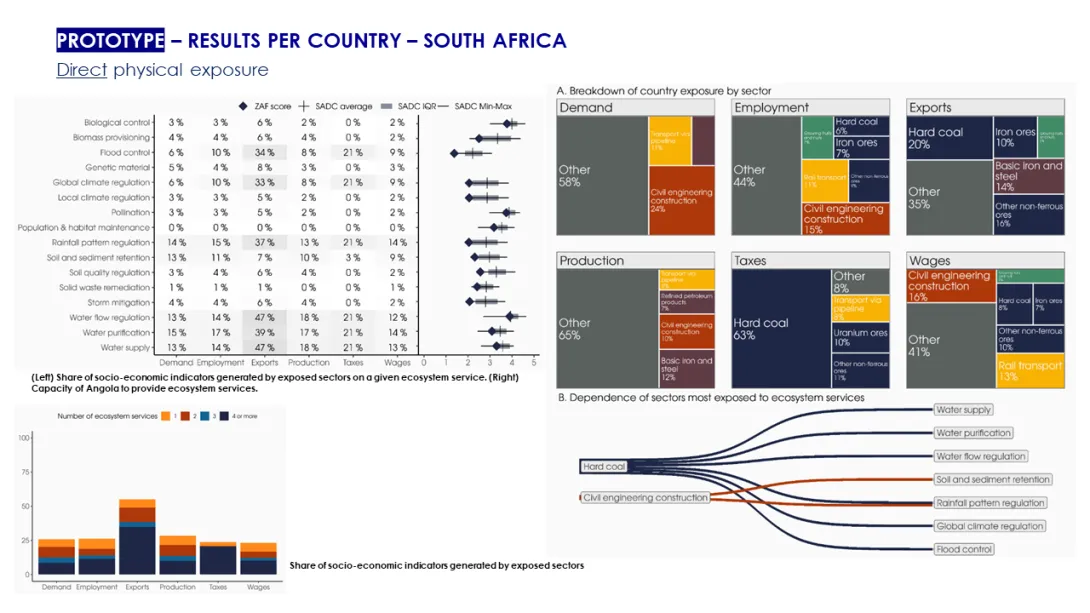
Building on AFD’s historical experience in socio-economic risk assessment and its numerous international cooperation on this subject, an initial prototype portal analyzing physical and transition risks linked to nature loss will be proposed to and challenged by partners, to consolidate and improve it through their feedback.The partners include three countries and three types of economic actors: DBSA, ie the development bank for Southern Africa; the Central Bank of Tanzania; the Department of Macroeconomic Policy within the Armenian Ministry of Finance; and the Financial Analysis and Forecasting Division (DEPF) of the Ministry of Finance of Morocco.
2. Addition of a module on opportunities related to nature preservation
A new module will be specifically developed and added to allow partners to analyze opportunities related to nature preservation, around two main areas of reflection:
- What are the economic activities that contribute strongly to a country's major macro-economic aggregates and that depend on ecosystem services in good condition, a condition that may be useful to preserve?
- What are the economic activities that also play an important socio-economic role in a country and that exert low pressures on nature degradation, activities that may be interesting to favor for a resilient transition?
3. Launch of an open and free version of the web portal
A free, open-access version of the portal will be made available by AFD, where it will be accessible to any user wishing to assess nature-related risks and opportunities in a given country, among the list of 150 countries covered. Users will be able to filter results on specific variables, adjust criticality thresholds, download calculation results, and generate graphs.
These data can inform actions aimed at better integrating biodiversity into public policies and reducing subsidies harmful to biodiversity (Targets 14 and 18 of the Kunming-Montreal Global Biodiversity Framework). It can also indirectly help reduce pressures on biodiversity and create sustainable opportunities for sustainable and desirable growth (Targets 7, 8, 10 and 11 of the Framework).
To learn more
- A “Silent Spring” for the Financial System? Exploring Biodiversity-Related Financial Risks in France (2021)
- Global biodiversity scenarios: what do they tell us for biodiversity-related socioeconomic impacts? (2022)
- Socioeconomic and spatially-explicit assessment of Nature-related risks: the case of South Africa (2023)
- Assessing economic exposure to nature-related risks (2025)
- Biodiversity, macroeconomics and sovereign risk (2026)

Contacts
- Constance Gires, Nature expert and Coordinator of the project
- Antoine Godin, Head of the Macroeconomic Modeling Unit at AFD
- Julien Calas, Research fellow at AFD
- Paul Hadji-Lazaro, Research fellow at AFD
 For some sixty countries, AFD analyzes ongoing development processes, characterizes growth trajectories, and identifies the associated economic, social, environmental, political, and financial vulnerabilities. These assessments, which meet a regulatory requirement for banks, inform the operational and strategic decisions of AFD Group.
Context
As a public development bank, AFD must gauge the issues at stake and monitor the risks associated with its financing. To do so, it relies on a team of around ten economists dedicated to analyzing the macroeconomic and financial situation of its various countries of operation. This monitoring feeds into country assessments that inform the Group's operational and strategic decisions in each of its regions of operation. This activity is part of one of AFD's priority research areas, dedicated to macroeconomic diagnostics and forecasting.
Objectives
Country assessments make it possible to analyze the development processes under way in the countries where AFD operates, to characterize their growth trajectories, and to identify the economic, social, political, and financial vulnerabilities associated with these trajectories. This enables AFD Group to properly gauge the issues at stake and monitor the risks associated with each of its investments.
The scope covered focuses on developing countries, particularly in Africa, for which macroeconomic analyses are scarce or infrequent. The analyses produced are therefore often highly complementary to existing coverage of global economic developments, which tends to focus more on advanced economies and major emerging markets.
Method
The work of AFD's country-risk economists draws on close, long-term monitoring and an in-depth understanding of local contexts. Short-term developments, often highlighted in the news, are systematically examined in light of the structural trends of each economy and its regional context, in order to bring out the macroeconomic issues specific to each country while assessing risks against comparable trajectories over time and across countries.
Country-risk economists place the study of socio-political vulnerabilities, growth models, public debt sustainability, external balances, and financial system soundness at the heart of their diagnostics, and pay particular attention to countries' exposure to climate and natural hazard risks.
Publications
The MacroDev collection
Some of the work carried out by country-risk economists, whether country assessments or cross-cutting analyses, leads to publications in the MacroDev collection of the Éditions Agence française de développement. In particular, the special “Semestrial Panorama” issues shed light on the key cyclical and structural issues facing emerging and developing countries.
The DecoDev webinars
The publication of each MacroDev “Semestrial Panorama” is accompanied by a DecoDev webinar: a session decoding the major macroeconomic trends, followed by three country focus segments.
The Team
-
Amaury MULLIEZ
Deputy Director of the Economic Diagnostics and Public Policy Department at AFD

-
Christophe BARAT
Country Risk Economist

-
Sylvain BELLEFONTAINE
Country Risk Economist

-
Benoît JONVEAUX
Country Risk Economist

-
Gaëlle BALINEAU
Country Risk Economist, Research Officer

-
Hélène EHRHART
Economist

-
Julien GOURDON
Country Risk Economist

-
Thibault VASSE
Country Risk Economist

 Through this research program on public development banks (PDBs), AFD helps build knowledge on the role, intervention models, and effectiveness of these key players in development financing. By supporting scientific production and coordinating an international community of researchers, the program aims to inform public policy and strengthen PDBs’ capacity to mobilize long-term financing in support of transitions.
Context
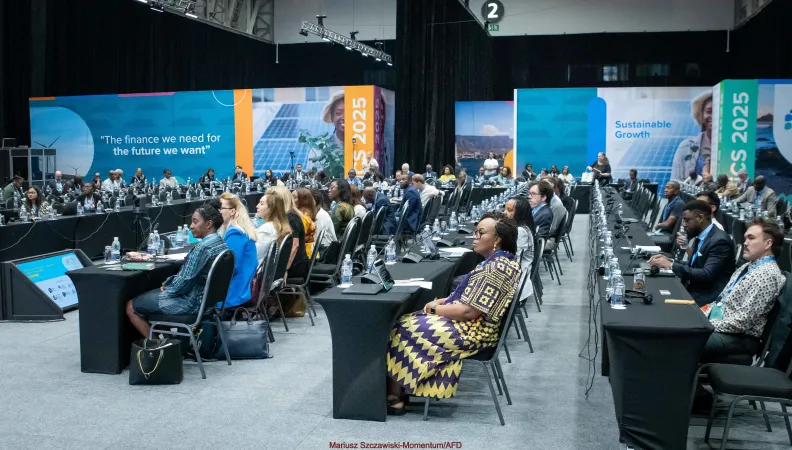
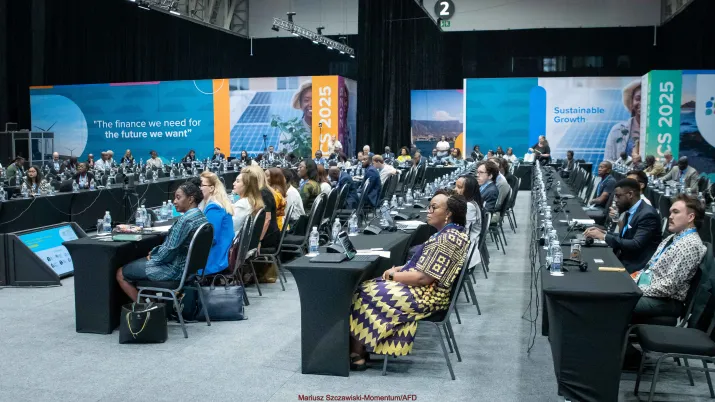
For decades, economists have debated the role and necessity of public banks in development financing. In 2020, the creation of the Finance in Common System (FiCS), which brings together more than 540 PDBs worldwide, has reinvigorated these debates, placing these actors at the heart of academic thinking and international policy dialogue.
For AFD Group, PDBs are strategic partners. Strengthening financial systems is one of the Group’s top priorities: expanding access to financing, supporting the transition toward more sustainable financial models, and strengthening the resilience and stability of financial institutions.
In 2024, AFD Group committed close to €3 billion to financial systems and PDBs account for nearly half of the financing devoted to this area. Beyond the volumes mobilized, the challenge is to strengthen the collective ability to better understand how development financing can respond to increasingly complex and interconnected challenges.
Objectives
AFD supports the production and dissemination of research aimed at analyzing the role of public development banks in the development financing architecture.
This activity, which falls under the priority research area “Geopolitics and Development Finance,” is structured around two complementary pillars:
Pillar 1 – Producing original research on development financing
Whether conducted internally or in partnership with universities and research institutions, AFD supports the production of original work that contributes to the literature on development financing. This research work focuses in particular on:
- the definition, mandates, and typologies of PDBs;
- their business models and their effectiveness in terms of development impact;
- the analysis and development of innovative financial instruments;
- synergies among PDBs, and their integration into local and international financial systems;
- the conditions for strengthening joint financing mobilization, including through the mobilization of private investment;
- governance issues, regulatory frameworks, and the constraints PDBs face.
AFD coordinates the Global Research Network on Public Development Banks (GRN), an international network bringing together academic and institutional researchers specializing in these issues. A genuine platform for exchange and dialogue, the GRN fosters interdisciplinary approaches and North-South and South-South collaboration, and disseminates research findings. By bringing researchers and practitioners together, it helps inform public policy and strengthen the effectiveness of public development banks in support of the Sustainable Development Goals.
Results
Since 2020, members of the Global Research Network (GRN) have collectively published nearly 100 original research articles. To structure and consolidate this work, AFD supported the production of the Public Development Banks Reference Book (2025), with support from the United Nations Department of Economic and Social Affairs (UNDESA) and the Finance in Common (FiCS) secretariat. Published by Pearson on the occasion of the 4th International Conference on Financing for Development (FfD4), this book is a landmark contribution to the academic literature on public development banks.
The program also enabled the development of the first database dedicated internationally to public development banks, co-designed by Peking University, the Fondation pour les Études et Recherches sur le Développement International (FERDI), and AFD. This resource is now a reference tool for researchers, financial institutions, and policymakers. By offering a harmonized typology of public financial institutions and internationally comparable data, it facilitates comparative analysis, strengthens transparency, and helps better track the evolution of public development banks and development finance institutions.
Findings from the program are regularly presented at international conferences and dialogues, particularly at Finance in Common (FiCS) summits. As part of France’s G7 presidency, AFD organized the first conference international academic dedicated exclusively to public development banks in 2026.
Discover also: Public Development Banks: What Research Tells Us, and Why It Matters
Research findings
The 2026 research conference provided an overview of current knowledge and research perspectives on public development banks. Drawing on the most recent academic work, a publication prepared following the conference provides a synthesis of the main lessons from the literature and highlights the current challenges these institutions face.
It sets out recommendations for key stakeholders, in particular finance ministers (in their capacity as shareholders and supervisors of PDBs), PDB leaders, and regulatory authorities. These recommendations aim to strengthen the role of public development banks as catalysts for long-term investment in support of national priorities and the delivery of global public goods.
Resources at a Glance

Contact
-
Jean-Baptiste JACOUTON
Research Officer on Sustainable Finance

Découvrir d'autres projets de recherche


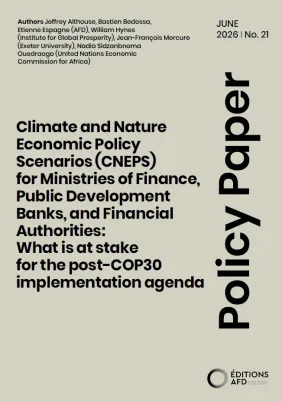
 The Climate and Nature Economic Policy Scenarios (CNEPS) initiative develops forward-looking economic scenarios that integrate climate change, biodiversity loss and transition dynamics into macroeconomic policy analysis for Ministries of Finance and Public Development Banks (PDBs).
 Co-designed with Ministries of Finance and PDBs, CNEPS aims at connecting global, regional and country-level perspectives to explore how geoeconomic, financial, technological and environmental transformations could reshape national economies, fiscal frameworks and development pathways and how countries could coordinate economic policy mixes and financing strategies in response.
Context
Ten years after the signing of the Paris Agreement, and five years into the Kunming-Montreal Agreement, he global economy is entering a period of profound structural change, often called “mid-transition”. Climate change, biodiversity loss, energy system transitions and shifting geopolitical dynamics are increasingly shaping economic development, financial stability and public finances. Climate shocks are already affecting fiscal balances and investment needs, while ecosystem degradation threatens key economic sectors such as agriculture, water and natural resources. At the same time, the transition toward low-carbon economies is transforming supply chains, trade relations and industrial strategies.
For Ministries of Finance, these dynamics are emerging as core macroeconomic risks while fostering new opportunities. Yet existing policy frameworks often struggle to integrate climate and nature fat-tailed risks (explication ou lien) into a systemic framework. Developing forward-looking economic scenarios that capture these interactions is therefore essential to support resilient fiscal planning and long-term development strategies.
It is in this context that AFD has launched the Climate and Nature Economic Policy Scenarios (CNEPS) initiative, a multilateral platform for the development of forward-looking economic scenarios to help policymakers anticipate these transformations and inform economic policy choices. It joins forces with an ecosystem of institutional, regional and academic partners to foster a shared language on plausible futures and related resilient economic policies.
Objective
The Climate and Nature Economic Policy Scenarios (CNEPS) initiative aims to develop forward-looking economic scenarios that help integrate climate change, biodiversity loss and transition dynamics into macroeconomic policy analysis. The project focuses on three main objectives:
- Technical integration: integrate climate and nature fat-tailed risks within macroeconomic policy frameworks, exploring nonlinear shocks, tipping points and geopolitical regime shifts, while building on existing structured country collaborations of AFD as well as regional and institutional partners.
- Policy interface: translate joint global scenarios into implications for fiscal policy, debt sustainability, industrial strategies and investment planning, while supporting champion countries in developing resilient national financing strategies.
- Coalition building: mobilise Ministries of Finance, Public Development Banks and academic partners, and connect existing finance-minister and public development banking platforms to scale impact and strengthen policy dialogue.
Method
The approach brings together global analytical work and country-level collaboration to explore how climate and nature risks, transition dynamics and geopolitical shifts could affect national economies and public finances.
The initiative builds on partnerships between research institutions, development finance actors and Ministries of Finance in participating countries. Academic partners contribute modelling expertise and scenario design, while Ministries of Finance and Public Development Banks provide policy perspectives and help identify the most relevant economic questions and applications.
The project mobilises an international knowledge network and works with partner countries to ensure that the scenarios developed respond to concrete policy needs and strengthen local analytical capacity.
For this project, AFD is partnering with the University of Exeter.
Expected results
The CNEPS initiative will deliver a first generation of forward-looking economic scenarios exploring how climate change, biodiversity loss and global transition dynamics could affect national economies and public finances.
Key outputs will include a first mid-transition analytical report presenting emerging global trends and systemic risks, as well as a first set of global scenarios developed with champion countries and regional partners. These scenarios will be translated into country-level assessments exploring implications for resilient fiscal policy, debt sustainability and investment strategies.
The project will also support participating countries in developing a first series of national CNEPS strategies aimed at informing resilient financing pathways and long-term economic planning.
Beyond analytical outputs, the initiative will contribute to policy dialogue and capacity strengthening through workshops, regional exchanges and engagement with international platforms bringing together Ministries of Finance and Public Development Banks.
Events
Several events were organized as part of the CNEPS Initiative :
A French Development Agency (AFD), Finance in Common (FiCS), International Development Finance Club (IDFC), UCL Institute for Global Prosperity (IGP) and The New Alignment (TNA) roundtable on Ministries of Finance, Public Development Banks and the incoming COP31 and UK G20 Presidency. The event explores how Climate and Nature Economic Policy Scenarios (CNEPS) can help Ministries of Finance and Public Development Banks coordinate around country platforms and other country-led investment frameworks to accelerate implementation in a turbulent mid-transition context.
In an increasingly fragmented geopolitical landscape, this one-day conference co-organized by AFD and the Energy Institute of University of Texas (Austin) in Paris convenes leading academics, policymakers and philanthropies to address a critical blind spot in global climate policy debates: the interactions between the transformation of energy systems and geopolitical shifts.
Across four sessions, the conference will explore why existing economic frameworks—often built on assumptions of global cooperation, free trade, and exogenous growth unrelated to energy use—fail to account for rising tensions and the non-linear risks associated with stranded assets and energy costs:
- Session 1: Understanding the role of energy in economic transitions: lessons from the 1970s to today
- Session 2: The geoeconomic turn of the energy transition: energy security, energy affordability and energy imperialism.
- Session 3: The macrofinancial turn of the energy transition: stranded assets, cost of capital and balance of payment instabilities
- Session 4: Building scenarios for the mid-transition period: what can the models tell us?
Dans un contexte géopolitique de plus en plus fragmenté, cette conférence d’une journée, co-organisée par l’AFD et l’Energy Institute de l’Université du Texas (Austin) à Paris, réunit des universitaires de premier plan, des décideurs politiques et des organisations philanthropiques pour aborder un angle mort critique dans les débats mondiaux sur la politique climatique : les interactions entre la transformation des systèmes énergétiques et les mutations géopolitiques.
Paris 20 March 2026- Agence Française de Développement (AFD) and the University of Exeter signed a Memorandum of Understanding at the British Embassy in Paris to strengthen collaboration on climate and nature economic policy analysis for Ministries of Finance and Public Development Banks.
This workshop convened over 240 participants, including representatives from Ministries of Finance, central banks, financial supervisors, public development banks, ministries of environment and development co-operation, research institutes, and academia. The event comprised a technical workshop in the morning and high-level sessions in the afternoon, both held under the Chatham House rule.
Contacts
- Etienne Espagne, Senior Economist, AFD
- Jean-François Mercure, Professor of Climate Policy, Exeter University
- Sam Mugume Koojo, Deputy Co-Chair CFMCA, Country Platform Hub, PAFCA
- Laura Sabogal Reyes, FiCS