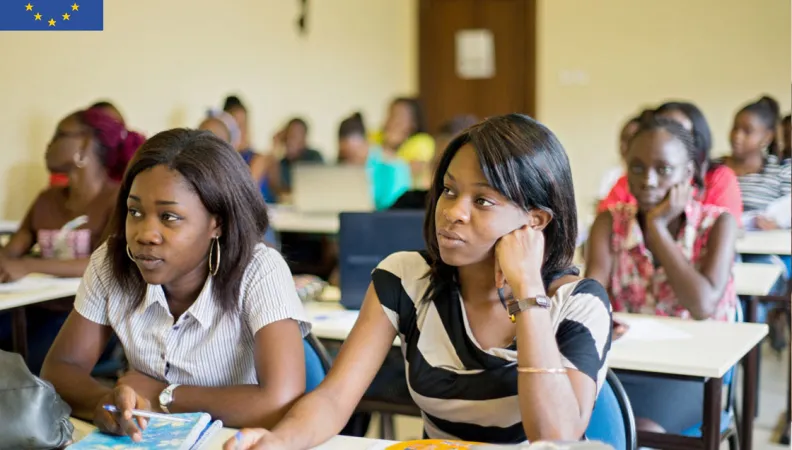
 Legal notice EU (project) Education plays a crucial role in both the production of and the fight against inequalities, within a single country and between different countries. The rapid increase in the private higher-education offer in emerging and developing countries is contributing to the growth in mass higher education, but it also brings up questions concerning social cohesion. This research program seeks to analyze the link between higher education, development of the private offer, and inequalities in seven countries on three continents.
Context
In 2015, the private sector accounted for 13% of students in higher education in Vietnam and 60% in India. To the extent that these figures are reliable (higher education institutes not always being registered in some countries), they indicate the significance the private sector has taken on at this level of education. In Peru and Mexico, nearly 7 out of 10 universities are private. The development of the private sector seems to have in part involved a movement toward democratization of access to higher education in the past 15 years. But this movement is not necessarily synonymous with reduction in inequalities in access or with conditions of academic success becoming more equal. For example, in the poorest quintile of Mexico, only 1% of the age 15-24 segment pursue studies in higher education, compared to 32% in the wealthiest quintile.
This project is part of the first phase of the Research Facility on Inequalities, coordinated by AFD and funded by the European Commission's Directorate-General for International Partnerships over the 2017-2020 period. The first phase of the Facility has led to the conduct of 22 research projects and the publication of around 100 research papers and policy briefs.
Goal
The objectives in this research program are to:
- describe trends in both public and private higher education;
- identify to what extent and the way in which public policies take inequalities in higher education into consideration, and if so which inequalities;
- identify to what extent and the way in which these public policies take into account the growth and/or consolidation of the private sector of higher education, as well as its role in reducing or increasing inequalities at this level;
- detect whether the actors of private-sector higher education include the fight against inequalities in their objectives and, if so, how and why.
Method
This multidisciplinary research program (covering sociology, economics, demography and educology) is original in that it analyzes data from different sources and of different types using a purposive sample of so-called developing or emerging countries: India and Vietnam for Asia; Mexico and Peru for Latin America; Senegal, Mali and the Democratic Republic of the Congo for Africa.
This work will help establish an international research network on the theme of higher education and inequalities. The countries were selected based on the different degrees of development of their system of public and private higher education and the way this teaching is structured (co-existence between public and private, porosity between the two sectors, competition, etc.). They also differ in terms of their social structure (unequal development of the middle classes, for example). The study will compare these regions and countries: the material collected in the various countries will be of the same nature and will be analyzed using the same methodological approaches.
Results
This research will give rise to conferences and seminars, a collective publication, country-documents, policy briefs, and research articles. The expected outcomes are:
- development of a typology on the current public and private offer of higher education in the selected countries;
- development of a conceptual framework and typologies on inequalities and private higher education;
- identification, in the different countries, of policies whose goal has been to work to reduce inequalities in higher education in the course of the past 15 years;
- qualitative analysis of the criteria for access to public or private higher education, for the different categories of students or populations concerned, the conditions in which they study, the processes of certifying school diplomas, etc.;
- identification of the factors of production of inequalities in higher education, and the indicators that might be used to measure and correct them.
You may find the research papers here (in French):
- Inégalités et enseignement supérieur : entre politiques publiques et développement du secteur privé en Argentine
- Universités privées au Mexique: entre reproduction, production et réduction des inégalités
- Le paradoxe de l'enseignement supérieur privé au Sénégal: réduire les inégalités tout en les maintenant
- Des inégalités éducatives à la mise en question de l'opposition public/privé dans l'enseignement supérieur congolais, un défi documentaire et conceptuel
- Enseignement supérieur au Vietnam: privatisation, démocratisation et inégalités
- Complexité et inégalités de l'offre universitaire privée au Pérou. Regard sur la diversité sociodémographique des étudiants et des conditions d'insertion professionnelle des diplômés d'universités privées
- L'expansion de l'enseignement supérieur privé et le creusement des inégalités sociales
- Enseignement supérieur et inégalités sociales en Inde
Contact :
Linda Zanfini, Research Officer, AFD
Rohen d’Aiglepierre, Research Officer, AFD
Étienne Gérard, Research Director, IRD and Director of the CEPED (since 2014)
Contactos:
- Linda Zanfini, encargada de investigación, AFD
- Rohen d’Aiglepierre, coordinador de investigación, AFD
- Étienne Gérard, director de investigación en el IRD y director del Ceped (desde 2014)
 Legal notice EU (project) Via their tax component and their component of transfers and public expenditure, budget policies are a crucial instrument for governments in their fight against inequalities. This research project seeks to improve understanding of the relationship between income inequalities and these budget policies in developing countries.
Context
Reduction of inequality is one of the core Sustainable Development Goals (SDGs). One of the targets of SDG 10 is for income growth of a country’s poorest 40% to be higher than the national average. Reaching this objective requires setting up economic policies on public expenditures and taxes that will benefit the poorest people. At the same time, mobilizing tax revenue can play a key role in financing the SDGs, but it is important to understand under what conditions this higher level of tax revenue collection is reconcilable with the goal of reducing inequalities.
This project is part of the first phase of the Research Facility on Inequalities, coordinated by AFD and funded by the European Commission's Directorate-General for International Partnerships over the 2017-2020 period. The first phase of the Facility has led to the conduct of 22 research projects and the publication of around 100 research papers and policy briefs.
Goal
This research project seeks to improve understanding of the relationship between income inequality and budget policies in developing countries. The study is divided into three parts:
- Investigation into the redistributive impact of taxes, transfers, and public expenditure in three countries of West Africa (Côte d’Ivoire, Mali, and Senegal). The analysis will try to answer the following questions:
- Who pays taxes, and who benefits from the transfers and public expenditures?
- What is the overall impact of the tax and transfer systems on inequalities?
- What tax instrument can mobilize revenues while reducing poverty and inequality?
- Study of the effect on inequalities from applying different types of taxes in the developing countries. Is the increase in tax revenues (measured by the ratio between revenue and GDP) linked to a reduction or an increase in inequalities? The relationship between the type of taxes levied and the change in inequalities within a country and between different countries will be studied in order to identify which taxes are progressive or regressive.
- Analysis of tax compliance behaviors in Africa, by identifying how the level of inequalities affects citizens’ attitude towards taxes.
Method
This research project will use econometric quantitative studies based on household survey data and macro-economic data available on a large number of countries (Parts 2 and 3). Microsimulation tools will also be used (Part 1).
Results
You may find the research papers and the policy briefs here :
Research papers:
- Fiscal consolidation and health inequality: Evidence from infant mortality in Sub-Saharan Africa
- Collect more, spend better? Assessing the incidence of fiscal systems and public spending in three francophone West African countries
- Inequality in the public good provision and attitude towards taxation: sub-national evidence from Africa
Policy briefs:
- Collect more, spend better? Enhancing fiscal redistribution in West Africa
- Fiscal consolidation in Sub-Saharan Africa: Unequal effects on children’s health
- Building fiscal capacity in Sub-Saharan Africa: The role of local inequality
- Measuring local inequality: Insights from data on night lights
Find also the presentation of the research paper "Inequality in the public good provision and attitude towards taxation: sub-national evidence from Africa" by Marin Ferry, Senior Lecturer at Gustave Eiffel University / Associate Researcher IRD-DIAL during the fourth webinar of the Research Facility on Inequalities:
Contact
-
Hélène EHRHART
Economist
Discover other research projects
Analyzing the employment effects of the “green economy” transition in South Africa
Completed
2023 - 2024