
 Legal notice EU (project) Education plays a crucial role in both the production of and the fight against inequalities, within a single country and between different countries. The rapid increase in the private higher-education offer in emerging and developing countries is contributing to the growth in mass higher education, but it also brings up questions concerning social cohesion. This research program seeks to analyze the link between higher education, development of the private offer, and inequalities in seven countries on three continents.
Context
In 2015, the private sector accounted for 13% of students in higher education in Vietnam and 60% in India. To the extent that these figures are reliable (higher education institutes not always being registered in some countries), they indicate the significance the private sector has taken on at this level of education. In Peru and Mexico, nearly 7 out of 10 universities are private. The development of the private sector seems to have in part involved a movement toward democratization of access to higher education in the past 15 years. But this movement is not necessarily synonymous with reduction in inequalities in access or with conditions of academic success becoming more equal. For example, in the poorest quintile of Mexico, only 1% of the age 15-24 segment pursue studies in higher education, compared to 32% in the wealthiest quintile.
This project is part of the first phase of the Research Facility on Inequalities, coordinated by AFD and funded by the European Commission's Directorate-General for International Partnerships over the 2017-2020 period. The first phase of the Facility has led to the conduct of 22 research projects and the publication of around 100 research papers and policy briefs.
Goal
The objectives in this research program are to:
- describe trends in both public and private higher education;
- identify to what extent and the way in which public policies take inequalities in higher education into consideration, and if so which inequalities;
- identify to what extent and the way in which these public policies take into account the growth and/or consolidation of the private sector of higher education, as well as its role in reducing or increasing inequalities at this level;
- detect whether the actors of private-sector higher education include the fight against inequalities in their objectives and, if so, how and why.
Method
This multidisciplinary research program (covering sociology, economics, demography and educology) is original in that it analyzes data from different sources and of different types using a purposive sample of so-called developing or emerging countries: India and Vietnam for Asia; Mexico and Peru for Latin America; Senegal, Mali and the Democratic Republic of the Congo for Africa.
This work will help establish an international research network on the theme of higher education and inequalities. The countries were selected based on the different degrees of development of their system of public and private higher education and the way this teaching is structured (co-existence between public and private, porosity between the two sectors, competition, etc.). They also differ in terms of their social structure (unequal development of the middle classes, for example). The study will compare these regions and countries: the material collected in the various countries will be of the same nature and will be analyzed using the same methodological approaches.
Results
This research will give rise to conferences and seminars, a collective publication, country-documents, policy briefs, and research articles. The expected outcomes are:
- development of a typology on the current public and private offer of higher education in the selected countries;
- development of a conceptual framework and typologies on inequalities and private higher education;
- identification, in the different countries, of policies whose goal has been to work to reduce inequalities in higher education in the course of the past 15 years;
- qualitative analysis of the criteria for access to public or private higher education, for the different categories of students or populations concerned, the conditions in which they study, the processes of certifying school diplomas, etc.;
- identification of the factors of production of inequalities in higher education, and the indicators that might be used to measure and correct them.
You may find the research papers here (in French):
- Inégalités et enseignement supérieur : entre politiques publiques et développement du secteur privé en Argentine
- Universités privées au Mexique: entre reproduction, production et réduction des inégalités
- Le paradoxe de l'enseignement supérieur privé au Sénégal: réduire les inégalités tout en les maintenant
- Des inégalités éducatives à la mise en question de l'opposition public/privé dans l'enseignement supérieur congolais, un défi documentaire et conceptuel
- Enseignement supérieur au Vietnam: privatisation, démocratisation et inégalités
- Complexité et inégalités de l'offre universitaire privée au Pérou. Regard sur la diversité sociodémographique des étudiants et des conditions d'insertion professionnelle des diplômés d'universités privées
- L'expansion de l'enseignement supérieur privé et le creusement des inégalités sociales
- Enseignement supérieur et inégalités sociales en Inde
Contact :
Linda Zanfini, Research Officer, AFD
Rohen d’Aiglepierre, Research Officer, AFD
Étienne Gérard, Research Director, IRD and Director of the CEPED (since 2014)
Contactos:
- Linda Zanfini, encargada de investigación, AFD
- Rohen d’Aiglepierre, coordinador de investigación, AFD
- Étienne Gérard, director de investigación en el IRD y director del Ceped (desde 2014)
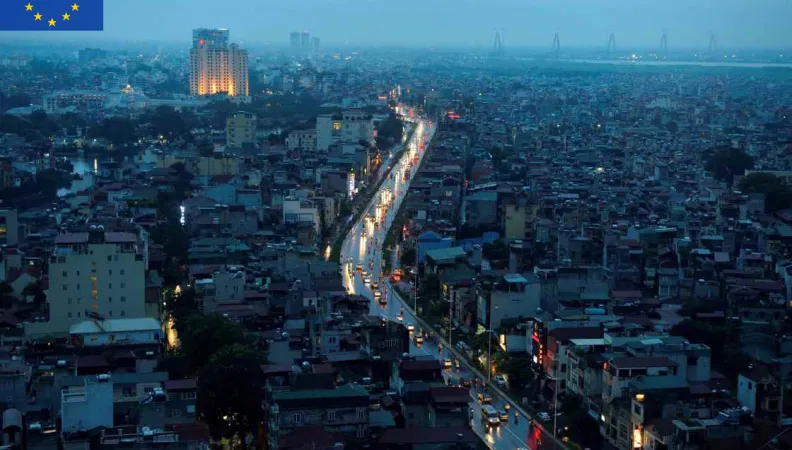 Legal notice EU (project) This project seeks to contribute to the goals of the research facility on inequalities through the analysis of multidimensional inequalities in Vietnam. The project will address the following key questions: What are the most relevant inequalities in Vietnam? What are the most critical inequality drivers ? What policies should national government prioritize to foster inequality reduction?
This project also originally focused on the analysis of inequalities in Burkina Faso. However, this project has been suspended.
Contexte
Despite a significant progress in Vietnam in terms of growth, poverty reduction and even inequality reduction, efforts on inequality and human development issues still need to be done.
In Vietnam, nearly 30 million people have been lifted above the official poverty line over the last three decades, and the country's human development index (HDI) has risen significantly. However, data shows that income inequality in Vietnam has increased over the last two decades. According to the World Bank, the Gini index rose from 35.7 to 38.7 from 1992 to 2012. Besides, in 2014, there were 210 super-rich individuals in the country whose combined wealth stood around $20bn, which is equivalent to 12% of the country's GDP. In fact, according to Oxfam-Vietnam calculations, the richest man in Vietnam earns more in a day than the poorest Vietnamese earns in 10 years.
This project is part of the first phase of the Research Facility on Inequalities, coordinated by AFD and funded by the European Commission's Directorate-General for International Partnerships over the 2017-2020 period. The first phase of the Facility has led to the conduct of 22 research projects and the publication of around 100 research papers and policy briefs.
Objectif
The goal is to adopt a multidimensional approach to provide convincing analysis on inequality. This will focus especially on inequality of opportunities and voice in order to use this as a process to engage with relevant stakeholders, especially in the debates on policy options to tackle inequality, and in mid-term to use the MIF as a way to influence monitoring of SDG 10 in the country.
The specific goals are as follows:
- The "Oxfam Vietnam Inequality Framework" is developed, piloted and adopted to the Vietnamese context;
- The OVIF is used as a tool to enhance in-depth understanding on multiple dimensions of inequality (paying special attention to inequality in voices and opportunity) and identify concrete policy gaps to tackle inequality in Vietnam;
The OVIF research findings and methodology are shared with policy makers, research institutes, and other development institutions.
Méthode
The Multidimensional Inequality Framework is designed to capture the multidimensional nature of inequality, which is experienced across a number of 7 life domains, and that there are many different forms of inequality (such as concentrations of wealth, pay gaps, dispersion of income, social gradients in mortality, and greater social isolation experienced by the elderly). Within each of the 7 life domains, the framework offers a series of sub-domains and a number of indicators and measures which can be used to measure and monitor multidimensional inequality in a given context. Many of the indicators and measures suggested under each subdomain are related to the SDGs framework, which governments are already committed to monitor. This can be a useful element to guarantee at least a minimum level of data availability in all countries. Besides, the Oxfam Inequality Toolkit, which is a key companion for the practical implementation of the MIF in a given context, suggests several global databases, aside from national household surveys, to be used by teams willing to implement the framework.
Résultats
The research findings point at persisting, critical inequalities across several life domains. After conducting quantitative and qualitative analysis, the research identifies large gaps between subpopulation groups across spatial, socio-economic, and ethnic axes of inequality in their capability to enjoy the right to a proper, quality education and to experience a life free of illness and access to quality healthcare facilities. People belonging to ethnic minorities (EM), women, and people living in rural provinces are more affected by inequalities in health and education than the Kihn, men, and higher-income households living in predominantly urban areas.
Furthermore, inequality in the capability to participate, raise one’s voice, and influence public matters is extremely acute between men and women and the poorest households, with a lower level of education, compared to the richest, urban, highly educated households.
You may find the research paper and the policy brief here:
- Research paper: Multidimensional inequality in Vietnam
- Policy brief: Multidimensional inequality in Vietnam
Please find the presentation of the report "Multidimensional Inequalities in Vietnam” by Vu Thi Quynh Hoa (Head of Campaign & Advocacy in Oxfam Vietnam) and Dr. Phuong Duc Tung (Director of the Mekong Development Research Institute) during the second webinar of the AFD Research Conversations:
Contact:
- Anda David, Research Officer, AFD