
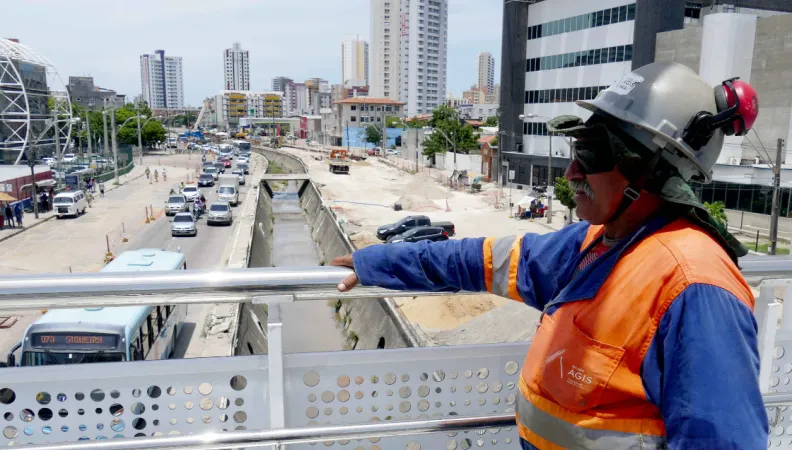
 Brazil faces significant challenges in its low-carbon transition, including maintaining global competitiveness and avoiding macroeconomic imbalances. To address these, in partnership with the Ministry of Finance, and in cooperation with CEPAL and IPEA, AFD is developing an economic modelling tool to assess the impacts of public policies, specifically those related to the Ecological Transformation Plan.
 Context
Brazil’s current development model, characterized by intensive use of natural resources and environmental degradation, has caused serious social and economic consequences. Additionally, the country faces the impacts of environmental degradation (extreme weather events, scarcity of natural resources, loss of biodiversity, reduced agricultural productivity…), that affect the poorest populations more severely.
In response, Brazil is actively engaging in the transition to a low-carbon economy. At COP28, in Dubai, Finance Minister Fernando Haddad has launched the Brazilian Ecological Transformation Plan (ETP). This Plan seeks to shift economic, technological and cultural paradigms towards sustainable development based on sustainable relationships with nature and its biomes. To achieve this, strong public and private investment – in sustainable infrastructure, clean technologies, and new production models – will be paramount.
However, achieving this ambition comes with significant challenges, particularly in maintaining external competitiveness. As it moves towards a greener economy, Brazil must ensure that its policies and investments do not compromise the competitiveness of its products in global markets, or create macroeconomic imbalances that could jeopardize the sustainability of these efforts.
Objectives
In partnership with the Ministry of Finance, and in cooperation with CEPAL and IPEA, AFD is developing a GEMMES economic modelling tool to test policy instruments capable of promoting a just and green transition.
The GEMMES Brazil model will serve to evaluate the impact of public policies, specifically the ones on the Ecological Transformation Plan, with a special focus on their long-term consequences for economic growth, employment, macroeconomic stability, and climate/environmental variables. Indeed, for a successful green transition, Brazil needs comprehensive and coordinated policies that not only cut emissions but also support socioeconomic development, protect the environment, and ensure macroeconomic stability.
GEMMES is an empirical structural macroeconomic model capable of identifying the specific dynamics of open developing countries. The model is built in partnership with local authorities and research institutes to guarantee that the tool is coherent with the country's needs and to assure that the partners are capable of using and improving independently. It is a monetary model that allows policymakers to test different policy instruments and identify the financial mechanisms and the consequences of these policies in different contexts.
Method
After developing a preliminary model calibrated with Brazilian data, the project team will refine the tool by incorporating the specific characteristics of Brazil’s sectoral, macroeconomic and financial framework:
- The model needs to account for the dynamics of interest and exchange rates and their impact on private investment and employment, as well as the fiscal and macro-financial constraints and the capacity of public investments in green infrastructure to drive a new ecological transformation plan.
- The model will also bring a sectoral approach to provide detailed estimates of the impact of climate measures and sectoral policies in the medium- and long-run, considering different domestic and international scenarios, as well as their capacity to strengthen strategic productive chains and promote structural change towards an economy less dependent on natural-resource exploitation.
Expected results
The project will result in a tool that models the macro-financial framework of the Brazilian economy, clearly identifying the mechanisms that determine interest rates and exchange rate dynamics, along with their impact on real variables (such as private sectoral investment decisions, exports, imports and market structure).
Throughout the project, the research team will organize workshops to ensure that the model responds to the specific needs of the Ministry of Finance, and training sessions will take place so that public policy analysts can use the model effectively to evaluate policy measures. Several publications, including one final book, are also expected.
Contact
-
Guilherme MAGACHO
Economist - Modeller
-
Gaëlle LE TREUT
Economist, modeller
Discover other GEMMES projects

 Can South Africa secure the necessary investments to transition to a low-carbon economy and adapt its infrastructure to climate change, while balancing economic growth and maintaining macro-financial stability? AFD is supporting South Africa in addressing climate change through the GEMMES South Africa project, developed with academic and institutional partners.
Context
South Africa requires significant investment to transition to a low-carbon economy and resilient infrastructure, especially in energy and water sectors. Heavily reliant on coal and facing increasing water scarcity due to climate change, South Africa’s shift towards sustainability is crucial for long-term environmental and economic stability.
With the support of AFD, the University of Cape Town (UCT), Development Bank of Southern Africa (DBSA), Presidential Climate Commission (PCC), National Treasury, and the Centre for Sustainability Transitions of Stellenbosch University are developing a model that evaluates the macroeconomic impacts and various policy options and financing mechanisms for transitioning South Africa's water, energy, and food (WEF) systems in response to climate challenges.
This project falls under the “South Africa – Towards Inclusive Economic Development” (SA-TIED) initiative, a research and policy programme aimed at fostering inclusive economic growth in South Africa.
The GEMMES programme is developing a general theoretical model on the one hand, and national models applied to concrete cases and adapted to the characteristics of each country on the other, including the GEMMES South Africa model.
Objectives
The GEMMES South Africa project aims to:
- Analyze the macro-financial impacts of transitioning to renewable energy, ensuring water security, and maintaining food sustainability;
- Provide policymakers with insights and forecasts to inform decision-making and long-term planning for economic growth, employment, and climate resilience and more specifically provide insights into the macroeconomic effects of climate-resilient investments up to 2050;
- Enhance understanding of the vulnerabilities and opportunities in South Africa’s transition by integrating macro-financial feedback loops into structural change analysis;
- Foster sustainable development and mitigate environmental risks, contributing to long-term economic stability and improved quality of life;
- Promoting public policy dialogue on South Africa's low carbon transition.
Method
In addition to its specific transdisciplinary approach, which makes this project one of the few to integrate the notion of strong sustainability, the originality of GEMMES lies in its consideration of macro-financial imbalances and the impact of the low-carbon transition on all elements of the balance of payments.
GEMMES South Africa builds on UCT’s SATIM-GE energy transition model incorporating macro-financial feedback loops, which provide critical insights into the country's economic vulnerabilities and investment opportunities during this transition.
GEMMES South Africa is built in partnership with local authorities and research institutes to guarantee that the tool is coherent with the country's needs and to assure that the partners are capable of using and improving independently. It will account for:
- the dynamics of interest and exchange rates and their impact on private investment and employment;
- the fiscal and macro-financial constraints;
- different dynamics between banks and non-bank financial institutions;
- the capacity of public investments in green infrastructure to drive a new ecological transformation plan;
- and, the impacts of climate changes.
Expected results
The GEMMES South Africa project anticipates several key publications, including:
- A presentation of the specificities of GEMMES-South Africa and its baseline simulations;
- The macro-financial implications of infrastructures investments;
- The macro-financial implications of climate change impacts.
These papers will provide valuable insights into the project's findings and contribute to ongoing discussions in the field.
Research findings
At this stage, while the project is still in its early phases, it is expected that integrating macro-financial feedback loops will play a significant role in shaping effective policies and investment strategies. As the project progresses, ongoing stakeholder dialogue will be crucial in refining these concepts and addressing future challenges in the transition process.
Download the publications related to other South Africa modelling projects:
Want to stay updated on AFD’s latest research?

Contacts
-
Paul HADJI-LAZARO
Economist - Modeller

-
Antoine GODIN
Economist - Modeler

Discover other GEMMES projects

 To what extent do partnerships between public actors and commons actors improve access to care? To answer this question, this action-research project examines Public-Community Care Partnerships (PCCPs), in the city of Bogotá, Colombia.
Context
The care economy is a field in which commons-based approaches are essential to tackling inequalities in access, which disproportionately affect women. Public-Community Care Partnerships (PCCPs) can be understood as a model of social commons for addressing this issue. PCCPs involve collaboration between public actors and community-led care initiatives, such as community care centers. They focus on the complementarity of action between public and community actors, with the aim of delivering public action focused on care services that are accessible and collectively managed.
This project was selected as part of AFD’s “Commons and Citizen Participation” call for research projects. This call was aimed at research projects examining the contribution of commons to democratic practices and citizen participation; the interactions between commons actors and public actors; and the capacity of the commons to shape public action. It is part of AFD’s research program on commons.
LEARN MORE ABOUT...
Objectives
The project studies Public-Community Care Partnerships in Colombia:
- By analyzing the extent to which they constitute a model for promoting access to care;
- By developing, testing, and evaluating public policy instruments to implement PCCPs, including a PCCP model contract.
This project is an action-research initiative that combines research activities with public policy dialogue in the city of Bogotá. The research is organized through learning communities, which bring together civil society actors from community care centers, project researchers, and public actors.
Through experimentation and learning by doing, the project will help answer the following research questions:
- What are the conditions for the emergence of PCCPs?
- To what extent do they constitute public policy tools?
- What governance, deliberation, compensation, and evaluation mechanisms underpin these PCCPs?
- How do PCCPs reflect a complementarity between public services and commons in terms of access to care?
Method
This participatory research, based on “learning communities,” involves public actors from both the Municipality of Bogotá and the national government from the outset of the project. The project will unfold in five stages:
- Study of the ecosystem of actors and their interrelationships in the field of care within the context under study;
- Selection of four community care centers (two as pilot partnership sites and two as counterfactuals) and conducting a diagnostic of these centers’ internal and external practices and processes (legal, accounting, logistics, communication);
- Establishment of “learning communities” in the two pilot centers conceived as spaces for dialogue and co-creation of the PCCP prototype, as well as legal and financial information and monitoring tools for the two partnerships. The pilots will run for 12 months;
- Evaluation of the pilots through in-depth interviews and surveys of stakeholders (before/after; and between community centers);
- Co-design and production of communication and dissemination materials.
Expected results
The project will produce deliverables at each stage:
- A survey report (stage 1);
- A baseline report on the analysis of the community care centers, the collaborative digital platform for knowledge management and information-sharing within the learning communities (stage 2);
- A prototype PCCP contract (stage 3);
- A report on the challenges and opportunities of learning communities around PCCPs (stage 4);
- Dissemination of the project's findings and lessons learned (stage 5).
The teams are also involved in a collective effort led by Coop des Communs, the Casa Comum platform, and AFD. The goal: to build a transnational learning community by exchanging on the work carried out, drawing on each other’s experience, and generating knowledge on the links between commons, citizen participation, and the transformation of public action. This network brings together complementary profiles — researchers, civil society, and public decision-makers involved in these experiments — coming notably from Brazil, Colombia, and Europe. Supported by meetings held in Brazil and Italy, this effort will lead to a collective volume, currently being drafted, that will compare and put into perspective the various research projects underway.
Want to stay up to date with AFD’s research news?

Contact
-
Stéphanie LEYRONAS
Research Officer