- Read more about Managing Urban commons in Brazil by drawing on Italian legal and participatory tools
This project aims to adapt legal and participatory tools developed in Italy to the Brazilian context in order to support citizen-led initiatives for managing urban commons. It is based on field studies and pilot initiatives in the cities of Goiânia and Goiás, with the objective of strengthening institutional recognition of local cooperative practices.
Context
In many Brazilian cities, residents spontaneously organize to collectively manage spaces, services, or resources: community gardens, building occupations, and cultural or solidarity-based initiatives. These practices, often referred to as “urban commons,” reflect strong civic engagement in Brazil, yet they remain insufficiently recognized by institutions. The current legal framework primarily favors public–private partnerships, often associated with the privatization of urban services.
In Italy, several cities have found concrete responses to this challenge. Since the 2000s, municipal regulations have enabled citizens to officially collaborate with authorities to take care of urban commons (public spaces, facilities, and heritage). More than 200 cities have adopted this model, which provides a legal framework without commodifying the spaces, resources, and services concerned.
It is within this context that this research project takes place. It is conducted in two cities in the state of Goiás, where strong community dynamics already exist (associations, rural communities, and cultural initiatives). More broadly, the project aligns with AFD’s research priorities on commons and citizen participation. It also contributes to AFD’s broader priorities related to strengthening local governance, citizen participation, social cohesion, and sustainable development.
Read also : How can the Commons approach transform Brazil?
Objectives
The central research question is: how to create an institutional framework that recognizes and supports these citizen-led practices without turning them into purely market-based services?
To address this, the project seeks to understand how residents in the cities of Goiânia and Goiás collectively take care of their spaces and resources. It also aims to equip local stakeholders with solutions—particularly legal tools—inspired by the Italian experience but adapted to the Brazilian context.
This will take the form of a mapping of local initiatives, the organization of workshops with relevant stakeholders, and the development of a proposed municipal regulation on urban commons. These outputs can help local authorities better support grassroots initiatives, strengthen citizen participation, and develop more inclusive public policies at lower cost.
Method
The project is based on an action-research approach: in addition to fieldwork, interviews, and observations, the research teams organize participatory workshops with residents, associations, and local authorities. A collaborative mapping exercise will document existing practices, while case studies will enable comparisons between Brazilian and Italian experiences. In a second phase, workshops will support the co-construction of concrete initiatives with local stakeholders, and seminars will foster dialogue between researchers, citizens, and policymakers.
The project draws on the expertise of two partners, the Federal University of Goiás and the Polytechnic University of Turin (Politecnico di Torino — PoliTo), as well as the experience developed within the Italian laboratory LABSUS, which specializes in regulations on commons. Local partners (civil society organizations and municipalities) are fully involved.
Expected results
In addition to scientific outputs, the project includes capacity-building activities for local partners through workshops and collaborative work. It will also deliver several outputs directly useful for local authorities:
- A collaborative mapping of urban commons practices
- A practical guide with a toolkit for local stakeholders
- A pilot project co-constructed with a citizen initiative
- A policy brief proposing a regulation on urban commons
A range of activities will support the dissemination of these tools and results: exhibitions and public events, an online platform, publications.
These outputs will provide local authorities with concrete levers to better support urban commons and will contribute to the broader debate on participatory urban policies in Brazil.
Want to stay up to date with AFD’s research news?
Contact
-
Stéphanie LEYRONAS
Research Officer
Discover more projects on the commons
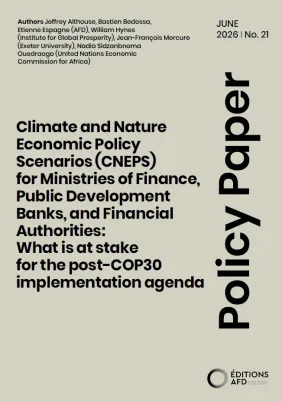
The Climate and Nature Economic Policy Scenarios (CNEPS) initiative develops forward-looking economic scenarios that integrate climate change, biodiversity loss and transition dynamics into macroeconomic policy analysis for Ministries of Finance and Public Development Banks (PDBs). Co-designed with Ministries of Finance and PDBs, CNEPS aims at connecting global, regional and country-level perspectives to explore how geoeconomic, financial, technological and environmental transformations could reshape national economies, fiscal frameworks and development pathways and how countries could coordinate economic policy mixes and financing strategies in response.
Context
Ten years after the signing of the Paris Agreement, and five years into the Kunming-Montreal Agreement, he global economy is entering a period of profound structural change, often called “mid-transition”. Climate change, biodiversity loss, energy system transitions and shifting geopolitical dynamics are increasingly shaping economic development, financial stability and public finances. Climate shocks are already affecting fiscal balances and investment needs, while ecosystem degradation threatens key economic sectors such as agriculture, water and natural resources. At the same time, the transition toward low-carbon economies is transforming supply chains, trade relations and industrial strategies.
For Ministries of Finance, these dynamics are emerging as core macroeconomic risks while fostering new opportunities. Yet existing policy frameworks often struggle to integrate climate and nature fat-tailed risks (explication ou lien) into a systemic framework. Developing forward-looking economic scenarios that capture these interactions is therefore essential to support resilient fiscal planning and long-term development strategies.
It is in this context that AFD has launched the Climate and Nature Economic Policy Scenarios (CNEPS) initiative, a multilateral platform for the development of forward-looking economic scenarios to help policymakers anticipate these transformations and inform economic policy choices. It joins forces with an ecosystem of institutional, regional and academic partners to foster a shared language on plausible futures and related resilient economic policies.
Objective
The Climate and Nature Economic Policy Scenarios (CNEPS) initiative aims to develop forward-looking economic scenarios that help integrate climate change, biodiversity loss and transition dynamics into macroeconomic policy analysis. The project focuses on three main objectives:
- Technical integration: integrate climate and nature fat-tailed risks within macroeconomic policy frameworks, exploring nonlinear shocks, tipping points and geopolitical regime shifts, while building on existing structured country collaborations of AFD as well as regional and institutional partners.
- Policy interface: translate joint global scenarios into implications for fiscal policy, debt sustainability, industrial strategies and investment planning, while supporting champion countries in developing resilient national financing strategies.
- Coalition building: mobilise Ministries of Finance, Public Development Banks and academic partners, and connect existing finance-minister and public development banking platforms to scale impact and strengthen policy dialogue.
Method
The approach brings together global analytical work and country-level collaboration to explore how climate and nature risks, transition dynamics and geopolitical shifts could affect national economies and public finances.
The initiative builds on partnerships between research institutions, development finance actors and Ministries of Finance in participating countries. Academic partners contribute modelling expertise and scenario design, while Ministries of Finance and Public Development Banks provide policy perspectives and help identify the most relevant economic questions and applications.
The project mobilises an international knowledge network and works with partner countries to ensure that the scenarios developed respond to concrete policy needs and strengthen local analytical capacity.
For this project, AFD is partnering with the University of Exeter.
Expected results
The CNEPS initiative will deliver a first generation of forward-looking economic scenarios exploring how climate change, biodiversity loss and global transition dynamics could affect national economies and public finances.
Key outputs will include a first mid-transition analytical report presenting emerging global trends and systemic risks, as well as a first set of global scenarios developed with champion countries and regional partners. These scenarios will be translated into country-level assessments exploring implications for resilient fiscal policy, debt sustainability and investment strategies.
The project will also support participating countries in developing a first series of national CNEPS strategies aimed at informing resilient financing pathways and long-term economic planning.
Beyond analytical outputs, the initiative will contribute to policy dialogue and capacity strengthening through workshops, regional exchanges and engagement with international platforms bringing together Ministries of Finance and Public Development Banks.
Events
Several events were organized as part of the CNEPS Initiative :
This workshop convened over 240 participants, including representatives from Ministries of Finance, central banks, financial supervisors, public development banks, ministries of environment and development co-operation, research institutes, and academia. The event comprised a technical workshop in the morning and high-level sessions in the afternoon, both held under the Chatham House rule.
In an increasingly fragmented geopolitical landscape, this one-day conference co-organized by AFD and the Energy Institute of University of Texas (Austin) in Paris convenes leading academics, policymakers and philanthropies to address a critical blind spot in global climate policy debates: the interactions between the transformation of energy systems and geopolitical shifts.
Across four sessions, the conference will explore why existing economic frameworks—often built on assumptions of global cooperation, free trade, and exogenous growth unrelated to energy use—fail to account for rising tensions and the non-linear risks associated with stranded assets and energy costs:
- Session 1: Understanding the role of energy in economic transitions: lessons from the 1970s to today
- Session 2: The geoeconomic turn of the energy transition: energy security, energy affordability and energy imperialism.
- Session 3: The macrofinancial turn of the energy transition: stranded assets, cost of capital and balance of payment instabilities
- Session 4: Building scenarios for the mid-transition period: what can the models tell us?
Dans un contexte géopolitique de plus en plus fragmenté, cette conférence d’une journée, co-organisée par l’AFD et l’Energy Institute de l’Université du Texas (Austin) à Paris, réunit des universitaires de premier plan, des décideurs politiques et des organisations philanthropiques pour aborder un angle mort critique dans les débats mondiaux sur la politique climatique : les interactions entre la transformation des systèmes énergétiques et les mutations géopolitiques.
Paris 20 March 2026- Agence Française de Développement (AFD) and the University of Exeter signed a Memorandum of Understanding at the British Embassy in Paris to strengthen collaboration on climate and nature economic policy analysis for Ministries of Finance and Public Development Banks.
Contacts
- Etienne Espagne, Senior Economist, AFD
- Jean-François Mercure, Professor of Climate Policy, Exeter University
- Sam Mugume Koojo, Deputy Co-Chair CFMCA, Country Platform Hub, PAFCA
- Laura Sabogal Reyes, FiCS
Discover other research projects
When Research Informs Public Action: A Toolkit to Rethink Monitoring and Evaluation
Completed
2020 - 2025
Exploring the dilemmas of Africa’s agroecological transition by 2050 (TAASF2050)
Ongoing
2022 - 2026
This project developed a simple method to improve the monitoring and evaluation of initiatives that seek to inform public action through research. This method enables a better understanding of the actual effects of these approaches on public decision-making, strengthens their governance, and promotes a more concrete use of scientific findings in the development of public policies.
Context
Public decision-makers are increasingly encouraged to rely on research-based evidence to design effective policies. However, in practice, scientific findings struggle to circulate beyond the academic world: they often arrive too late, are written in language that is not easily accessible outside academic circles, or are poorly suited to the concrete challenges faced by public actors.
At the same time, projects that foster dialogue between researchers and policymakers are complex to implement and evaluate: they must constantly adapt to shifting political contexts and produce diffuse or indirect effects that are not easily measured. Traditional monitoring and evaluation tools, centred on quantitative indicators, rigid frameworks and logical matrices, fail to capture these dynamics effectively. They are primarily used for accountability to donors, rather than for collective learning or project adaptation.
AFD supports numerous research projects aimed at informing public action. Observing this gap between researchers and policymakers, it sought to develop a monitoring and evaluation method that is more useful, more flexible, and better suited to these projects, in order to improve the measurement of their real impact and strengthen the influence of research on public policy.
Objectives
The project consisted of designing a monitoring and evaluation method specifically tailored to initiatives that connect research and public action. It addresses a twofold challenge: tracking the real effects of these projects over time, and helping stakeholders in managing them more effectively in uncertain and shifting contexts.
Rather than limiting itself to a purely accounting-based quantification of activities or formal outputs (number of reports, workshops or publications), the method focuses above all on the changes the project has helped set in motion: have trust-based relationships been built? Are the knowledge outputs being mobilised? Are practices and modes of collaboration evolving? Underlying this is a threefold objective: to better understand what truly works by identifying relevant signals of change; to produce useful information for adjusting strategies during project implementation (identifying obstacles, reinforcing effective actions); and to improve the formulation of public policy recommendations.
This approach contributes to enhancing the quality of public decisions by promoting a more concrete, more practical, consistent, and targeted use of scientific knowledge.
Results
The project resulted in a research paper, a technical report, and a monitoring and evaluation toolkit designed for development practitioners.
This method was tested on real-world research projects and co-developed with the various types of stakeholders involved, in order to capture their respective needs and constraints: researchers and public institutions, but also local organisations, civil society actors, and donors.
The approach is intentionally light and adaptable, allowing it to fit the time and resource constraints of partners, particularly in countries of the Global South. Local stakeholders are fully involved in data collection, interpretation, and the adjustment of actions. In practice, the method combines collective workshops, simple data collection tools (interviews, testimonials, observations), and moments of shared analysis. It draws in particular on the "theory of change", a tool that enables a team to clarify the expected outcomes of a project, the intermediate steps required, and the conditions for success.
Resources
Application Cases
The monitoring and evaluation method was tested across around ten projects in North Africa, Madagascar and the Sahel region, before being deployed across other geographies. It led to the following results:
- Exchanges between researchers, policymakers and local partners enabled the dissemination of findings and the sharing of lessons learned.
- Institutional and academic partners strengthened their capacities in monitoring and evaluation, policy dialogue facilitation, and project impact analysis.
- In several cases, the approach helped adjust strategies during implementation and improve the formulation of recommendations for policymakers. In doing so, it contributed to a more structured, better informed and more sustainable dialogue between research and public action.
FOCUS ON… COMMONS FOR CARE IN COLOMBIA
Applied in January 2025 as part of the Public–Commons Partnerships in Health in Colombia project, the method helped recalibrate the project’s level of ambition by aligning initially mismatched objectives and activities, while also informing its ongoing management during implementation.
Next steps
This approach advances thinking on the use of research in public action by demonstrating that effective monitoring and evaluation can serve as a strategic management tool, rather than merely a control mechanism. It highlights the need to strengthen local capacities in monitoring and evaluation, as well as skills in facilitating dialogue between science and public decision-making.
However, some questions remain regarding the sustainability of the observed effects and the ability to scale up the approach. Further experimentation is underway to consolidate the methodology and adapt it to other contexts. The toolkit will also soon be deployed in the context of macroeconomic modelling projects, illustrating the approach’s strong thematic adaptability—one of its key added values.
Contacts
- Stéphanie Leyronas
- Camille Tchounikine
- Annabelle Moreau Santos
- Sophie Salomon
Discover other research projects
When Research Informs Public Action: A Toolkit to Rethink Monitoring and Evaluation
Completed
2020 - 2025