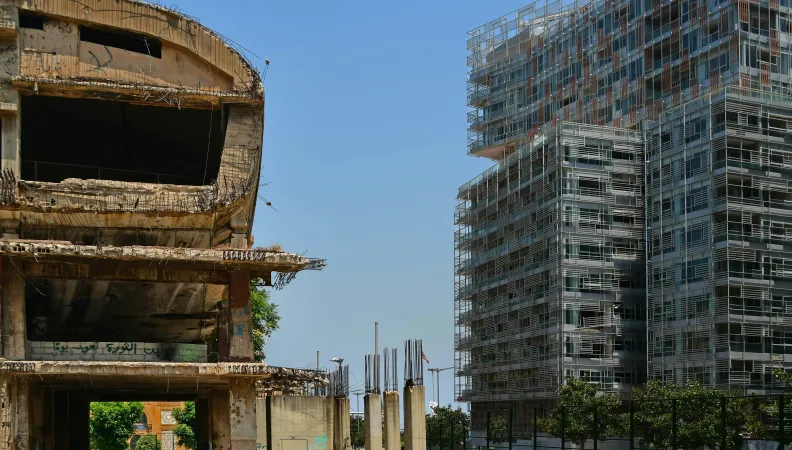
 In a Middle East undergoing profound reconfiguration, while Lebanon, Syria and Gaza face massive destruction across their territories, this observatory aims to analyse the dynamics and modalities of the reconstruction processes currently taking shape. These comparative insights will enable AFD and its partners to better understand these operating environments and the dynamics among the actors involved, in order to act effectively.
Context
Lebanon, Syria, Gaza: the Middle East is home to some of the world's most complex reconstruction efforts, taking place in conflict and post-conflict settings and involving significant financing challenges. For Syria alone, the World Bank estimates reconstruction costs at 216 billion dollars.
However, the challenges are not solely financial or technical: these reconstruction processes unfold within complex political, economic and social environments, involving many stakeholders whose interests and approaches may sometimes diverge. To engage effectively in this complex geopolitical landscape, a thorough understanding of the operating environments is essential – not only for AFD Group, but also for other development actors.
Objectives
Led by IFRI and coordinated by AFD, this observatory project analyses the state of destruction and the prospects for reconstruction across three territories: Gaza, Lebanon and Syria. Its aims to :
- Understand the local dynamics (social, political and economic) of reconstruction : What are the actual needs? What is the state of the social fabric? Who are the key stakeholders and how do they interact?
- Identify practical and feasible reconstruction pathways : What positions are the governments of these countries taking? What role can the private sector play, and how can public-private partnerships be structured? What role can civil society organisations and diasporas play?
- Compare the positioning of external actors (European institutions and states, Israel, the United States, Gulf countries, Turkey, China, Iran and Russia) : What reconstruction plans are being proposed, and what is the level of their involvement? How do diplomacy, reconstruction and economic interests interact? Do these actors prioritise humanitarian assistance or reconstruction? What is France’s position?
Method
To stay as close as possible to developments in this fast-moving context, a monitoring system will be established to map reconstruction projections and track decisions made by the various countries involved. IFRI will produce maps whenever relevant to support a better understanding of the broader challenges.
Three field missions will be carried out directly by IFRI researchers and/or researchers based in the region. The methodology will primarily rely on interviews, conducted either in person or remotely when travel is not possible. Syria is a particularly relevant case in this regard, as territorial disparities pose a major challenge for operators.
Operating in an interactive manner, the observatory will remain open to regular and on-request exchanges with French institutions that share an interest in these questions.
Expected results
The project deliverables will include:
- Field mission reports with an oral presentation of findings;
- Publications on cross-cutting themes within IFRI’s publication series;
- A final report, covering all three reconstruction efforts and framed around a central research question, published in the collections of Éditions Agence française de développement;
- A final conference that may introduce comparative perspectives (Ukraine, Africa).
Contacts
- Dorothée SCHMID, Program Manager for Turkey/the Middle East, IFRI
- Elodie RICHE, Research Officer, AFD
Want to stay up to date with AFD’s research news?

Discover other research projects
When Research Informs Public Action: A Toolkit to Rethink Monitoring and Evaluation
Completed
2020 - 2025
 The Climate and Nature Economic Policy Scenarios (CNEPS) initiative develops forward-looking economic scenarios that integrate climate change, biodiversity loss and transition dynamics into macroeconomic policy analysis for Ministries of Finance and Public Development Banks (PDBs).
 Co-designed with Ministries of Finance and PDBs, CNEPS aims at connecting global, regional and country-level perspectives to explore how geoeconomic, financial, technological and environmental transformations could reshape national economies, fiscal frameworks and development pathways and how countries could coordinate economic policy mixes and financing strategies in response.
Context
Ten years after the signing of the Paris Agreement, and five years into the Kunming-Montreal Agreement, he global economy is entering a period of profound structural change, often called “mid-transition”. Climate change, biodiversity loss, energy system transitions and shifting geopolitical dynamics are increasingly shaping economic development, financial stability and public finances. Climate shocks are already affecting fiscal balances and investment needs, while ecosystem degradation threatens key economic sectors such as agriculture, water and natural resources. At the same time, the transition toward low-carbon economies is transforming supply chains, trade relations and industrial strategies.
For Ministries of Finance, these dynamics are emerging as core macroeconomic risks while fostering new opportunities. Yet existing policy frameworks often struggle to integrate climate and nature fat-tailed risks (explication ou lien) into a systemic framework. Developing forward-looking economic scenarios that capture these interactions is therefore essential to support resilient fiscal planning and long-term development strategies.
It is in this context that AFD has launched the Climate and Nature Economic Policy Scenarios (CNEPS) initiative, a multilateral platform for the development of forward-looking economic scenarios to help policymakers anticipate these transformations and inform economic policy choices. It joins forces with an ecosystem of institutional, regional and academic partners to foster a shared language on plausible futures and related resilient economic policies.
Objective
The Climate and Nature Economic Policy Scenarios (CNEPS) initiative aims to develop forward-looking economic scenarios that help integrate climate change, biodiversity loss and transition dynamics into macroeconomic policy analysis. The project focuses on three main objectives:
- Technical integration: integrate climate and nature fat-tailed risks within macroeconomic policy frameworks, exploring nonlinear shocks, tipping points and geopolitical regime shifts, while building on existing structured country collaborations of AFD as well as regional and institutional partners.
- Policy interface: translate joint global scenarios into implications for fiscal policy, debt sustainability, industrial strategies and investment planning, while supporting champion countries in developing resilient national financing strategies.
- Coalition building: mobilise Ministries of Finance, Public Development Banks and academic partners, and connect existing finance-minister and public development banking platforms to scale impact and strengthen policy dialogue.
Method
The approach brings together global analytical work and country-level collaboration to explore how climate and nature risks, transition dynamics and geopolitical shifts could affect national economies and public finances.
The initiative builds on partnerships between research institutions, development finance actors and Ministries of Finance in participating countries. Academic partners contribute modelling expertise and scenario design, while Ministries of Finance and Public Development Banks provide policy perspectives and help identify the most relevant economic questions and applications.
The project mobilises an international knowledge network and works with partner countries to ensure that the scenarios developed respond to concrete policy needs and strengthen local analytical capacity.
For this project, AFD is partnering with the University of Exeter.
Expected results
The CNEPS initiative will deliver a first generation of forward-looking economic scenarios exploring how climate change, biodiversity loss and global transition dynamics could affect national economies and public finances.
Key outputs will include a first mid-transition analytical report presenting emerging global trends and systemic risks, as well as a first set of global scenarios developed with champion countries and regional partners. These scenarios will be translated into country-level assessments exploring implications for resilient fiscal policy, debt sustainability and investment strategies.
The project will also support participating countries in developing a first series of national CNEPS strategies aimed at informing resilient financing pathways and long-term economic planning.
Beyond analytical outputs, the initiative will contribute to policy dialogue and capacity strengthening through workshops, regional exchanges and engagement with international platforms bringing together Ministries of Finance and Public Development Banks.
Events
Several events were organized as part of the CNEPS Initiative :
A French Development Agency (AFD), Finance in Common (FiCS), International Development Finance Club (IDFC), UCL Institute for Global Prosperity (IGP) and The New Alignment (TNA) roundtable on Ministries of Finance, Public Development Banks and the incoming COP31 and UK G20 Presidency. The event explores how Climate and Nature Economic Policy Scenarios (CNEPS) can help Ministries of Finance and Public Development Banks coordinate around country platforms and other country-led investment frameworks to accelerate implementation in a turbulent mid-transition context.
In an increasingly fragmented geopolitical landscape, this one-day conference co-organized by AFD and the Energy Institute of University of Texas (Austin) in Paris convenes leading academics, policymakers and philanthropies to address a critical blind spot in global climate policy debates: the interactions between the transformation of energy systems and geopolitical shifts.
Across four sessions, the conference will explore why existing economic frameworks—often built on assumptions of global cooperation, free trade, and exogenous growth unrelated to energy use—fail to account for rising tensions and the non-linear risks associated with stranded assets and energy costs:
- Session 1: Understanding the role of energy in economic transitions: lessons from the 1970s to today
- Session 2: The geoeconomic turn of the energy transition: energy security, energy affordability and energy imperialism.
- Session 3: The macrofinancial turn of the energy transition: stranded assets, cost of capital and balance of payment instabilities
- Session 4: Building scenarios for the mid-transition period: what can the models tell us?
Dans un contexte géopolitique de plus en plus fragmenté, cette conférence d’une journée, co-organisée par l’AFD et l’Energy Institute de l’Université du Texas (Austin) à Paris, réunit des universitaires de premier plan, des décideurs politiques et des organisations philanthropiques pour aborder un angle mort critique dans les débats mondiaux sur la politique climatique : les interactions entre la transformation des systèmes énergétiques et les mutations géopolitiques.
Paris 20 March 2026- Agence Française de Développement (AFD) and the University of Exeter signed a Memorandum of Understanding at the British Embassy in Paris to strengthen collaboration on climate and nature economic policy analysis for Ministries of Finance and Public Development Banks.
This workshop convened over 240 participants, including representatives from Ministries of Finance, central banks, financial supervisors, public development banks, ministries of environment and development co-operation, research institutes, and academia. The event comprised a technical workshop in the morning and high-level sessions in the afternoon, both held under the Chatham House rule.
Contacts
- Etienne Espagne, Senior Economist, AFD
- Jean-François Mercure, Professor of Climate Policy, Exeter University
- Sam Mugume Koojo, Deputy Co-Chair CFMCA, Country Platform Hub, PAFCA
- Laura Sabogal Reyes, FiCS