
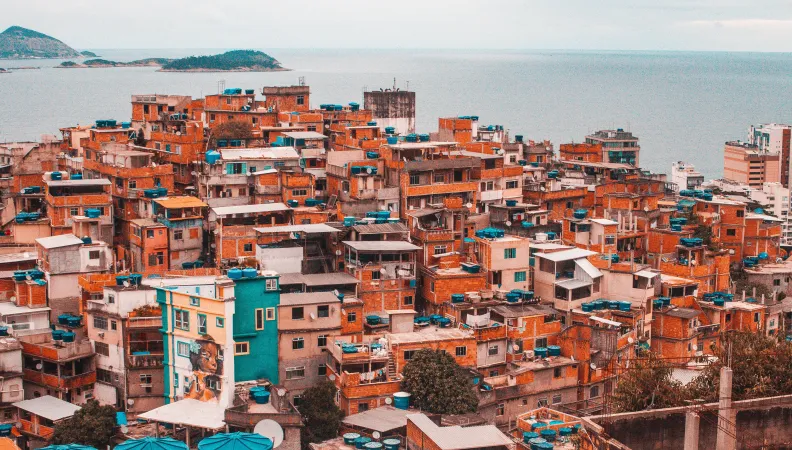
 This research project focused on collective arrangements for access to land and housing in developing cities that are linked with the concept of commons. It studied the implementation of some collective forms of land use in developing cities and their effects, particularly in terms of access to land and housing, reduction of urban inequalities and social inclusion.
Context
Despite a renewed interest for the notion of “commons” within the academic world, little work has been done about land and housing issues in cities of the Global South.
Yet access to urban land is a major issue for dwellers of these rapidly growing cities and a determining factor for the improvement of their living conditions and for their access to “adequate housing”, according to UN terminology. The mainstream approach to urban land tenure, based on full individual private ownership and the free market, generates speculation and land grabbing, and exclusion of the most precarious households.
The critical dimension of the commons notion opens up innovative ways to produce housing in the Global South, according to plural perspectives that take into consideration the inhabitant’s needs and their agency abilities.
Objectives
This research project aimed to highlight the diversity of hybrid, permeable, evolving commons within space and time. These commons aim at getting and securing access rights to land and housing and associated services, which often arise from unexpected opportunities.
The research team looked at innovative ways of holding land: commonly held, with a housing function and in a nonspeculative perspective (when the transfer of land is carried out according to a framework decided beforehand by a community, without any capital benefit).
Method
The methodology was based on case studies in developing cities:
- The first phase of the study (2017-2018) led to three field surveys in Burkina Faso, Kenya and India.
- The second phase (2018-2020) consisted of two additional field surveys (Brazil, Mexico), as well as the follow-up of the work carried out in New Caledonia by students in the framework of the School of Urban Affairs (Master’s Degree « Urban Planning Cycle») of Sciences Po Paris.
The team consisted of:
- An academic with authorization to supervise research (HDR), who directed the study;
- A research engineer, who provided the scientific coordination of the study;
- Local researchers specialising in land and urban issues in survey countries.
The study consisted of five phases: documentary research, field research, data processing, drafting of deliverables, valorisation of research findings.
Results
This research project resulted in the publication of several research papers:
- “Land-based commons for inclusive cities” (available in French): this research paper presents the conclusions of 8 case studies, focused on securing popular habitat through shared ownership of the land.
- “Does Mexico’s social land still bear commons?” (available in French): Mexican common land has undergone major transformations since the 1990s. This research paper presents the study on the outskirts of the metropolitan area of Mexico City led by the students of the Urban Planning Programme of Sciences Po Paris, under the supervision of Jean-François Valette.
- “Regularizing Rio favelas through land pooling?”: the paper sheds light on an original system of collective land regularization in precarious neighborhoods, which puts into practice the notion of “plural property” running through Brazilian law, and which defends the right of the inhabitants to remain in place.
- “User cooperatives in Uruguay: the challenge of housing as common” (available in Spanish)
The final report of the research project on urban land-based commons for housing in the Global South can be downloaded here.
All the publications and events related to the research project are listed on the following website: Communs fonciers pour l’habitat – Quelle contribution à l’inclusion urbaine dans les Suds ? (hypotheses.org)
Lessons learned
"The commons can be understood as a social policy of housing, offering access to housing to the most vulnerable social categories. Moreover, they can provide an alternative path to classical public housing policies which favor individual private property. Indeed, even though these initiatives emerge from dwellers organizations, they might be supported and framed by national governments. Often acknowledged, supported and even presented as standard to be followed, the commons have drawn increased attention recently from dwellers federations, associations, NGOs and international institutions that document their functioning and contribute to the international circulation of these alternative ideas." (Simonneau & Denis, 2021)
Contacts
- Claire Simonneau, professor and researcher at Université Gustave Eiffel and researcher at the Laboratoire Techniques, territoires et sociétés (LATTS)
- Stéphanie Leyronas, research officier at AFD