Share the page
Defining an alternative path for AI governance in the Global South
Published on
As AFD takes part in the AI for Good Summit, two recent studies it supports outline ways to build artificial intelligence (AI) governance that fully includes countries in the Global South, particularly in Africa.
Both the Global Dialogue on AI Governance (6–7 July) and the AI for Good Summit (7–10 July) place a strong emphasis on AI governance – meaning the rules, public policies, and institutions that shape the development and use of AI. Two AFD partnerships highlight practical ways to strengthen this governance by placing African perspectives at the center of international discussions.
Maximizing benefits while managing risks
Supported by appropriate governance, AI can contribute to sustainable development in many ways, from improving epidemic detection and expanding farmers' access to climate services to making language learning more accessible. As AI evolves rapidly, countries need strategies, public policies, and regulatory frameworks that maximize its benefits while addressing risks related to data protection, cybersecurity, accountability, and fundamental rights.
Integrating African perspectives into AI governance
Developing effective AI governance remains a global challenge, including across Africa. The report Africa-Europe Cooperation on the Governance of Artificial Intelligence, produced by Lawyers Hub with support from AFD, shows that although national AI strategies and governance frameworks are becoming more common, implementation remains the main challenge.
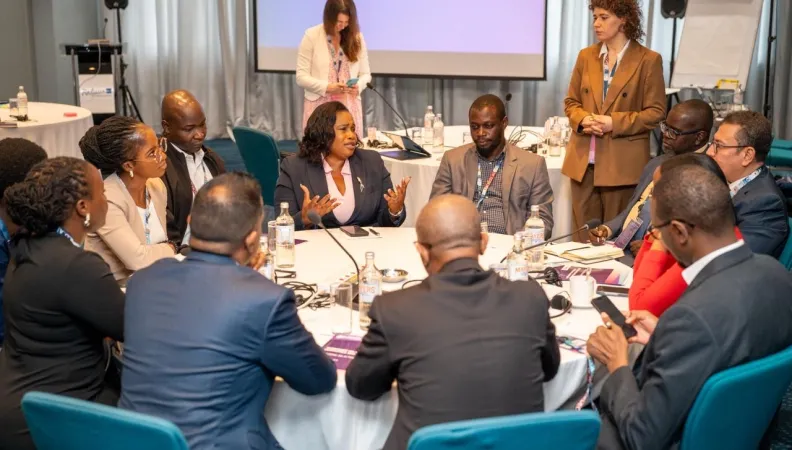
This finding was reinforced during a meeting held in Nairobi in March 2026 by AFD, the Organisation for Economic Co-operation and Development (OECD), the UK Foreign, Commonwealth & Development Office (FCDO), and the Government of Kenya. The event brought together public officials and representatives from Africa's AI ecosystem. Participants identified several key obstacles, including limited digital infrastructure, insufficient computing capacity, connectivity challenges, skills shortages, and gaps in data governance, institutional capacity, and regulatory frameworks.
More broadly, these challenges reflect an imbalance in global AI governance. African countries remain underrepresented in the development of international standards, despite the direct impact those standards have across the continent. Alongside the dominant Chinese and US approaches, a third path based on inclusion, cooperation, and sustainable development is emerging as an important alternative.
Renewing regional cooperation
During the March 2026 workshop, several countries presented recent progress. South Africa and Benin have adopted personal data protection laws, while Senegal and Egypt are strengthening their digital infrastructure and integrating AI into education. Participants emphasized the importance of stronger regional cooperation to pool expertise, share experience, and develop approaches tailored to local contexts.
The Lawyers Hub report similarly calls for shared AI governance that fully involves African countries in shaping international standards, with support from development finance institutions to strengthen research, regulatory capacity, and public institutions.
AFD Group supports France and Europe in advancing responsible AI
AFD Group is supporting this momentum through its financing and research activities. It has developed the AI Potential Index, a tool that assesses countries' AI readiness and needs, including infrastructure, skills, and data governance, to help direct investment toward responsible and inclusive AI ecosystems.
Through its subsidiary Expertise France, AFD Group also supports partner countries through several initiatives.
In Senegal, the Goin' Digital project, co-financed by the European Union, France, and Germany, supports implementation of the national AI strategy by strengthening public sector capabilities, the startup ecosystem, and open data.
In Botswana, the EU Support to Digital Transformation project helps modernize digital governance by drawing on French expertise in AI.
In the Mediterranean region, the Structuration du secteur IA en Méditerranée (Sila) (Structuring the AI Sector in the Mediterranean) project, financed by the Fonds Équipe France (Team France Fund), supports AI startups, strengthens business support organizations, and promotes cooperation among researchers, entrepreneurs, and public authorities.
Further reading
Read more
Financial and digital inclusion for women in Africa: seven years of action by the G7 Partnership
Published on July 1, 2026

[Feature report] Africa Forward summit: Nairobi hosts a new dialogue between France and Africa
Published on May 11, 2026

Coalition launched to strengthen dialogue between public development banks and civil society
Published on June 16, 2026