Share the page


Support to Transnet’s freight decarbonization and corporate sustainability program
Project

-
Project start date
-
Status
Ongoing
-
Project end date
-
-
Project duration
-
15 years
-
AFD financing amount
-
€ 300 000 000
-
Country and region
-
Location
-
South Africa
-
Type of financing
-
Beneficiaries
-
Transnet SOC Limited


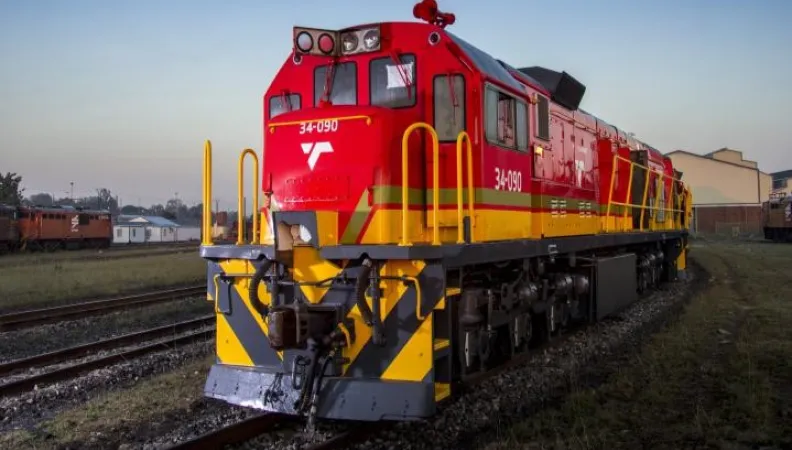
Transnet SOC Limited (“Transnet”) and France, through Agence Française de Développement (AFD), signed a EUR 300M (approximately ZAR5,8bn) loan agreement to enhance Transnet’s contribution to a more resilient and efficient South African economy in the face of climate change.
Context
Transnet is the national public operator in charge of rail freight transport and most ports in South Africa. Transnet plays an enabling role in South Africa’s Just Energy Transition Investment Plan (JET-IP) due to its strategic position in freight and energy related logistics, and its stated objective to reduce the carbon intensity of its operations.
The transport operator nevertheless faces a combination of structural and operational challenges that have led to a gradual deterioration in its performance and competitiveness, aggravated by the Covid crisis. These challenges are also compounded by extreme weather events, such as flooding, which illustrate the increasing vulnerability of rail and port infrastructure to the effects of climate change.
In 2023, Transnet launched a recovery plan that aims to stabilize and increase the group’s activities and to lay the foundation for a more permanent, resilient and sustainable trajectory. The recovery plan outlines large-scale investments in rolling stock renewal, track rehabilitation, port modernization and energy transition to restore performance and align with climate and social priorities of South Africa’s Just Energy Transition Investment Plan (JET-IP). The AFD loan facility intends to contribute to Transnet’s transformation efforts.
This loan forms part of France’s contribution to South Africa’s Just Energy Transition Partnership (JETP), implemented by AFD since 2021, and fulfils France’s €1 billion commitment announced at COP26.
Description
The AFD loan supports the “Transnet Freight Decarbonization and Corporate Sustainability Program,” which aims to strengthen Transnet’s operational sustainability and advance the decarbonization of South Africa’s freight sector. It focuses on improving its operational efficiency, enabling a transition to a low-carbon operating model aligned with South Africa’s JET-IP, and enhancing the company’s long-term financial sustainability. Unlike traditional project finance, where loan proceeds are allocated to specific investments, Transnet retains the flexibility to deploy funds across a widely defined programme, allowing it to respond dynamically to its evolving business needs.
Disbursements of this loan are conditional on Transnet achieving certain mutually-agreed milestones, including:
- Modernisation of core transport operations to improve service quality and reliability. This will be achieved through the rehabilitation of 550 km of rail along the Cape and Container corridors, improving reliability and enabling a shift of freight from road to lower-carbon rail transport;
- Enhancement of Transnet’s strategic business diversification (explore green hydrogen and transition minerals logistics to replace anticipated decline in coal volumes);
- Preparation for procurement of 300 GWh of renewable energy by 2027, to support the pathway to net-zero emissions;
- Strengthening of Transnet’s ESG capacities. These milestones are intended to reduce emissions intensity across Transnet’s operations, strengthen the climate resilience of priority corridors, and deliver governance improvements that reinforce Transnet’s long-term climate change resilience.
Impacts
The programme will support Transnet’s decarbonization strategy and could generate annual reductions of at least 360,000 tCO2 eq per year. This ambition is based on (i) on a modal shift from road to rail enabled by the rehabilitation of 550 km of strategic railway lines by the end of 2027; and (ii) on the purchase in substitution of 300 GWh of renewable electricity by 2027, or 20% of the current annual demand of Transnet’s railway division. The program also provides for the strengthening of Transnet’s environmental and social management system, through obtaining ISO 14001 and 45001 certifications and developing internal skills.
Sustainable Development Goals
Industry, Innovation and Infrastructure
Goal 9 promotes the resilient and sustainable development of infrastructure, industrialization, and innovation. These sectors must be drivers for poverty reduction and improved quality of life worldwide – while limiting environmental impact.
SDG 9 calls for financial, technological, and technical support to industries, and for promoting innovation and scientific research. Achieving this goal requires strengthened international cooperation in R&D, and effective technology transfer to developing countries.
Reduced Inequalities
Goal 10 calls on countries to adapt policies and legislation to increase the income share of the poorest 40% and to reduce wage inequalities based on gender, age, disability, social or ethnic origin, or religion. This includes promoting greater representation of developing countries in global decision-making.