
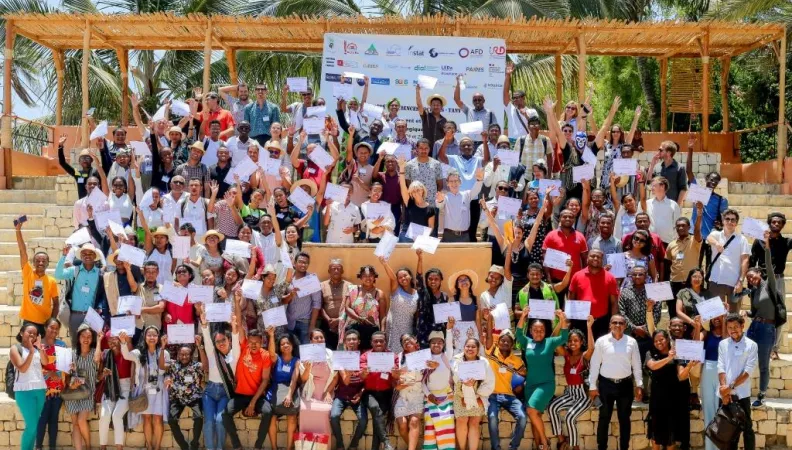
 Closing ceremony of the Tany Vao 2022 summer school in Madagascar. PAIRES is a partnership between AFD and the French National Research Institute for Sustainable Development (IRD) that funds a series of impact assessments of development interventions supported by AFD, with a focus on research from the Global South.
 Context
A partnership between the French National Research Institute for Sustainable Development (IRD) and AFD was established in 2020 to identify and implement a series of impact evaluations of interventions supported by AFD. The IRD provides the expertise, networks, and operational capacity to carry out these evaluations with partners in the Global South. The partnership was extended in October 2024, allowing new projects to be selected for evaluation.
Impact evaluations aim to provide information on the effectiveness of projects in producing concrete development results. The objective is to estimate whether the effect observed following an intervention is actually attributable to that intervention, and to what extent. To do this, assessments rigorously measure the effects of interventions using quantitative, qualitative, or mixed methods.
This project takes place in a context when there are growing expectations for evaluations that provide a better understanding and measurement of the results and impacts of development interventions. It contributes to meet these expectations in the same way as other types of evaluation, particularly project evaluations carried out by French cooperation actors.
The IRD is recognized for its scientific excellence, its multidisciplinary approach, its experience in conducting impact evaluations, and its local presence, which enables it to develop close ties with university teams and national statistical institutes in the South with which it can collaborate. This collaboration is also part of a shared research agenda and is covered by an institutional partnership between AFD and the IRD.
Objectives
The PAIRES program funds impact evaluations of development projects financed by AFD Group, with three objectives:
- To enrich dialogue with public authorities and stakeholders on development projects and their results;
- To strengthen the role, skills, and practice of research in the South in the field of impact evaluation;
- To foster academic debate on key development issues.
Method
Impact evaluations use methods derived from social science research to identify and measure the effects that are strictly attributable to an intervention. Quantitative methods generally involve comparing changes in the situation of the population benefiting from the intervention with those of a population that has not been exposed to the intervention but is comparable to the beneficiary population. Impact evaluation, generally using counterfactuals, therefore makes it possible to isolate the causal effect of an intervention on a variable of interest and to quantify that effect.
Beyond promoting impact evaluations, the PAIRES partnership promotes multidisciplinary evaluations, combining quantitative and qualitative methodologies in order to strengthen the lessons learned about the mechanisms underlying change (or the absence of change).
In addition, the PAIRES program involves researchers from the countries of intervention in all its studies to ensure that the specificities of each context are taken into account and with a view to capacity building.
Results
Over its first five years of implementation, PAIRES has mobilized 6 French research laboratories and 10 laboratories in the Southern countries concerned. A total of 8 impact evaluations, 8 feasibility studies, and 4 training courses have been funded since the project began.
The ongoing impact evaluations cover 11 countries in Africa, Asia, and Latin America and span a range of sectors (health, energy, biodiversity, infrastructure, education, gender equality). They have enabled collaboration with several academic, public, and civil-society institutions in France and in Global South countries. Other evaluations are currently being identified.
In terms of capacity building, PAIRES has notably supported two summer schools and four training courses in geospatial impact evaluation in Madagascar. The program has also funded two joint doctoral contracts between the University of Antananarivo and Paris Saclay University.
Lessons learned from impact assessments
Find below the publications and blog articles related to the impact assessments funded under the PAIRES partnership.
The REDGAS assessment aimed to quantify the health, economic, and social impacts of access to gas cooking for households in Burkina Faso.
Publications :
- REDGAS : Retours sur l’enquête de situation de référence
- Mesures de l’exposition des personnes aux particules fines par méthode gravimétrique dans le cadre de l’étude REDGAS
- Pollution de l’air et consommation de bois au Burkina Faso
- Se baser sur le terrain pour mieux cibler l’intervention : Une étude socioanthropologique en baseline
- Seroprevalence and risk factors for SARS-CoV-2 infection in middle-sized cities of Burkina Faso: A descriptive cross-sectional study
- Reducing Pollution from Cooking Smoke: key lessons from the REDGAS randomized study in Burkina Faso
- Présentation du projet et de ses résultats
- Clean Cooking: Insights from two new AFD and FID Experiments
Do forest management plans contribute to promoting the sustainable use of forest resources in the Congo Basin?
Publications :
- Impact Evaluation Study of Forest Management Systems on the Forest Cover in the Congo Basin
- Do forest-management plans and FSC certification help avoid deforestation in the Congo Basin?
- Focus : Plans d’aménagement forestier et conditions de vie des populations des forêts d’Afrique centrale
- Plans d'aménagement forestier et conditions de vie des populations des forêts d'Afrique centrale : une revue de la littérature
The BETSAKA project (Biodiversity-economic tradeoff and synergy assessments for conservation areas): what are the environmental and socioeconomic impacts of terrestrial protected areas in Madagascar from 2000 to 2024?
Publications :
- Impact of protected areas on deforestation in Madagascar from 2000 to 2023: A pre-analysis plan | PLOS One
- Long-term socio-environmental monitoring of protected areas is a persistent weak point in developing countries: Literature review and recommendations
- Madagascar rural observatory surveys, a longitudinal dataset on household living conditions 1995–2015
What has been the impact of the Health Voucher on the use of maternal health services by pregnant women in Cameroon?
Publications :
- Coming soon
What is the impact of a parenting education program on children's cognitive and non-cognitive development?
Publications :
What is the impact of viewing awareness videos on domestic violence on knowledge, attitudes, and reporting of domestic violence?
Publications :
How does education through sport help transform gender attitudes and behaviors among middle school students?
Publications :
Contacts
- Flore Gubert, IRD Scientific Coordinator
- Ingrid Dallmann, AFD Project Manager
- Alice Lebreuilly, IRD PAIRES Project Coordinator
Discover other research projects


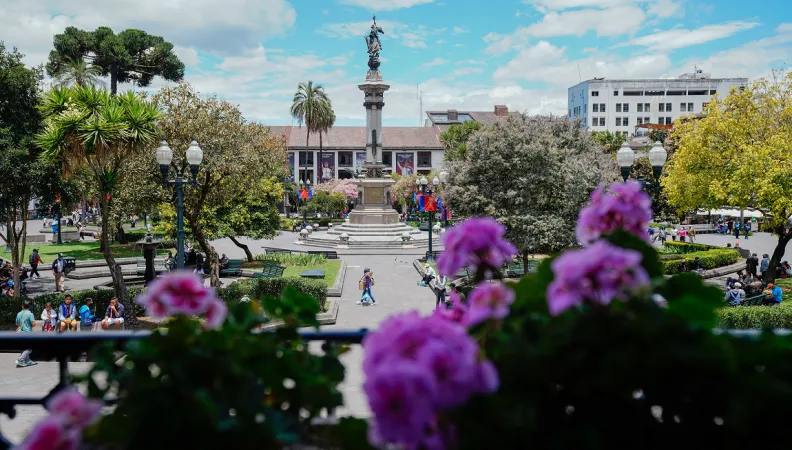 As part of the ENSLAC project, AFD is working with Yes Innovation and its partners to study and identify replicability levers for nature-based solutions in three South American countries – Ecuador, Colombia and Peru. Fifteen initiatives are analyzed in order to understand how natural ecosystems are mobilized in urban areas, what are their impacts and how nature-based solutions (NBS) could be more widely integrated into spatial and urban planning.
Context
Latin America is the second most urbanized region in the world, with 81% of its population concentrated there. This strong urbanization, its rapid growth and the weakness of urban planning policies affect areas of high ecological and environmental value. However, natural ecosystems can be a source of solutions for those involved in urban design and development, in particular to respond to the risks generated or exacerbated by climate change.
Understanding nature-based solutions (NBS), studying their implementation conditions and analyzing their integration into public policies is therefore necessary to ensure the livability of cities in the long term. While NBS and green infrastructure are still recent in the urban landscape, initiatives have been deployed for several years and are a privileged source of data to exploit.
This project is part of the ECOPRONAT research programme, which supports research on how to better take into account biodiversity and mainstream it into key economic sectors.
Objectives
The ENSLAC (Enabling Nature based solutions Scale-up in Latin American Cities) project aims to analyse the mechanisms that enable the scale-up of nature-based solutions implementation in Latin American cities, drawing on 15 case studies in Peru, Colombia and Ecuador. This research approach aims to:
- Analyze the challenges of ecological restoration for the management of risks related to the impacts of climate change in urban areas;
- Understand the levers for using NBS as a tool for urban planning and development;
- Identify the temporal, technical, cultural, political, social, financial and cooperative processes that have enabled large-scale NBS-based projects;
- Assess the influence of national or supranational strategies and policies on NBS development;
- Disseminate the knowledge produced by focusing on formats and channels that can be used for the training of urban development actors.
To explore these issues, Yes Innovation, based in Quito, works with the Humboldt Institute for Biological Resources Research, an institution linked to the Ministry of the Environment of Colombia, and Periferia Territorios Vivos, a Peruvian organization specialized in urban planning with an ecological approach.
Method
This research project uses two analytical tools (depending on the case study and the available field data):
- Temporal and spatial analysis (known as BA/CI, which refers to a Before/After and Conservation/Intervention analysis);
- Comparative analysis between case studies on NBS and reference cases of comparable characteristics but without implementation of NBS.
Results
The ENSLAC research project aims to:
- Understand mechanisms that enable scale-up of nature-based solutions as a tool for urban and peri-urban planning;
- Identify replicability levers of these NBS for Latin American cities;
- Produce training materials for urban development actors.
The research team presented its findings during a webinar from the Research Conversations series. The replay is available below (in French and Spanish).
Find out more

Contact
-
Julien CALAS
Research Officer on Biodiversity