 Legal notice EU (project) The Extension of the EU-AFD Research Facility on Inequalities in partnership with Fedesarrollo and in close collaboration with the Ministry of Finances implemented the methodology of the Commitment to Equity (CEQ) to analyze the country's fiscal structure and its impact on inequalities specially after major changes caused by the Covid 19 pandemic and the fiscal reform passed at the end of 2022.
Context
Prior to the pandemic caused by COVID - 19, Colombia had shown positive results with respect to the reduction of poverty and inequality. For example, total poverty was reduced by 6.1 percentage points between 2012 and 2018 from 40.8% to 34.7% as was extreme poverty, which went from 11.7% to 8.2%, according to official statistics. Likewise, although Colombia is among the most unequal countries in the region, it reduced its Gini index by about 0.03 units from 0.539 in 2012 to 0.508 in 2017, according to data from the National Administrative Department of Statistics (Departamento Administrativo Nacional de Estadísticas, 2021).
However, with the public health contingency, many people lost their jobs or had their incomes reduced due to pandemic containment measures that affected both aggregate supply and aggregate demand. Naturally, according to official statistics, poverty levels increased significantly and inequality rebounded to the levels of five years ago. In fact, by 2020, the country was, according to the latest ECLAC Social Panorama, the most unequal in Latin America (Economic Commission for Latin America and the Caribbean, 2021).
In this sense, the country's tax structure plays a fundamental role to the extent that direct, indirect and in-kind transfers are transformed into support for the most vulnerable households so that they can meet their basic needs and balance these inequalities to some extent. In addition, taking into account that progressivity is one of the principles of the tax system, those with higher incomes should pay higher taxes to finance social spending. In this sense, the tax reform that began to take effect in 2018 and now the Fiscal Reform adopted at the end of 2022 made some major modifications to the corresponding statute with the objective of increasing revenues.
This project is part of the Extension of the EU-AFD Research Facility on Inequalities. Coordinated by AFD and financed by the European Commission, the Extension of the RFI will contribute to the development of public policies aimed at reducing inequalities in four countries: South Africa, Mexico, Colombia and Indonesia over the period 2021-2025.
Objectives
The methodology developed by the Commitment to Equity institute (CEQ) has been used to carry out this study. The CEQ methodology allows to do a fiscal incidence analysis, that is, to analyze the redistributive impact of public policy instruments, on the tax side, as well as on the social spending side, on poverty and inequalities. In this sense, based on household surveys, it is possible to assess the redistributive capacity of taxes and transfers (whether direct or indirect) to guide public policy in this area.
The aim of the study was to identify which policies, either from the tax side or from the expense side, allow a greater impact (negative or positive) on inequalities. This then gives us, and the government, a clearer picture of the effects of the fiscal structure.
In addition, the project sought to build a tool that parameterizes the tax structure and social spending and allows making microsimulations that are useful for policy discussions. In this sense, this project sought to accompany the teams of the Ministry of Economy, providing them with a tool that allows them to carry out the necessary simulations to evaluate the impacts of different policies. The recently adopted tax reform was also analyzed through the lens of this tool.
Research findings
You will find below the research paper related to this project:
Contact
-
Anda DAVID
Economist, scientific coordinator of the EU-AFD Facility on Inequalities

Discover other research projects

Reducing spatial inequalities through efficient public service delivery in Colombia
Completed
2024 - 2025


 Legal notice EU (project) This research project conducted by the Extension of the EU-AFD Research Facility on Inequalities in close collaboration with DANE and DNP, and in partnership with Fedesarrollo, conducted a comprehensive analysis of inequalities in Colombia through the implementation of the diagnostic on inequalities. It also aimed, together with DANE, to strengthen statistics on inequalities in the country.
Context
In Colombia, and in other countries, the objective of the Extension of the EU-AFD Research Facility on Inequalities is to provide analysis, methodologies, and statistics that allow understanding the state of inequalities in the country, the dynamics and interrelationships with the different areas, sectors, and regions of the economy. The objective is to provide robust and updated data, to provide evidence for the construction of public policies, but also to identify areas where data collection can be improved, and those where research can be deepened to better understand the context and support the construction of public policies aimed at reducing inequalities...
In Colombia, DANE has made great progress in recent years in the collection and availability of data in order to analyze and better understand the reality of the country. Several studies have been carried out with some of these data, but, for several years, there has been no comprehensive analysis of inequalities at the national level using several databases to get a complete picture of the country's situation. Since mid-2021, AFD has been working hand-in-hand with DANE and Fedesarrollo to carry out a multidimensional diagnostic on inequalities, based on an innovative reference methodology created by AFD. It provides a comprehensive view of the country's situation as it covers a wide range of aspects (health, education, incomes, etc.) all under the prism of inequalities and using different indicators and databases.
This project is framed in a context in which inequalities acquire crucial relevance in the public policy of the current government and in the agreements adopted by it within the framework of the 2030 agenda, as well as in its entry into the OECD.
This project is part of the Extension of the EU-AFD Research Facility on Inequalities. Coordinated by AFD and financed by the European Commission, the Extension of the Facility will contribute to the development of public policies aimed at reducing inequalities in four countries: South Africa, Mexico, Colombia and Indonesia over the period 2021-2025.
Objectives
The project aimed to support and strengthen the production of national statistics on inequalities, promoting exchanges and interoperability between DANE and other national and international institutions. More specifically, the main objectives were:
- To implement the methodology of the multidimensional diagnostic on inequalities, and therefore create the first national diagnostic on inequalities in Colombia. For this, AFD worked hand in hand with Fedesarrollo and in close collaboration with DANE.
- To accompany DANE's technical teams in the production, updating and improvement of statistics on inequalities based on the inequality diagnostic methodology. These data will be used to monitor over time the evolution of the indicators considered relevant, and, depending on the outcome of the data collected, to advance in analyses that integrate elements related to climate change and the environment.
- To support DANE’s technical teams in implementing new methodologies and initiatives to obtain statistics that allow a better understanding of the distribution of income of individuals and households in the country. Workshops and seminars served to share experiences and establish practices that allow high-quality data for decision-making.
Find out more about the methodology

Research findings
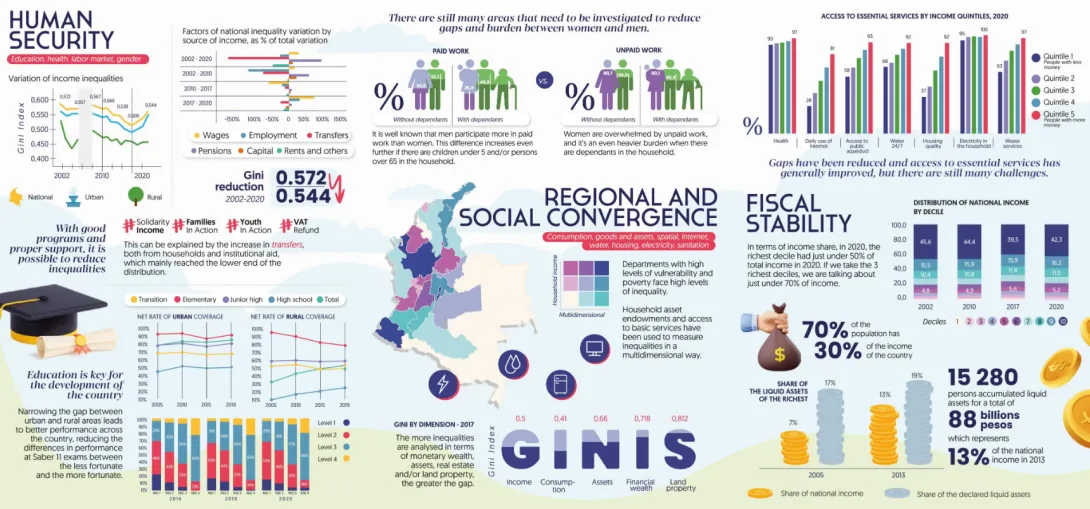
The research project led to the publication of the multidimensional diagnostic on inequalities in Colombia. It takes into account multiple dimensions of inequality: income distribution, consumption, labour income, household assets and services, level of wealth in land and financial assets, access to and quality of education and health, access to basic services... This document is key to understanding the gaps that exist in Colombia, and allows for evidence-based decision-making and progress towards reducing inequalities.
To go further

Contact
-
Anda DAVID
Economist, scientific coordinator of the EU-AFD Facility on Inequalities
Discover other research projects
Analysis of Colombia’s fiscal policy and public spending impact on inequalities
Completed
2022 - 2023


Reducing spatial inequalities through efficient public service delivery in Colombia
Completed
2024 - 2025
 Colombia has demonstrated its commitment to climate issues through its commitment to implementing its nationally determined contribution (NDC) under the Paris Agreement. Developing an ecologically and economically sustainable development trajectory is a significant challenge, which the GEMMES Colombia project supports through sound methodology and policy-based dialogue.
Context
Highly exposed to the effects of climate change and to the degradation of natural resources, Colombia is strengthening its climate policy, considering a green growth strategy, particularly since the 2014-2018 National Development Plan. Nevertheless, the country's dependence on raw material exports and its strong integration into international financial markets generate monetary, financial and commercial vulnerabilities.
AFD is supporting Colombia in its efforts to tackle climate change through the GEMMES Colombia project, which is part of the third climate policy loan since 2018. The GEMMES programme, by integrating the impact of climate change into its forecasts, is developing a general theoretical model on the one hand, and national models applied to concrete cases and adapted to the characteristics of each country on the other, including the GEMMES Colombia model.
Objectives
The GEMMES Colombia project, which is fully in line with AFD's commitment to strong sustainability, aims to :
- Highlight potential fragilities in the Colombian economy through a better understanding of the interactions between fiscal, monetary and trade policies and the country's NDC objectives;
- Identify the opportunities generated by the energy transition in Colombia: structural changes and financing methods under the best possible conditions;
- Quantifying the macroeconomic impact of NDC-related investments, particularly in the financial and tax sectors;
- Promoting public policy dialogue on Colombia's energy transition:
- Providing a decision-making tool for decision-makers on climate policies, with a view to limiting the consequences identified without compromising the implementation of Colombia's NDC objectives;
- By promoting the appropriation and sustainability of the GEMMES modelling tool within the partner institutions.
Method
In addition to its specific transdisciplinary approach, which makes this project one of the few to integrate the notion of strong sustainability, the originality of GEMMES lies in its consideration of macro-financial imbalances and the impact of the low-carbon transition on all elements of the balance of payments.
Moreover, GEMMES Colombia is part of a partnership initiative that is organised around two phases:
- The first phase is based on the development of the model and the macroeconomic analysis of the Colombian NDC trajectory, in partnership with the National Planning Department (DNP) and the Ministry of Finance (MHCP) supported by AFD's modelling teams.
- The second is intended to ensure the sustainability of the project after the end of the support, with the analysis by the National University of Bogota (UNAL) of the interactions between trade, fiscal and monetary policies and the NDC trajectory, as well as the training of students in sustainable development through the Catedra course as well as in the GEMMES methodological approach.
Results
The GEMMES Colombia model, enriched by academic expertise and integrated into decision-making processes through Colombian ministries, has become a key tool for public policy dialogue on the energy transition:
- At the request of the Colombian authorities, GEMMES was added to the MHCP’s macroeconomic models in 2023 and was coupled with the Energyscope energy model, a tool for energy assessment and planning. The model’s adoption continued in 2024 with an executive training session on its use provided to MHCP officials.
- These exchanges are ongoing through the GEMMES Strategic Committee, composed of the Ministry of Finance and Public Credit (MHCP), the National Planning Department (DNP), the Ministry of Mines and Energy (MME), and the Banco de la República.
FIND OUT MORE
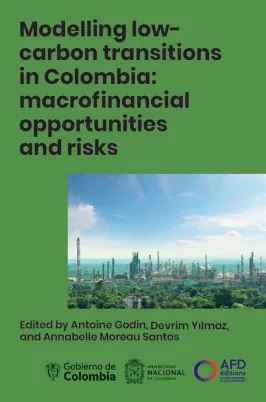
Furthermore, the research work led to the publication of a collective volume launched in June 2024, presenting the scientific findings and policy recommendations derived from the project: Modelling Low-Carbon Transitions in Colombia: Macrofinancial Opportunities and Risks
This work also gave rise to a new initiative: the creation of PowerShift, a strategy game designed to support multi-stakeholder dialogue around Colombia’s NDC.
Watch the replay of the GEMMES Colombia book launch (in Spanish)
The first results of the project had been presented at the virtual congress "Conexión DNP: transfiriendo conocimiento para innovar" on 2 and 3 December 2021. The project partners expressed their satisfaction, with the MHCP showing a particular interest in modelling after a year of remote work due to the Covid-19 pandemic.
In March 2022, a university course on sustainable development (Catedra), partly based on the results of the GEMMES Colombia project, was launched at UNAL. As a continuation of this initiative, a second course on the modelling of ecological transitions in the Global South was given in 2023.
Research findings
The GEMMES Colombia model, by developing scenarios on fossil fuel exports and alternative policies for the 2023-2050 period, as well as financing scenarios of the NDC trajectory, contributes to informing decision-makers in their political strategy to fight global warming. The model also allowed the National Planning Department (DNP) to analyze the consequences of economic shocks such as the loss of the country’s investment quality, the reduction of coal exports or the bankruptcy of Evergrande in China.
The conclusion is clear: a diversification of the production structure and a transformation of public finances are essential if Colombia is to meet the challenges of a global low-carbon transition and ensure its own energy transition. The GEMMES model highlights the importance of using a combination of private investment and public green bonds to finance Colombia's climate ambition.
Related publications
Contact
-
Antoine GODIN
Economist - Modeler